


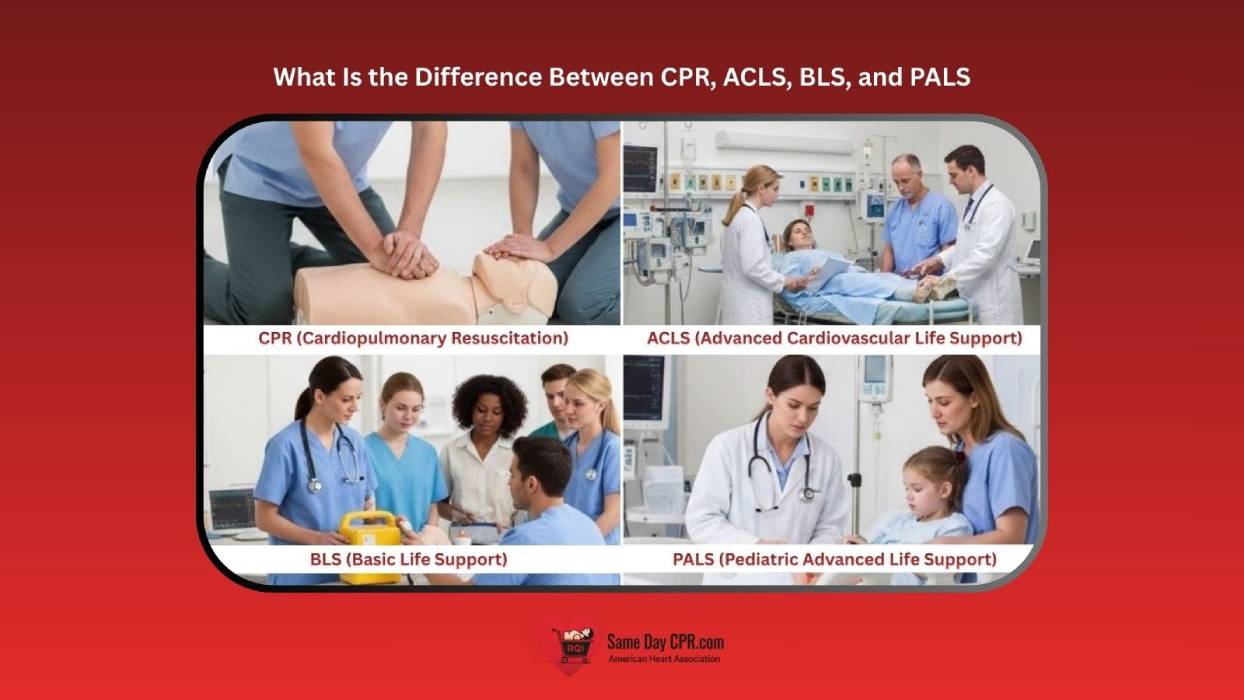
Understanding the distinctions between CPR (Cardiopulmonary Resuscitation), ACLS (Advanced Cardiac Life Support), BLS (Basic Life Support), and PALS (Pediatric Advanced Life Support) sets you apart in emergency medical education. CPR provides the foundational technique you use to revive individuals during cardiac emergencies. ACLS prepares healthcare professionals to manage complex cardiac crises, while BLS teaches essential life-saving skills that anyone can learn. PALS focuses on treating infants and children.
These terms may look similar, but once you learn how ACLS, BLS, PALS, and CPR differ, you’ll feel better prepared to assist someone in need. If you’ve ever wondered which CPR certification you need or what sets them apart, you’re in the right place. In this guide, break down the differences in a clear, simple way so you can confidently choose the training that fits your role and experience.
CPR (Cardiopulmonary Resuscitation)
CPR, or cardiopulmonary resuscitation, uses chest compressions and rescue breaths to keep blood and oxygen circulating during a cardiac or respiratory emergency. This basic life-saving technique applies to everyone, not just healthcare professionals, because teachers, coaches, parents, and everyday bystanders often become the first to respond when someone collapses.
CPR training teaches essential skills such as performing adult and pediatric CPR, giving rescue breaths, using an automated external defibrillator (AED), and managing choking situations.
You can use CPR anywhere an emergency occurs, at home, in public, or in the workplace, to sustain life until emergency medical services arrive.
Above all, CPR pushes you to act immediately with simple, effective steps during those critical first minutes when a fast response can truly save a life.
BLS (Basic Life Support)
BLS, or Basic Life Support, provides a structured, healthcare-oriented version of CPR that prepares trained providers to respond effectively to cardiac and respiratory emergencies. It targets healthcare professionals such as nurses, EMTs, physicians, medical students, and other clinical personnel who may need to deliver life-saving care in both medical and emergency settings.
While CPR for the general public focuses on simple, immediate actions, BLS emphasizes proper technique, teamwork, and the use of professional medical equipment to ensure safe and effective intervention.
The BLS curriculum teaches high-quality CPR, two-rescuer coordination, effective use of AEDs, rescue breathing with bag-mask devices, advanced airway techniques, and strong team dynamics during resuscitation.
What sets BLS apart from standard CPR is its integration of professional-level skills and a structured approach tailored to trained responders, going beyond the fundamental techniques taught to the general public.
ACLS (Advanced Cardiovascular Life Support)
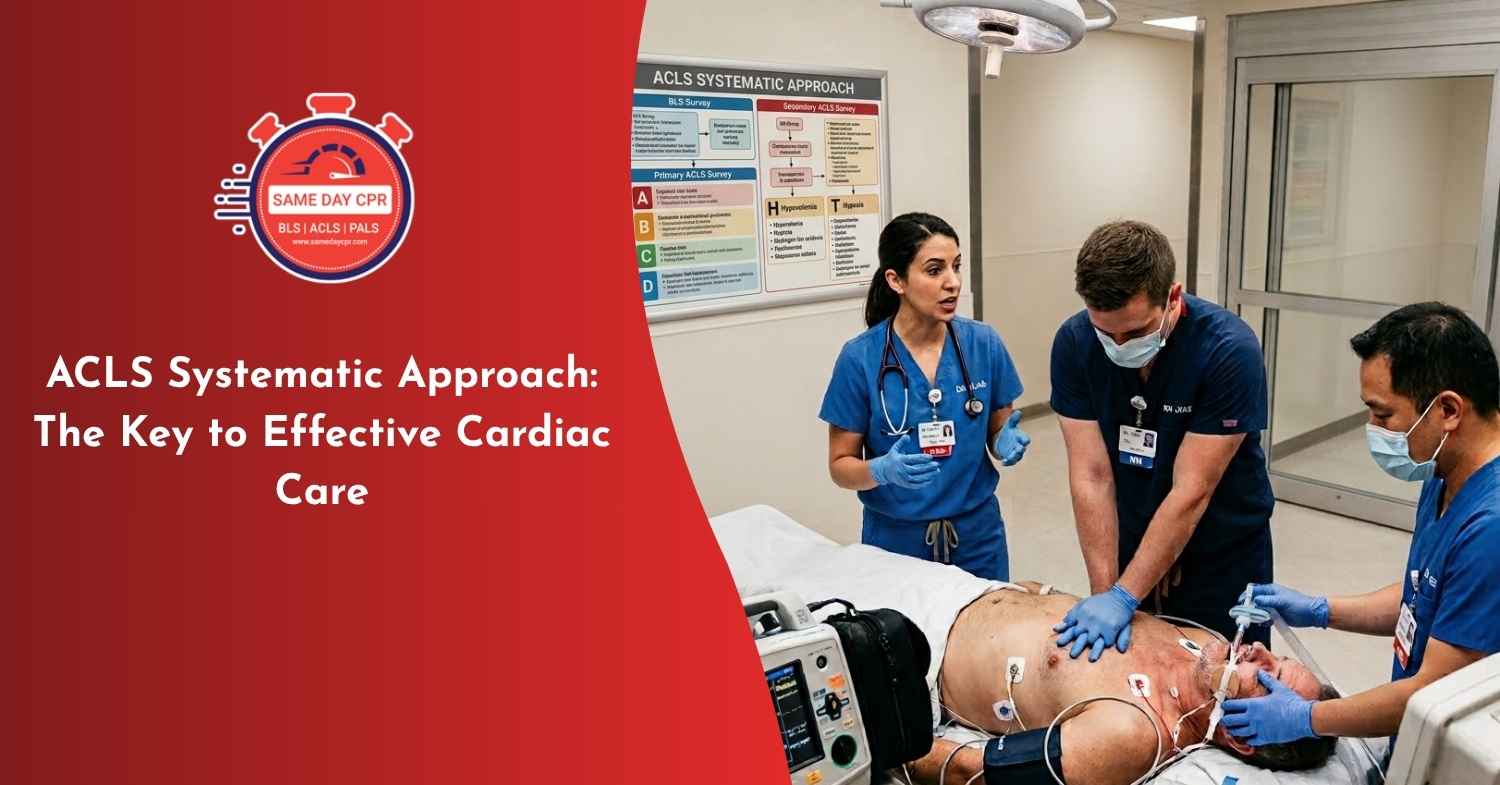
ACLS, or Advanced Cardiovascular Life Support, uses a structured, algorithm-driven approach to manage adult cardiac arrest and severe cardiopulmonary emergencies. It serves registered nurses, paramedics, physicians, advanced emergency responders, and hospital code team members who may need to treat critically ill adult patients. If you’re determining whether this training is appropriate for your role, understanding who needs ACLS certification can help clarify which healthcare professionals typically require or benefit from the credential.
ACLS equips healthcare providers to recognize life-threatening conditions, make rapid and accurate decisions, and perform advanced interventions that can stabilize a patient during a crisis.
Training covers a wide range of skills, including cardiac arrest algorithms, airway management, IV and IO medication administration, ECG rhythm interpretation, post-cardiac arrest care, and effective leadership within a resuscitation team.
ACLS plays an essential role by blending technical proficiency with structured, high-stakes decision-making to ensure efficient, coordinated care during emergencies.
Unlike Basic Life Support (BLS), which focuses on CPR and fundamental life-saving actions, ACLS expands into advanced airway techniques, medication administration, and ECG-based diagnosis and treatment, enabling providers to address the underlying causes of cardiac emergencies, not just perform resuscitation.
PALS (Pediatric Advanced Life Support)
PALS, or Pediatric Advanced Life Support, provides a specialized form of emergency care that helps healthcare providers recognize and respond to life-threatening medical events in infants and children. It equips clinicians with the knowledge and skills needed to stabilize young patients in critical situations.
PALS serves pediatric nurses, EMS providers, pediatric hospital staff, and family practice or emergency clinicians who may encounter seriously ill or injured children. For healthcare professionals determining whether the course is appropriate for their role, learning who needs PALS certification can help clarify which providers typically benefit from this specialized training.
The curriculum covers pediatric cardiac arrest algorithms, respiratory distress and respiratory failure management, shock recognition and treatment, pediatric ECG interpretation, and weight-based medication dosing, all of which are essential for delivering rapid, accurate, and age-appropriate care.
PALS differs from ACLS because it tailors its training to the unique physiology and anatomy of children. While ACLS focuses on adults, PALS addresses the distinct airway structures, medication responses, and clinical presentations seen in pediatric patients, ensuring safe and effective treatment during emergencies.
Side-by-Side Comparison Table
This table makes it easy to see the differences between each certification. You can quickly find the right course for your skills and role.
| Certification | Audience | Skills Taught | Setting |
|---|---|---|---|
| CPR | General public, first responders, healthcare providers | Chest compressions, rescue breathing, AED use, choking response | Any setting (home, work, public) |
| BLS | Healthcare providers | High-quality CPR (all ages), AED use, choking relief, team resuscitation | Hospitals, clinics, ambulances |
| ACLS | BLS-trained healthcare providers | Advanced airway, ECG, cardiac meds, team resuscitation | Hospitals, ED, ICU |
| PALS | Providers treating children | Pediatric CPR, airway, ECG, pediatric meds, resuscitation algorithms | Pediatric hospitals, ED, ICU |
Which Certification Is Suitable For You
Choosing the right certification helps you feel confident in an emergency. Let’s explore which course fits your role and skills best.
- CPR is perfect for teachers, parents, coaches, and anyone in the community. You will learn how to save lives with basic chest compressions and AED use.
- BLS suits anyone working in healthcare who wants to respond to emergencies. You will practice high-quality CPR and teamwork during patient resuscitation.
- ACLS is ideal for nurses, paramedics, doctors, and advanced medical roles. You will master heart rhythms, emergency drugs, and advanced life support skills.
- PALS is designed for professionals caring for infants and children. You will gain skills to handle pediatric emergencies with confidence.
Choosing the Right Life-Saving Skill From CPR to PALS
In summary, knowing the differences between CPR, BLS, ACLS, and PALS can give you confidence in an emergency. To begin with, CPR teaches anyone how to take immediate action. After that, BLS builds on this foundation by equipping healthcare professionals with essential skills. In addition, ACLS goes even further, providing trained providers with the tools to handle complex adult cardiac emergencies. At the same time, PALS focuses specifically on children, recognizing their unique needs. Consequently, each program has its place, and therefore, understanding which one fits your role helps you act quickly and effectively when seconds matter most. Moreover, by learning the right techniques, you can make a real difference and save lives.
Same Day CPR offers AHA CPR, BLS, ACLS, PALS, First Aid, and AED courses with fast, same-day certification. Complete the included online AHA course, then attend a hands-on session at one of our 100+ locations. You’ll receive your official AHA certification card immediately upon completion. Visit our website or call today to get started.