


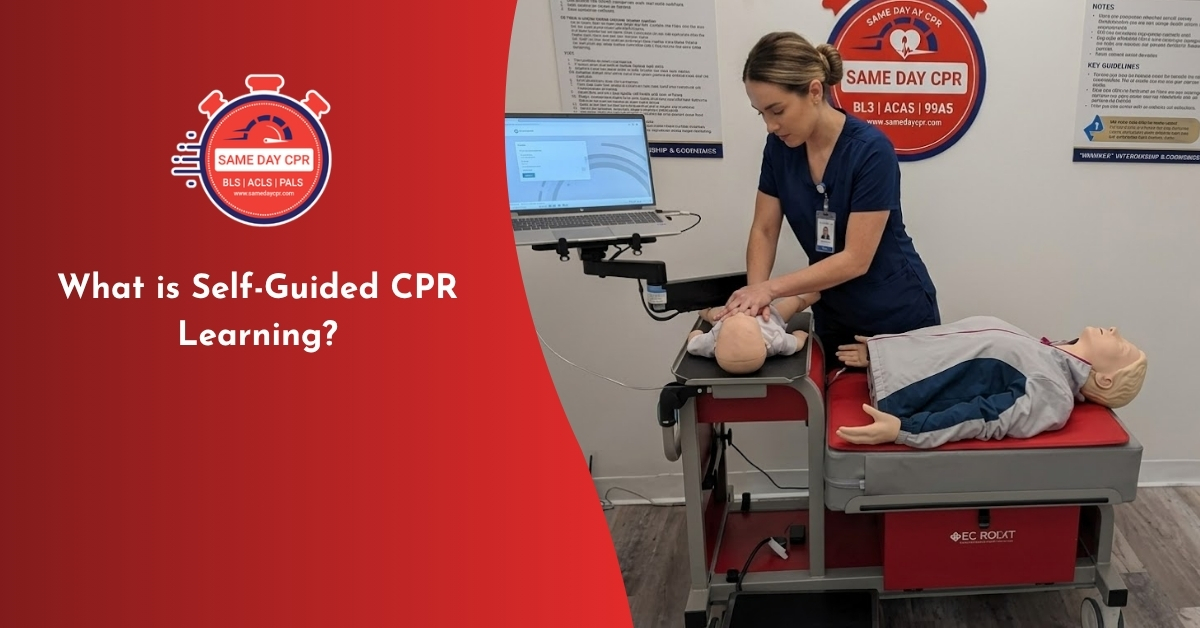
Self-guided CPR learning is a flexible training format recognized by the American Heart Association (AHA) that allows individuals to complete the theoretical part of certification on their own schedule using approved online materials. After finishing the study portion at home, learners attend a short in-person skills session at the CPR Verification Station, where a certified AHA Voice-Assisted Manikin (VAM) evaluates hands-on abilities such as chest compressions, rescue breaths, and AED use.
Unlike traditional CPR classes that are fully instructor-led and scheduled at fixed times, this approach separates learning from skills testing. This means you can study independently whenever it fits your schedule, then complete a brief verification session that usually takes less than an hour. For a closer look at the practical and financial advantages of this approach, see renting vs. traditional CPR training, how CPR verification stations save time and money.
It is not an easier or lower standard option. The same AHA requirements and certification outcomes still apply. The difference is the structure, which makes it more accessible for busy professionals, caregivers, and anyone who cannot commit to a full-day classroom course. In short, you handle the learning portion yourself, while the in-person session confirms that you meet the required practical standards for certification.
How the Self-Guided Learning Process Works Step by Step
The self-guided CPR learning process follows a clear two-part structure. The first part is completed on your own. The second part takes less than an hour in person. Here is how the process works from start to finish.
Step 1: Choose Your Certification Level
Before you begin studying, you need to identify which AHA certification fits your situation. The self-guided format is available for CPR, Basic Life Support (BLS), Advanced Cardiovascular Life Support (ACLS), and Pediatric Advanced Life Support (PALS). Each certification serves a different audience and skill level.
CPR is suited for general adults, parents, and caregivers. BLS is the standard requirement for healthcare providers such as nurses, medical assistants, and emergency responders. ACLS is intended for advanced clinicians who manage cardiac arrest and other cardiovascular emergencies. PALS is for healthcare professionals who treat pediatric patients.
Choosing the right level at the start ensures your study material and certification align with your personal or professional needs.
Step 2: Complete the Online HeartCode Course
Once you have selected your certification level, you purchase and complete the corresponding AHA HeartCode course online. HeartCode is the official self-guided digital learning platform from the AHA and is the only online coursework accepted for this pathway.
The HeartCode course walks you through all core knowledge for your certification, including how to recognize cardiac arrest, perform high-quality chest compressions, use an AED, deliver rescue breaths, and work as part of a resuscitation team for BLS, ACLS, and PALS. The course includes videos, interactive modules, and knowledge checks to reinforce learning as you go.
You complete the course on your own schedule. There are no set class times, no instructor pacing, and no deadlines beyond your course access period. Most learners finish CPR or BLS HeartCode in about one to two hours. ACLS and PALS usually take longer due to more advanced material.
Step 3: Pass the Online Assessment
At the end of your HeartCode course, you complete a final knowledge assessment. This graded test evaluates your understanding of the material. You must pass it before moving on to the in-person skills session. Your results are automatically recorded in the HeartCode platform once you pass.
It is important not to rush through the modules. Any gaps in learning will become clear during the hands-on evaluation.
Step 4: Locate a CPR Verification Station
After passing your online assessment, you schedule an in-person skills session at an AHA-authorized CPR verification station near your home.
When scheduling, make sure the location is authorized for your certification level. Not all stations offer every certification type. BLS verification is widely available, while ACLS and PALS sessions are more commonly offered at hospitals and advanced training centers.
Step 5: Attend the Skills Verification Session
The in-person session is where an AHA-certified Voice-Assisted Manikin (VAM) evaluates your hands-on skills. You bring proof of your online completion, usually a certificate or digital record from the AHA training portal.
During the session, the VAM assesses your ability to perform required skills. For CPR and BLS, this includes correct compression depth and rate, proper hand placement, effective rescue breaths, and AED use. For ACLS and PALS, it also includes team communication, advanced airway skills, and scenario-based responses.
This session is not a re-teaching of the course. It is a skills check, so coming prepared makes the process smooth and efficient.
Step 6: Receive Your AHA Certification Card
Once you have completed both the online assessment and hands-on skills, you will receive your official AHA certification card. It is valid for two years and is recognized the same way as a traditional classroom-issued card. There is no difference on the card between self-guided and in-person training pathways. Employers, licensing boards, and clinical supervisors accept both equally.
The full process, from purchasing your HeartCode course to receiving your certification card, can be completed in a single day. The self-guided pathway maintains the same standards as traditional training. It simply gives you more flexibility in how you complete it.
Who Self-Guided Learning Is Developed For?
Self-guided AHA learning is for a specific type of learner who already has a clinical context, limited time, and a need for an AHA certification that fits a demanding schedule. BLS, ACLS, and PALS are healthcare-focused credentials, and this pathway is built around that reality.
Working Healthcare Professionals With Recertification Needs
The largest group using this pathway is healthcare professionals renewing an expiring certification. BLS, ACLS, and PALS are valid for two years, and recertification is required for employment or licensure compliance. For clinicians with shift work or unpredictable schedules, traditional classroom courses can be difficult to attend. The self-guided format allows HeartCode coursework to be completed in short sessions, with the skills verification scheduled separately at a convenient time.
Nurses and Allied Health Professionals
Nurses, dental hygienists, physical therapists, respiratory therapists, surgical technicians, medical assistants, and other allied health professionals commonly use self-guided BLS. BLS is a standard requirement across most clinical settings, including hospitals, clinics, and surgical centers. The self-guided format allows professionals to meet this requirement without disrupting work schedules and fits well with independent continuing education habits.
Physicians and Advanced Practice Providers
Physicians, physician assistants, nurse practitioners, emergency and critical care clinicians, and other advanced providers commonly use self-guided ACLS. This pathway is efficient for experienced clinicians because it allows faster progression through material they already understand. The focus is on demonstrating current competency rather than relearning foundational concepts.
Pediatric and Neonatal Healthcare Professionals
Pediatric nurses, pediatric physicians, neonatologists, and clinicians working in neonatal or pediatric care settings commonly use self-guided PALS. This format provides AHA-approved coursework that can be completed independently before a focused skills session. It is especially useful in settings where scheduled PALS classes are limited or infrequent.
New Healthcare Graduates
New graduates entering clinical roles may use this pathway for initial certification when timelines between graduation and job start dates are tight. The course must still be completed in full, the assessment passed, and skills verification completed before certification is issued. Standards remain the same as classroom training.
Professionals in Remote or Underserved Areas
Healthcare workers in rural or underserved regions often use self-guided learning due to limited access to scheduled classroom courses. The online coursework can be completed anywhere, while only the skills session requires travel to an authorized verification site, reducing overall logistical burden.
Who This Pathway Is Not For?
This pathway is not intended for individuals without a clinical background seeking ACLS or PALS, as these courses assume prior healthcare knowledge. It is also not ideal for learners who require heavy instructor-led instruction during the learning phase rather than only during skills verification.
Finally, employers or licensing bodies may have specific format requirements, so acceptance should always be confirmed before enrolling.
How Self-Guided Learning Differs From a Traditional CPR Class
Self-guided CPR learning and traditional CPR classes both teach lifesaving skills in different ways. One lets you study at your own pace with digital tools, while the other follows a set schedule with direct instructor support in a classroom.
| Aspect | Self-Guided CPR Learning | Traditional CPR Class |
|---|---|---|
| Learning Style | Independent study using videos, apps, manuals, or online modules | Instructor-led, structured classroom training |
| Pace | Self-paced (learn anytime, anywhere) | Fixed schedule and set duration |
| Hands-on Practice | Practicing on a manikin at the CPR Verification Station | Practicing on a manikin in class |
| Feedback | Correction and guidance from an AHA-certified VAM | Correction and guidance from a certified instructor |
| Interaction | No direct interaction | High interaction with the instructor and other learners |
| Flexibility | Very flexible | Less flexible due to scheduled sessions |
Empowering Flexible Lifesaving Learning
In summary, self-guided learning is a flexible and effective approach to gaining essential knowledge and practical competencies by studying independently and demonstrating understanding through hands-on practice. It allows learners to progress at a comfortable pace while still meeting rigorous training standards. Through programs offered by the American Heart Association, individuals can prepare for CPR, BLS, ACLS, and PALS in a way that accommodates busy schedules without compromising quality or credibility.
This method builds confidence by enabling learners to first understand the material thoroughly and then apply it during focused skills sessions. It also enhances retention, as topics can be reviewed as often as needed until they are fully understood. Many participants appreciate the reduced pressure of rigid class schedules while still maintaining high expectations and outcomes. Overall, self-guided learning makes it more accessible for individuals to develop lifesaving capabilities and feel prepared to respond effectively in emergencies.
At Same Day CPR, we offer self-guided CPR training across more than 100+ locations. Our facilities are centrally located and easily accessible for students and healthcare professionals throughout the United States.