-
 30,000+ Students Sucessfully Trained Annually
-
30,000+ Students Sucessfully Trained Annually


 30,000+ Students Sucessfully Trained Annually
When a patient’s heart suddenly begins beating too fast, rapid assessment and timely intervention are essential to prevent serious complications and maintain effective circulation. Adult tachyarrhythmia with a pulse is a condition in which an adult’s heart beats abnormally fast, usually at a rate greater than 150 beats per minute, while still maintaining a detectable pulse. This rapid rhythm can originate from the atria or ventricles and can reduce the heart’s ability to pump blood effectively. Patients experience symptoms such as palpitations, chest pain, shortness of breath, dizziness, or low blood pressure. Some tachyarrhythmias are relatively stable, whereas others can quickly become life-threatening if they impair circulation or progress to cardiac arrest.
The Adult Tachyarrhythmia With a Pulse Algorithm, developed by the American Heart Association as part of Advanced Cardiovascular Life Support (ACLS), provides a structured approach for assessing and managing these abnormal rhythms. The algorithm helps healthcare providers determine whether the patient is stable or unstable and guides appropriate interventions, such as synchronized cardioversion for unstable patients or medications and monitoring for stable patients. Its role is to promote rapid recognition, timely treatment, and improved patient outcomes while reducing complications associated with severe tachyarrhythmias.
Note: This adult tachyarrhythmia with a pulse algorithm guideline remains valid for the period 2025–2030.
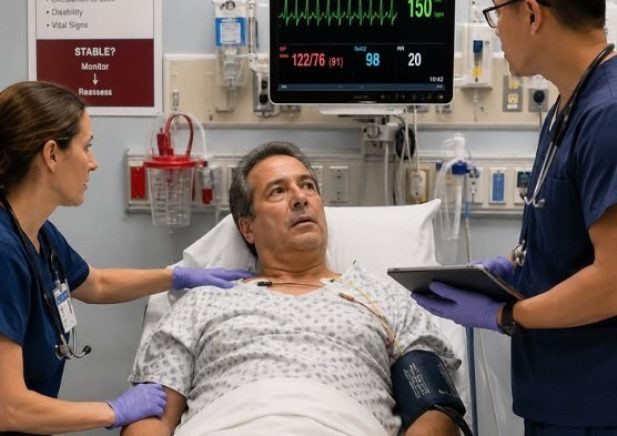
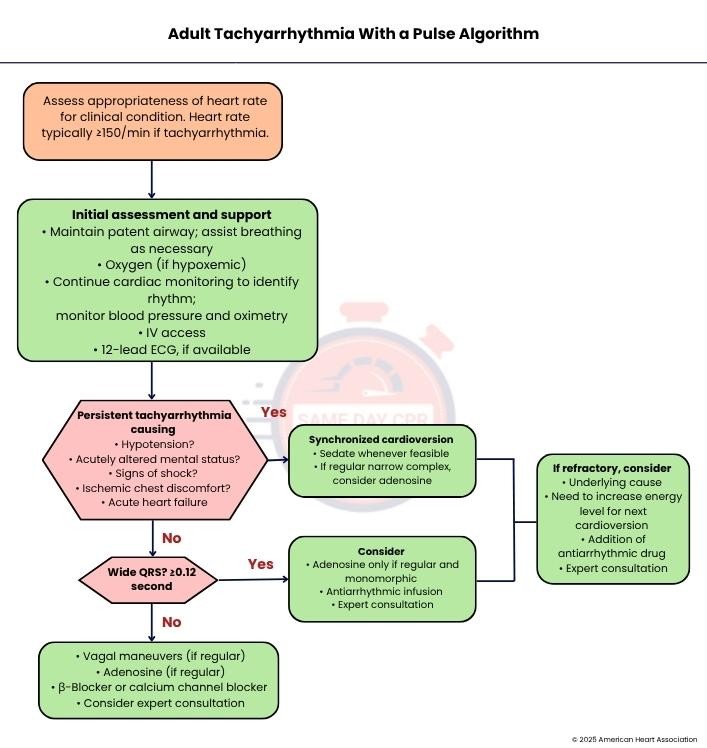
This first step is about recognizing whether the patient truly has a dangerous fast heart rhythm (tachyarrhythmia). In most clinical situations, a heart rate of 150 beats per minute or more raises concern. The healthcare provider first checks if the situation fits this emergency algorithm and confirms that the fast heart rate is clinically significant and not just a mild or temporary increase due to stress, fever, or exercise.
In this step, the focus is on stabilizing the patient and gathering essential information. The airway is checked to ensure it is open, and breathing support is given if needed. Oxygen is provided if oxygen levels are low. Continuous monitoring of heart rhythm, blood pressure, and oxygen saturation helps track how serious the condition is. An IV line is placed so medications can be given quickly, and a 12-lead ECG (Electrocardiogram) is done if available to clearly identify the type of abnormal heart rhythm.
This step checks whether the fast heart rhythm is causing life-threatening instability. The clinician looks for signs such as low blood pressure, confusion, shock, chest pain from reduced blood flow, or sudden heart failure. If any of these dangerous signs are present, the patient needs immediate emergency treatment with synchronized cardioversion (Step 6). If none of these severe symptoms are present, the patient is considered stable enough to continue with further evaluation in Step 4.
Here, the ECG is used to determine whether the QRS complex is wide or narrow. A wide QRS (≥ 0.12 seconds) usually suggests that the abnormal rhythm is coming from the ventricles or has abnormal conduction pathways, which is more serious. If the QRS is wide, the algorithm moves to Step 8 for specific treatment options. If it is narrow, meaning the electrical signal is conducting normally through the heart, the patient proceeds to Step 5 for targeted management.
In this step, treatment focuses on slowing or stopping the abnormal rhythm if the patient is stable and the rhythm is likely regular. Vagal maneuvers (like bearing down or carotid massage) can help reset the heart rhythm. Adenosine can be used if the rhythm is regular, as it briefly slows conduction through the heart and can terminate certain arrhythmias. If needed, medications like beta-blockers or calcium channel blockers are used to control heart rate. Because rhythm interpretation can be complex, expert consultation is often considered.
This step is used when the patient is unstable. Synchronized cardioversion delivers a controlled electrical shock timed with the heart’s rhythm to restore a normal heartbeat. Sedation is given if possible to reduce discomfort, since the procedure can be painful. In some cases, if the rhythm is regular and narrow complex, adenosine can still be considered, but the priority is restoring stability quickly. After cardioversion, the process continues to Step 7 for further management.
If the abnormal rhythm does not respond to initial treatment, this step focuses on troubleshooting and escalation. Doctors look for the underlying cause, such as an electrolyte imbalance or heart disease, that is driving the arrhythmia. The energy level of cardioversion is increased if repeated shocks are needed. Antiarrhythmic medications are added to help stabilize the rhythm, and expert consultation is important for complex or persistent cases.
This step is mainly for wide QRS tachycardias that are still present, but the patient is stable. Adenosine is considered only if the rhythm is regular and monomorphic, as it can help diagnose or sometimes terminate certain rhythms. Antiarrhythmic drugs given as an infusion can be used to control the abnormal electrical activity in the heart. Because wide complex tachyarrhythmias can be complex and risky, expert consultation is strongly recommended, and care is often cycled back to Step 7 for ongoing reassessment and management.
Synchronized cardioversion uses a carefully timed electrical shock to reset the heart when it beats too fast or irregularly. Doctors choose the energy level based on device instructions and rhythm type, and if the correct setting is unclear, they use the highest available energy to increase the chance of restoring a normal heartbeat safely and effectively.
Adenosine is a very fast-acting medicine that briefly slows electrical signals in the heart to stop certain rapid rhythms. It works within seconds, so it must be given quickly through a vein, followed immediately by a saline flush to push it into the bloodstream.
The first dose is 6 milligrams injected quickly into a vein and immediately followed by a saline flush. This rapid delivery is important because the medicine breaks down very quickly and needs to reach the heart at once to work properly.
If the first dose does not stop the abnormal rhythm, a stronger dose of 12 milligrams is given in the same rapid way. This second dose gives another chance to restore a normal heart rhythm.
Antiarrhythmic Infusions for Stable Wide QRS Tachycardia
These medicines are used when the patient is stable but still has a wide QRS, a fast heart rhythm that could become dangerous. They work by slowly correcting abnormal electrical activity in the heart and are given under close monitoring.
Procainamide helps slow down abnormal electrical signals in the heart and can restore a normal rhythm. It is given slowly through a vein while doctors carefully watch the heart rhythm and blood pressure to avoid complications.
The infusion continues at a controlled rate until the rhythm returns to normal, blood pressure becomes too low, the QRS widens significantly, or the maximum safe dose is reached. These limits help prevent toxicity while still treating the dangerous rhythm effectively.
After stabilization, a lower continuous dose is used to maintain a steady heart rhythm. It should be avoided in patients with a prolonged QT interval or congestive heart failure because it can increase the risk of serious complications.
Amiodarone is a strong antiarrhythmic drug used to treat serious fast heart rhythms that threaten life. It works by stabilizing the heart’s electrical activity and preventing abnormal rhythms from continuing or returning.
The first dose is given slowly over ten minutes to help calm the heart rhythm. If ventricular tachycardia returns, the same dose can be repeated to regain control.
After the initial treatment, a continuous infusion is given at a low rate to keep the heart stable. This helps prevent the abnormal rhythm from coming back during the critical recovery period.
In short, Adult tachyarrhythmia with a pulse requires quick thinking and clear action to protect the patient and keep blood flowing properly. The structured algorithm guides healthcare providers to assess the heart rhythm, check stability, and choose the right treatment at the right time. It supports safe decisions by separating stable cases from those that need immediate electrical therapy. With careful monitoring, simple maneuvers, and timely medication or cardioversion, many patients can return to a normal rhythm. Each step works together to reduce risk and improve recovery chances in urgent situations. This approach also helps teams stay focused and organized when every second matters. Overall, using this method strengthens patient safety and improves outcomes during fast heart rhythm events.
Managing adult tachyarrhythmias in high-pressure situations requires quick decision-making and solid clinical knowledge. An ACLS class helps healthcare professionals build confidence and improve skills in handling cardiac emergencies. Same Day CPR offers structured training to improve emergency preparedness. Registering for this course can help providers respond more effectively when time is critical.