-
 30,000+ Students Successfully Trained Annually
-
30,000+ Students Successfully Trained Annually

-
30,000+ Students Sucessfully Trained Annually

 30,000+ Students Successfully Trained Annually
When a child faces a serious medical emergency, rapid response is critical. Healthcare providers need a clear and structured approach to quickly assess the child’s condition and provide effective treatment. The PALS algorithm was developed to guide pediatric emergency care by combining evidence-based resuscitation practices into a step-by-step process. It helps teams recognize life-threatening conditions and deliver timely interventions, including airway management, breathing support, circulation assessment, medication administration, and cardiac rhythm treatment.
This guide explains what the PALS algorithm is, how it works, and the main pathways used during pediatric emergencies. It also covers key assessments, common medications, and important updates from the American Heart Association (AHA) 2025 CPR & ECC Guidelines.
This resource serves as a practical reference for healthcare professionals, students, and PALS trainees who want to understand the fundamentals of pediatric emergency response. It is not a replacement for official AHA PALS certification training, clinical judgment, or your organization’s emergency care protocols.
Pediatric Advanced Life Support (PALS) is a set of clinical guidelines and step-by-step algorithms used to manage life-threatening emergencies in infants and children. Developed by the AHA, the PALS algorithm helps healthcare providers quickly assess pediatric patients, make informed decisions, and provide timely treatment.
Rather than a single pathway, the PALS algorithm includes separate algorithms for emergencies such as cardiac arrest, respiratory failure, shock, and life-threatening arrhythmias. It emphasizes early recognition, high-quality CPR, effective airway management, appropriate medication use, and identifying reversible causes.
By following these structured steps, healthcare providers can deliver coordinated care, reduce treatment delays, and improve outcomes during pediatric emergencies.

The PALS systematic approach provides a structured framework for evaluating and treating critically ill or injured children. It helps healthcare providers quickly recognize life-threatening conditions, prioritize care, deliver appropriate treatment, and monitor the child’s response. The process follows a logical sequence that includes an initial impression, detailed assessment, treatment, and continuous reassessment.
The first step is to form a rapid initial impression using the Pediatric Assessment Triangle (PAT). This visual assessment takes only a few seconds and helps determine how sick the child is without touching the patient. It evaluates three key areas:
After the initial impression, healthcare providers perform the ABCDE assessment to identify and manage immediate life threats.
Any life-threatening problem identified during the primary assessment should be treated immediately before moving to the next step.
Once the child is stable, the secondary assessment provides a more detailed evaluation to identify the underlying cause of the illness or injury. This includes a focused physical examination, medical history, and diagnostic testing when needed.
Healthcare providers commonly use the SAMPLE history to gather important information:
The tertiary assessment involves additional diagnostic tests, such as laboratory studies or imaging, when they are needed to confirm the diagnosis or guide ongoing treatment. The results help healthcare providers refine the care plan and monitor the child’s progress.
Reassessment is an essential part of the PALS systematic approach. After every intervention, healthcare providers evaluate the child’s response and repeat the assessment as needed. This helps identify changes in the child’s condition early and ensures that treatment is adjusted promptly.
By following this systematic approach, healthcare teams can make informed decisions, improve communication, prioritize life-saving interventions, and provide safe and effective pediatric emergency care.
High-quality CPR is the foundation of the PALS algorithm and the most important intervention during pediatric cardiac arrest. It maintains blood flow to the brain and vital organs until the heart can be restarted. Even with advanced treatments, successful resuscitation depends on effective chest compressions and proper ventilation.
To perform high-quality CPR, healthcare providers should:
High-quality CPR should begin immediately after cardiac arrest is recognized and continue throughout resuscitation. It supports every other step of the PALS algorithm and gives the child the best chance of survival.
The Pediatric Cardiac Arrest Algorithm provides a structured approach for managing children without a pulse or signs of effective circulation. It emphasizes immediate high-quality CPR, effective ventilation, rhythm assessment, defibrillation when appropriate, medication use, and identifying reversible causes. The goal is to restore circulation and improve the chances of survival.
The Pediatric Bradycardia with a Pulse Algorithm guides healthcare providers in managing children with a slow heart rate and a pulse. It focuses on identifying the cause of bradycardia, supporting airway and breathing, providing oxygen when needed, and evaluating signs of poor perfusion. If the child remains unstable, interventions such as CPR, medications, or pacing may be considered based on the patient’s condition.
The Pediatric Tachyarrhythmia With a Pulse Algorithm helps healthcare providers evaluate and treat children with an abnormally fast heart rate while maintaining circulation. It begins with assessing the child’s stability, identifying the type of rhythm, and providing appropriate interventions such as vagal maneuvers, medications, or synchronized cardioversion when needed.
The Pediatric Septic Shock Algorithm guides recognizing and managing children with severe infection and signs of shock. It focuses on early identification, maintaining oxygen delivery, supporting circulation, administering fluids or medications when appropriate, and continuously monitoring the child’s response to treatment.
The Pediatric Post–Cardiac Arrest Care Algorithm focuses on stabilising the child after return of spontaneous circulation (ROSC) by maintaining adequate oxygenation, ventilation, blood pressure, and blood glucose while identifying and treating the underlying cause. It also recommends continuous monitoring, seizure management, temperature control, and transfer to a paediatric intensive care unit for ongoing post–cardiac arrest care.
“Note: AHA hasn’t updated the Pediatric Septic Shock Algorithm and Pediatric Post–Cardiac Arrest Care Algorithm in 2025, so they still follow the 2020 guidelines.”
During PALS, healthcare providers use several medications to treat life-threatening cardiac rhythms, bradycardia, tachycardia, and cardiac arrest. Knowing the correct indication and pediatric dosage helps ensure timely and safe treatment during emergencies. The table below highlights some of the most commonly used PALS medications.
| Drug | Primary Use | Pediatric IV/IO Dose & Guidelines |
|---|---|---|
| Epinephrine | Cardiac arrest, symptomatic bradycardia | 0.01 mg/kg (0.1 mL/kg of 1:10,000 concentration). Repeat every 3 to 5 minutes. Maximum single dose: 1 mg. |
| Adenosine | Supraventricular Tachycardia (SVT) | First dose: 0.1 mg/kg (maximum 6 mg). Second dose: 0.2 mg/kg (maximum 12 mg). Follow each dose with a rapid saline flush. |
| Amiodarone | Pulseless ventricular tachycardia and ventricular fibrillation | Cardiac arrest: 5 mg/kg IV/IO bolus (maximum 300 mg). Perfusing tachyarrhythmias: 5 mg/kg over 20 to 60 minutes (maximum 300 mg). |
| Atropine | Symptomatic bradycardia caused by increased vagal tone or primary AV block | 0.02 mg/kg. Minimum dose: 0.1 mg. Maximum single dose: 0.5 mg. |
| Lidocaine | Alternative antiarrhythmic for ventricular fibrillation or pulseless ventricular tachycardia | Initial loading dose: 1 mg/kg IV/IO. |
| Magnesium Sulfate | Torsades de pointes and severe hypomagnesemia | 25 to 50 mg/kg over 15 to 30 minutes. Maximum dose: 2 g. |
Important Note: Medication doses should always be verified using the most recent AHA PALS guidelines and adjusted according to the patient’s clinical condition and institutional protocols.
During pediatric cardiac arrest, healthcare providers should always consider the H’s and T’s, which are common reversible causes that can trigger or worsen the arrest. Identifying and treating these underlying conditions can significantly improve the chances of return of spontaneous circulation (ROSC).
| H’s – Reversible Physiologic Causes | T’s – Reversible Mechanical/Toxin Causes |
|---|---|
| Hypovolemia: Severe blood or fluid loss that reduces blood circulation. | Tension Pneumothorax: Trapped air in the chest compresses the lungs and heart, limiting circulation. |
| Hypoxia: Inadequate oxygen supply to the body’s tissues. | Cardiac Tamponade: Fluid surrounding the heart prevents it from pumping effectively. |
| Hydrogen Ion (Acidosis): Excess acid in the blood that affects heart function. | Toxins: Drug overdoses, poisonings, or other toxic exposures that interfere with heart function. |
| Hypo or Hyperkalemia: Low or high potassium levels that can cause dangerous heart rhythm disturbances. | Pulmonary Thrombosis: A blood clot in the lungs that blocks blood flow. |
| Hypothermia: A low body temperature that slows normal heart and body functions. | Coronary Thrombosis: A blood clot in the coronary arteries that reduces blood supply to the heart. Although uncommon in children, it should be considered in appropriate clinical situations. |
Throughout resuscitation, the team should continuously assess for these reversible causes while providing high-quality CPR and following the appropriate PALS algorithm. Early recognition and prompt treatment of the underlying cause can improve patient outcomes and increase the likelihood of successful resuscitation.
Successful pediatric resuscitation depends on strong teamwork. In PALS, every team member has a specific role and works together to deliver fast, organized, and effective care. Clear communication and coordinated actions help reduce delays, prevent mistakes, and ensure that critical interventions are completed on time.
Key elements of effective PALS team dynamics include:
Strong team dynamics improve coordination during high-stress emergencies and help ensure that every step of the PALS algorithm is performed efficiently. By working together with clear communication and shared responsibility, the resuscitation team can provide the best possible care for critically ill children.
PALS certification is valuable for healthcare professionals who care for infants and children during medical emergencies. It helps them build the skills and confidence to respond quickly and provide safe, effective care.
A PALS certification remains valid for two years. You can complete the training through a blended course that includes online study and an in-person skills session, or by attending a fully in-person class. Before signing up, check that the course follows the latest AHA guidelines.
If your current certification has not expired, you can continue using it even if new guidelines are released. Once it is time to renew, select a course that covers the most recent PALS recommendations. Many training providers regularly update their course materials and practice scenarios to reflect the latest treatment guidelines and algorithms.
In summary, understanding the PALS algorithm helps healthcare providers respond with confidence during pediatric emergencies. A clear, step-by-step approach supports faster decisions, better teamwork, and more effective care during critical situations. By learning the systematic assessment process, practicing high-quality CPR, following the correct treatment algorithms, and recognizing reversible causes, providers can improve the care they deliver to critically ill children. Regular training and staying current with the latest AHA guidelines help keep these skills sharp and ready for real emergencies. While this guide provides a strong foundation, hands-on practice and official PALS certification remain essential for building the knowledge and confidence needed to provide the best possible care.
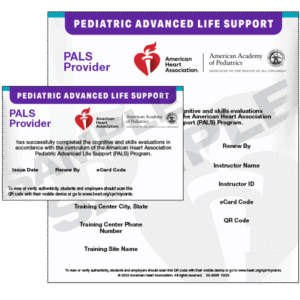
Ready to earn your American Heart Association PALS certification? Same Day CPR offers fast and flexible PALS certification training for healthcare professionals who care for infants and children during emergencies. Complete a short online PALS course at your own pace, then finish a brief in-person skills session at one of our CPR Verification Stations. After completing both parts, you will receive your AHA PALS Provider card the same day and gain the knowledge and confidence to respond effectively during pediatric emergencies.
Stay calm and follow the assessment process while using approved cognitive aids or algorithm reference cards if they are available. Working closely with your team and following current protocols helps you provide safe and effective care.