-
 30,000+ Students Sucessfully Trained Annually
-
30,000+ Students Sucessfully Trained Annually


 30,000+ Students Sucessfully Trained Annually
It only takes a small object and a few seconds for an ordinary moment to become an emergency. Knowing how to recognize the early signs of an airway blockage can make all the difference before help arrives. Child Foreign Body Airway Obstruction occurs when a child accidentally inhales or swallows an object that becomes lodged in the airway, making it difficult or impossible to breathe. For this guide, a child is generally defined as anyone under the age of 18. Common objects that can cause an airway blockage include small toys, coins, buttons, beads, nuts, grapes, popcorn, and pieces of food. Depending on the size and location of the object, the blockage may be partial or complete. A child with a partial obstruction may cough forcefully, make wheezing sounds, or have trouble speaking, while a complete obstruction can prevent breathing and may quickly become life-threatening. Because younger children often explore the world by putting objects in their mouths, they are at a higher risk of experiencing this type of emergency.
The Child Foreign Body Airway Obstruction Algorithm, developed by the American Heart Association and American Academy of Pediatrics as part of Pediatric Basic Life Support (BLS), provides a clear step-by-step approach for recognizing and managing choking emergencies in children. Its main role is to help rescuers quickly assess whether the airway is partially or completely blocked and choose the correct intervention based on the child’s condition. The algorithm guides caregivers and healthcare providers through actions such as encouraging coughing when appropriate, delivering back blows and abdominal thrusts for a conscious child with a severe blockage, and beginning CPR if the child becomes unresponsive. By following this structured process, rescuers can reduce delays, avoid unnecessary actions, improve patient safety, and increase the chances of clearing the airway before emergency medical services arrive.
Note: This child foreign body airway obstruction algorithm guideline remains valid for the period 2025–2030.

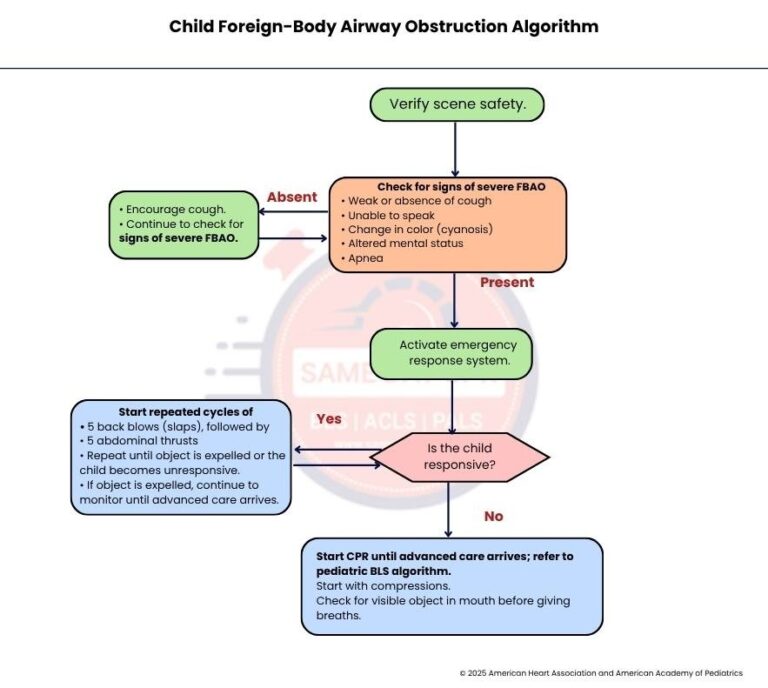
A child can choke without warning, so knowing what to do can help you respond quickly and safely. This step-by-step guide explains each action in a simple way to help you provide the right care until emergency help arrives.
Before helping the child, make sure the area is safe for both you and the child. Look around for any dangers, such as moving vehicles, fire, electrical hazards, or other unsafe conditions. Entering an unsafe scene can put you at risk and prevent you from providing effective care. Once you are sure the environment is safe, approach the child and prepare to assess their condition.
Check the child for signs of severe foreign body airway obstruction (FBAO). These signs include a weak or absent cough, inability to speak, change in color (cyanosis), altered mental status, and apnea. A child with severe airway obstruction may struggle to breathe, become silent instead of coughing, or appear blue due to a lack of oxygen. If these signs are absent, proceed to Step 3. If these signs are present, proceed to Step 4 immediately.
If the child has a mild airway obstruction and can cough, encourage them to keep coughing because a strong cough is often the most effective way to remove the object. Do not interfere by giving back blows or abdominal thrusts if the child can cough forcefully. Continue to watch the child closely and check for signs of severe FBAO. If the condition worsens, return to Step 2 and reassess for severe airway obstruction.
If the child shows signs of severe airway obstruction, activate the emergency response system as soon as possible. Call your local emergency number or ask another person nearby to make the call while you stay with the child. Getting emergency medical services on the way early ensures that advanced care is available if the obstruction cannot be removed or the child's condition becomes worse.
Check whether the child is responsive by speaking to them and gently tapping their shoulder. A responsive child may open their eyes, answer you, cry, or move when you talk to them. If the child is responsive, proceed to Step 6 and begin treatment for severe airway obstruction. If the child is unresponsive, proceed immediately to Step 7 and start CPR.
Begin repeated cycles of 5 back blows (slaps) followed by 5 abdominal thrusts. Continue these cycles until the object is expelled or the child becomes unresponsive. If the object is expelled, continue to monitor the child until advanced care arrives because breathing problems can still develop after the blockage is removed. If the child becomes unresponsive at any time, immediately proceed to Step 7.
If the child becomes unresponsive, start CPR and continue until advanced care arrives. Begin with chest compressions to help circulate blood and increase the chance of dislodging the object. Before giving rescue breaths, check for a visible object in the mouth and remove it only if you can clearly see it. Continue CPR according to the Pediatric Basic Life Support algorithm until the child recovers or emergency medical personnel take over.
In short, a choking emergency can happen in seconds, but knowing the Child Foreign Body Airway Obstruction Algorithm helps you respond with confidence and care. By recognizing the signs of an airway blockage, choosing the correct action, and following each step in order, you can give a child the best chance of breathing again while waiting for emergency medical services. Learning these skills through regular training and reviewing the latest guidelines will help you stay prepared for unexpected situations. Quick action, calm thinking, and the right response can make a meaningful difference during a choking emergency.
If you want to build your lifesaving skills, Same Day CPR offers BLS Certification classes with blended learning that combines online coursework and hands-on training to help you feel ready to respond when it matters most.