


If you are looking into life-saving certifications, you have likely come across CPR and BLS and noticed that they are sometimes used interchangeably. This often leads to confusion, especially for people deciding which course to take for work, school, or personal preparedness.
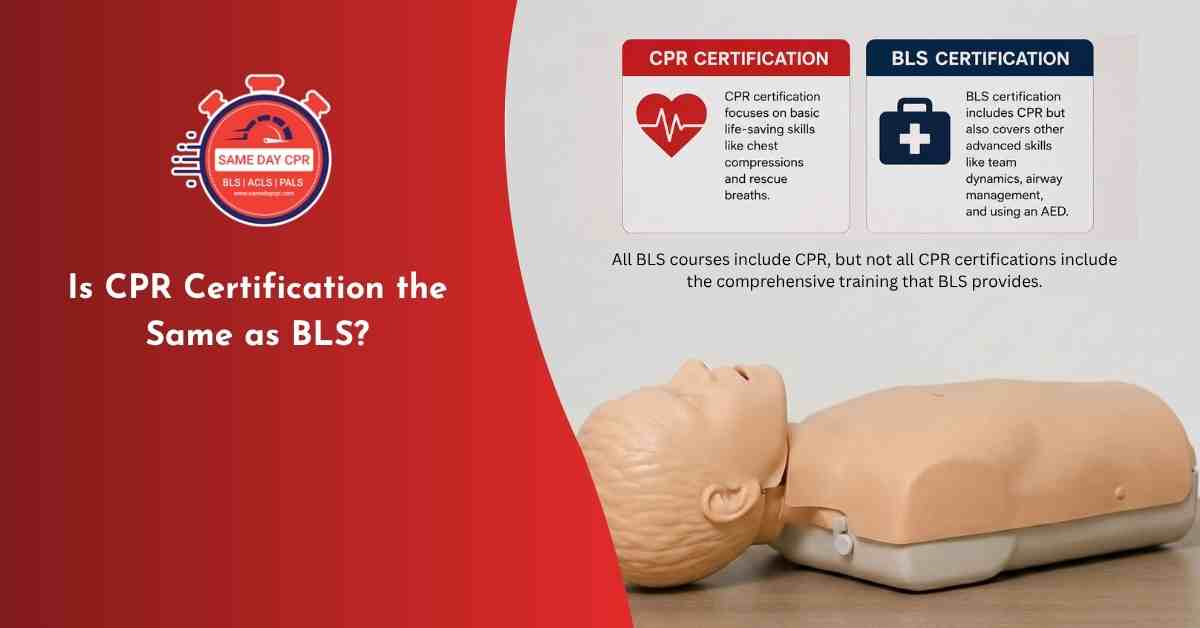
The short answer is: No, CPR certification and BLS certification are not the same. However, they are closely related. CPR is actually a core component of BLS, but BLS includes additional advanced skills and is intended for more clinical or professional healthcare environments.
Understanding the difference matters because choosing the wrong certification can affect job eligibility, compliance requirements, and your level of preparedness in real emergencies.
CPR vs BLS: The Core Difference Explained
The main difference between CPR and BLS lies in scope, depth, and intended audience.
- CPR (Cardiopulmonary Resuscitation) focuses on basic, immediate life-saving actions used when someone’s heart stops beating or they stop breathing.
- BLS (Basic Life Support) includes CPR but expands it with more advanced techniques used in healthcare and emergency response settings.
In simple terms:
- CPR is the foundation.
- BLS is the professional-level expansion of that foundation.
While both aim to save lives during cardiac arrest or respiratory failure, BLS is more structured, more detailed, and meant for trained responders working in teams.
What Is CPR? (Defining the Foundation)
CPR is an emergency procedure used when a person’s heart or breathing stops. Its goal is to maintain blood flow and oxygen circulation until professional medical help arrives.
Without CPR, brain damage can begin within minutes, and survival chances drop rapidly. That’s why CPR is considered one of the most essential emergency skills anyone can learn.
Who Needs CPR Training?
CPR training is suitable for the general public, not just healthcare professionals. It is commonly taken by:
- Parents and caregivers
- Teachers and school staff
- Coaches and fitness trainers
- Workplace employees (safety compliance roles)
- Community members who want emergency preparedness
Because it is widely applicable, CPR courses are developed to be simple, accessible, and easy to apply in real-life emergencies.
Key Skills Taught in CPR
CPR certification focuses on essential, high-impact emergency actions:
1. Chest Compressions
Chest compressions are the most important part of CPR. They manually pump blood through the body when the heart has stopped.
- Recommended rate: 100–120 compressions per minute
- Depth: about 2–2.4 inches for adults
- Full chest recoil is required for effectiveness
High-quality compressions help maintain oxygen flow to the brain and vital organs until help arrives.
2. Rescue Breaths
CPR also teaches rescue breathing to supply oxygen to the lungs.
A common ratio used is:
- 30 compressions: 2 breaths
However, in some situations, especially for untrained bystanders, compression-only CPR is recommended.
3. AED (Automated External Defibrillator) Use
CPR training includes basic AED awareness and usage.
An AED:
- Analyzes heart rhythm
- Determines if a shock is needed
- Helps restore normal heart rhythm
It is made to be simple, so even non-medical responders can use it effectively.
What Is BLS? (Defining the Advanced Standard)
BLS stands for Basic Life Support, but despite the word “basic,” it refers to a more advanced level of emergency care than CPR.
BLS is aimed primarily for healthcare providers and professional responders who work in environments where emergencies require coordinated team response and clinical precision.
It includes CPR but adds additional skills needed in hospitals, ambulances, and clinical care settings.
How BLS Builds on CPR
BLS includes everything in CPR but expands it in three major ways:
- More advanced airway and breathing management
- Team-based emergency response
- Clinical-level precision and protocols
This makes BLS more structured and suitable for environments where multiple responders work together.
In short:
All BLS providers are CPR certified, but not all CPR providers are BLS certified.
Who Needs BLS Certification?
BLS is intended for individuals who are responsible for patient care or emergency response in professional settings, such as:
- Doctors and nurses
- Medical and nursing students
- Paramedics and EMTs
- Hospital and clinical staff
- Dental professionals
- First responders
These individuals require more than basic CPR because they may be responsible for managing life-threatening situations as part of a coordinated team.
Key Skills Taught in BLS
BLS training includes CPR but adds advanced techniques used in healthcare environments:
1. High-Quality CPR for All Ages
BLS reinforces CPR with stricter performance standards for adults, children, and infants, ensuring accuracy in professional care settings.
2. Two-Rescuer and Team-Based CPR
Unlike CPR, BLS emphasizes teamwork. Roles are divided between:
- Chest compressors
- Airway managers
- AED operators
This reduces delays and improves efficiency during resuscitation.
3. Bag-Valve Mask (BVM) Ventilation
BLS teaches the use of a bag-valve mask to deliver oxygen effectively to patients who are not breathing.
This skill requires training to ensure:
- Proper mask seal
- Correct ventilation rate
- Avoiding over-ventilation
4. Advanced AED Integration
In BLS, AED use is practiced within full resuscitation scenarios, ensuring smooth coordination without interrupting chest compressions.
5. Airway Obstruction Management
BLS includes treatment for choking in adults, children, and infants using:
- Abdominal thrusts
- Back blows
- Chest thrusts (for infants)
This prepares providers for real-world emergency airway situations.
The Bottom Line on BLS
BLS is a professional-level certification developed for high-responsibility environments. It prepares individuals to use advanced techniques, work in teams, and respond to life-threatening emergencies with clinical efficiency.
Key Differences Between CPR and BLS Certification
Here is a simplified breakdown of how they differ:
| Feature | CPR Certification | BLS Certification |
| Target Audience | General public, teachers, caregivers, workplace staff | Healthcare providers, EMTs, nurses, doctors |
| Skill Level | Basic emergency response | Advanced clinical response |
| CPR Skills | Yes | Yes (more advanced standards) |
| AED Use | Basic training | Integrated into full resuscitation scenarios |
| Team-Based Response | Not included | Core component |
| Bag-Valve Mask Use | Not included | Included |
| Complexity | Simple, individual response | Structured, team-based care |
| Environment | Public or workplace emergencies | Clinical and hospital settings |
Similarities Between CPR and BLS
Even though they differ in depth, CPR and BLS share several important similarities.
- Both certifications focus on responding to cardiac arrest, where immediate action is critical to survival.
- Both emphasize high-quality CPR as the foundation of emergency response.
- Both CPR and BLS certifications are commonly based on AHA standards, ensuring consistency and scientific accuracy.
- Neither certification is permanent. Both typically require renewal every two years to ensure skills remain current.
- Both CPR and BLS teach emergency response for adults, children, and infants, with adjustments based on age and condition.
Final Answer: Are CPR and BLS the Same?
No, CPR certification and BLS certification are not the same.
- CPR is a basic life-saving certification for the general public
- BLS is a more advanced certification prepared for healthcare professionals
However, CPR is included within BLS, meaning BLS is essentially a more advanced extension of CPR training.
Choosing between them depends on your goals:
- If you want basic emergency preparedness → CPR is enough
- If you work in healthcare or clinical settings → BLS is required
CPR or BLS: Which Certification Is Right for Your Needs?
In summary, CPR certification and BLS certification are not the same, but they are closely connected in emergency care. CPR teaches essential actions that help someone survive when breathing or heart function stops, making it ideal for everyday situations and general safety awareness. BLS builds on these abilities and adds advanced techniques, structured teamwork, and clinical-level response used in healthcare settings.
Organizations such as the AHA set widely accepted standards that guide both training paths and ensure consistent quality. Choosing between them depends on your goals and responsibilities, since one focuses on public readiness while the other supports professional medical care. If you want basic confidence to act during emergencies, CPR training is usually enough. If you work in a medical or clinical environment, BLS provides the deeper preparation you need to respond effectively.