



Ever wondered how a few seconds and the right action can make the difference between life and death during a cardiac emergency? Proper AED pad placement is one of the most important factors in ensuring an automated external defibrillator (AED) delivers an effective shock during sudden cardiac arrest. While AEDs are designed to be simple and guide users through voice instructions, correct pad positioning ensures that electrical energy travels through the heart in the most effective way possible. When pads are placed correctly, the shock has a higher chance of restoring a normal heart rhythm, while incorrect placement can reduce effectiveness and delay life-saving treatment.
Understanding how and where to place AED pads is essential for anyone who may need to respond to a cardiac emergency.
Why AED Pad Placement Matters
AEDs work by delivering a controlled electrical shock to the heart when it detects a life-threatening rhythm such as ventricular fibrillation or pulseless ventricular tachycardia. However, the shock is only effective if it passes through the heart muscle in the correct direction.
Proper pad placement ensures:
- The electrical current travels directly across the heart
- The shock is strong enough to reset abnormal rhythms
- The AED can accurately analyze the heart rhythm
- Energy loss through surrounding tissues is minimized
When pads are misplaced, the electrical pathway may not effectively pass through the heart. This reduces the impact of the shock and may lower the chance of successful defibrillation. Correct placement is therefore not just a technical detail; it directly influences survival outcomes.
Standard AED Pad Placement (Adults and Older Children)
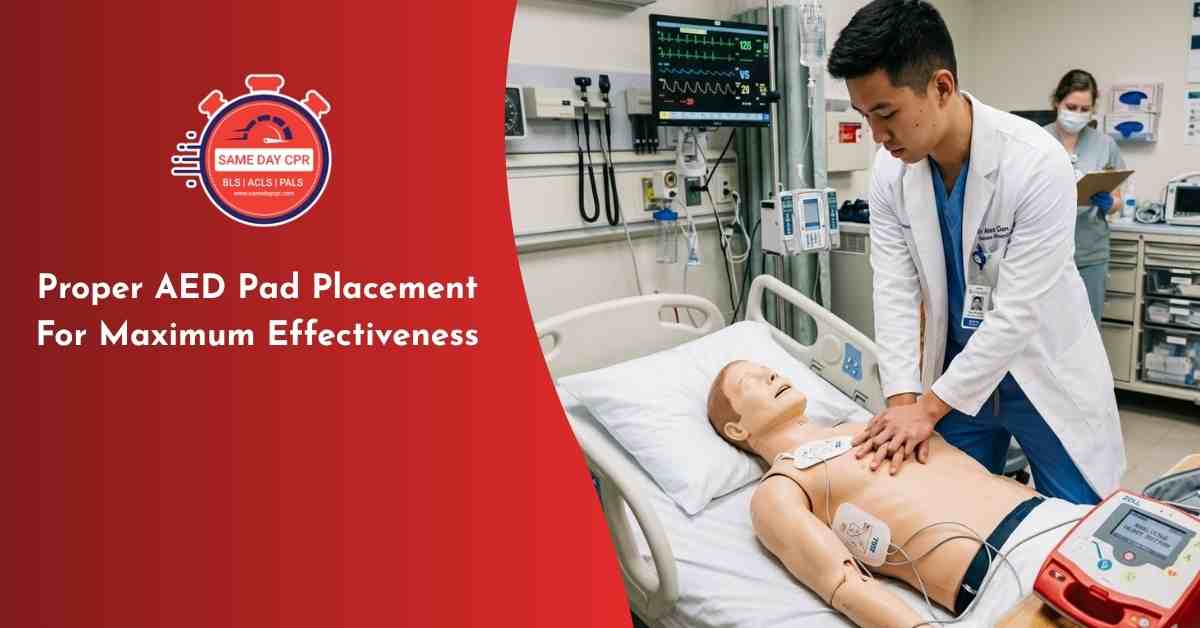
Most AEDs follow a standard placement known as the anterior–lateral position, which is used for adults and older children.
Step-by-step placement:
- First pad (upper right chest):
Place the pad just below the right collarbone, slightly away from the center of the chest. - Second pad (lower left chest):
Place the second pad on the left side of the chest, a few inches below the armpit, along the mid-axillary line.
Why this works:
This positioning creates a diagonal electrical pathway across the heart. The current flows through the central chest region where the heart is located, maximizing the likelihood of successfully correcting abnormal rhythms.
Key points:
- Pads should not touch or overlap
- Pads must stick directly to bare skin
- Follow the diagram on the AED pads whenever available
- Placement should be quick and precise without delay
This is the default method recommended by all modern AED devices and training programs.
Alternative Placement: Anterior–Posterior Position
In some situations, an alternative pad placement may be used: the anterior–posterior position.
Pad placement:
- One pad is placed in the center of the chest (over the sternum or slightly left of center)
- The second pad is placed on the upper back, between the shoulder blades
When this method is used:
- The standard chest placement is not possible due to injury or obstruction
- The patient has a pacemaker or an implanted defibrillator in the usual pad area
- The patient has a large chest or body shape that makes standard placement difficult
- In some hospitals or advanced care settings
Why it works:
This method sends the electrical current from front to back, still passing through the heart but along a different axis. It can be just as effective when applied correctly.
However, in emergencies, anterior–lateral placement remains the preferred and fastest option unless there is a clear reason to change it.
Step-by-Step Guide to Applying AED Pads Correctly
Correct placement must be done quickly, but without skipping essential steps. AEDs are designed to guide users, but understanding the process improves confidence and accuracy.
Step 1: Turn on the AED
Switch on the device immediately. It will begin giving voice instructions that guide every step of the process.
Step 2: Expose the Chest
Remove all clothing covering the chest. The skin must be bare, clean, and dry for proper pad adhesion and signal transmission.
If the chest is wet, quickly dry it. If the environment is unsafe (water, rain), move the person if possible without delaying care.
Step 3: Prepare and Open Pads
Take the pads from their packaging and check the diagrams printed on them. These diagrams clearly show the correct placement and should always be followed.
Step 4: Apply Pads to Correct Positions
For adults:
- Right pad: just below the right collarbone
- Left pad: lower left side of the chest, under the armpit area
Press firmly so the pads fully adhere to the skin.
Step 5: Ensure Correct Spacing
Make sure pads are not touching or too close together. Proper spacing ensures the electrical current passes through the heart instead of around it.
Step 6: Stop all Movement
No one should be touching the patient while the AED analyzes the heart rhythm. Movement can interfere with readings.
Step 7: Allow AED Analysis
The device will automatically assess the heart rhythm and determine whether a shock is needed. Do not touch the patient during this time.
Step 8: Follow Prompts Immediately
If a shock is advised, ensure everyone is clear and press the shock button when instructed. Resume CPR immediately after the shock or if no shock is advised.
Pediatric AED Pad Placement
Children require special consideration due to their smaller chest size.
Standard approach (children and infants):
- If child pads are available, use them
- If not available, adult pads can be used carefully
Placement options:
Front-and-back placement (recommended for small children):
- One pad in the center of the chest
- One pad on the upper back between the shoulder blades
This prevents pad overlap and ensures safe electrical flow through the heart.
Important note:
AED use should never be delayed due to pad size availability. Always use what is available immediately.
Common AED Pad Placement Mistakes
Even small errors can reduce AED effectiveness. The most common mistakes include:
- Incorrect Positioning: Placing pads randomly or too high/low reduces the effectiveness of the shock. Always follow the diagram.
- Pads Too Close Together: If pads are too near each other, the electrical current may not pass through the heart properly.
- Poor Skin Contact: Pads placed over clothing, sweat, or moisture reduce conductivity and accuracy.
- Ignoring Device Instructions: AEDs are designed to guide users step-by-step. Skipping instructions can lead to errors.
- Delayed Placement: Time is critical. Spending too long adjusting pads can reduce survival chances.
Special Situations and How to Handle Them
Some situations may require quick adjustments in AED practice, they are as follows:
- Wet or Sweaty Chest: Dry the chest quickly before applying pads. Water reduces electrical effectiveness.
- Excessive Chest Hair: If pads do not stick properly, remove hair quickly using a razor if available. Otherwise, press firmly and proceed.
- Implanted Medical Devices: If a visible lump (pacemaker or ICD) is present, place the pad slightly away from it, not directly over it.
- Medication Patches: Remove patches before placing pads, as they may interfere with electrical flow or heat up during shock delivery.
- Pregnancy: AED use is safe and necessary during pregnancy. Apply pads in standard positions without delay.
Key Principles of Effective AED Pad Placement
To summarize the core principles:
- Ensure pads create a clear path through the heart
- Place one pad above the right chest and one on the left side (standard method)
- Maintain proper spacing between pads
- Ensure full skin contact
- Follow AED diagrams exactly
- Avoid delaying treatment for perfect conditions
The Importance of Correct AED Pad Placement
In summary, proper AED pad placement is a critical step in delivering effective defibrillation during sudden cardiac arrest. While AEDs are designed to be user-friendly, correct positioning ensures the electrical shock passes through the heart in the most efficient way possible.
The standard anterior–lateral placement is the preferred method in most cases, while anterior–posterior placement serves as a useful alternative in special situations. By understanding correct placement techniques and avoiding common mistakes, responders can significantly improve the chances of restoring a normal heart rhythm.
In an emergency, speed and correct action together save lives, and proper AED pad placement is central to both.