


Airway emergencies don’t give you much time. When something blocks the airway completely, oxygen stops reaching the lungs and the brain. Within minutes, severe oxygen deprivation can lead to brain injury and cardiac arrest. That’s why recognizing severe airway obstruction fast isn’t just a BLS skill; it can mean the difference between life and death. After the emergency, knowing what to do after a choking incident can also help you understand the appropriate follow-up steps and when medical evaluation may be necessary.
One of the first things BLS training teaches you is how to tell the difference between a mild and a severe obstruction. With a mild blockage, some air is still getting through. The person can cough, speak, or breathe, maybe not easily, but they can do it. With a severe obstruction, that airflow is critically reduced or gone entirely. The signs are unmistakable once you know what to look for, and spotting them early is everything.
Why Recognizing Severe Airway Obstruction Matters in BLS
In BLS, you have to identify the problem before you can respond appropriately. No technique, whether abdominal thrusts, back blows, or CPR (Cardiopulmonary Resuscitation), should be used without first understanding what you’re dealing with. If you need to respond to a conscious choking adult, understanding how to do the Heimlich maneuver can help you become familiar with the abdominal-thrust technique used to address a severe airway obstruction. A severe airway obstruction can quickly progress to unconsciousness and cardiac arrest.
If you mistake a severe obstruction for a mild one, or miss it altogether, you lose precious time. Knowing exactly what to look for lets you act quickly and correctly, and that accuracy saves lives.
Airway Obstruction in BLS
Severe airway obstruction in BLS shows clear warning signs when air cannot move through the throat and the person struggles to breathe or speak. These signals show a medical emergency that needs fast action to restore airflow and protect the brain and heart.
1. Inability to Speak
When the airway is fully or nearly fully blocked, air can’t pass through the vocal cords. The person goes completely silent, no words, no sounds. That’s one of the clearest early signs of a severe obstruction. Someone with a mild blockage can usually still talk, even if their voice sounds strained. Complete silence tells you that airflow has dropped to a critical level.
2. Silent or Ineffective Cough
Coughing is the body’s built-in way of clearing the airway. A strong cough can often knock out a mild blockage on its own. But when the obstruction is severe, the cough either goes completely silent or becomes so weak that it does nothing. No air is moving past the blockage. If you see someone trying to cough but getting nowhere, that’s your signal; they can’t fix this on their own.
3. Inability to Breathe or Severe Respiratory Distress
Someone with a severe obstruction will visibly fight for breath. You’ll see their chest heaving, their neck straining, every muscle working, but no air is actually moving in or out. That gap between effort and result is a major red flag. In BLS, when you see that kind of labored, unproductive breathing, you act immediately.
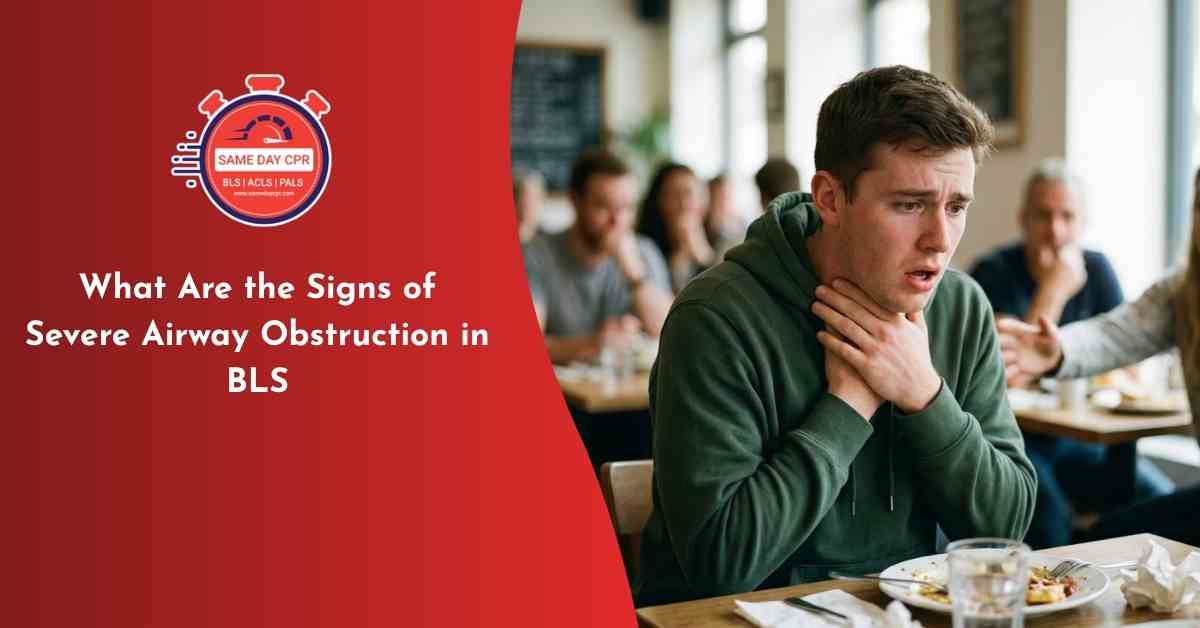
4. The Universal Choking Sign
Most people instinctively clutch their throat with one or both hands when they’re choking severely. This is called the universal choking sign, and BLS training highlights it for good reason. When someone can’t speak, and they’re grabbing their throat, they’re telling you something is very wrong. Don’t second-guess it; treat it as a severe obstruction right away.
5. High-Pitched Breathing Sounds or Complete Silence
Sometimes a severely blocked airway produces stridor, a high-pitched, crowing, or wheezing noise caused by air being forced through an almost closed passage. But in a complete blockage, there’s no sound at all. Total silence from the airway is actually more alarming than stridor. Either way, in BLS, you treat both as serious warning signs that demand an immediate response.
6. Cyanosis, Bluish Discoloration of the Skin, Lips, or Nails
Cyanosis, that bluish or grayish tint that shows up on the lips, fingernails, or skin, means oxygen levels in the blood have dropped significantly. It’s a late sign, which means by the time you see it, the body has already been oxygen-deprived for a while. If you notice cyanosis, the situation is critical. The obstruction has been there long enough to start affecting vital organs. You need to act right now.
7. Panic, Agitation, and Visible Distress
When the brain starts running low on oxygen, it triggers a powerful alarm response. You’ll see it in the person’s face and body, wide eyes, frantic movement, confusion, and intense fear. That panic isn’t overreaction; it’s the brain signaling a real emergency. On its own, panic doesn’t confirm a severe obstruction. But combine it with an inability to speak, a silent cough, or the choking sign, and you have a very clear picture.
8. Loss of Consciousness
If the blockage doesn’t get cleared, the person will eventually pass out. This is the point where things become truly life-threatening. Once they’re unconscious, they can’t protect their own airway. The gag reflex disappears. You’re now in a race against time. BLS guidelines are clear here: lower them carefully to the ground, call emergency services if you haven’t already, and start CPR. The chest compressions you deliver may actually help dislodge whatever is blocking the airway.
How to Distinguish Severe From Mild Airway Obstruction
Getting this distinction right matters because your response changes completely depending on which one you’re dealing with.
- With a mild obstruction, air is still moving. The person can breathe, speak, and produce a real cough. Your job here is to encourage them to keep coughing and stay close to monitor them. Don’t jump in with physical techniques; you could actually make things worse.
- With a severe obstruction, the air has stopped or nearly stopped. They can’t speak, they can’t cough effectively, and they may already be showing signs of cyanosis or fading consciousness. Now you act, call emergency services, and if they’re still conscious, start back blows and abdominal thrusts. If they go unresponsive, start CPR immediately.
Ask yourself one question: Can this person move air? If the answer is no, or even if you’re not sure, treat it as severe and respond without hesitation.
Recognizing Choking Emergencies as a Critical BLS Skill
In short, when you’re trained in BLS, recognizing the signs of severe airway obstruction quickly and accurately can literally save someone’s life. Every major sign points to the same thing: air has stopped moving, and the body is running out of time. Whether it’s an inability to speak, a silent or useless cough, visible respiratory distress, the universal choking sign, abnormal or absent breath sounds, cyanosis, panic, or loss of consciousness, each one tells you that the situation is critical and that you need to act right now.
The sooner you recognize what’s happening, the sooner you can step in before oxygen deprivation does permanent damage. No technique works if you don’t first know what you’re looking at. That’s what makes recognition the foundation of everything in BLS. When you understand exactly what severe airway obstruction looks like, you don’t freeze, you don’t second-guess yourself, you respond with the speed and confidence the moment demands.