-
 30,000+ Students Sucessfully Trained Annually

-
30,000+ Students Sucessfully Trained Annually



-
30,000+ Students Sucessfully Trained Annually
30,000+ Students Sucessfully Trained Annually
Surviving a cardiac arrest is only half the battle, as the hours and days following return of spontaneous circulation (ROSC) are critical to recovery. Adult post-cardiac arrest care refers to the specialized treatment provided after ROSC to stabilize the patient, prevent further organ damage, and improve survival with favorable neurological outcomes. This includes optimizing oxygenation and ventilation, supporting circulation, identifying and treating the underlying cause of the arrest, managing blood glucose and body temperature when appropriate, and providing continuous monitoring in an intensive care setting.
Although spontaneous circulation has returned, resuscitation is not complete after ROSC. Multiple stabilization measures often occur simultaneously during the early post-cardiac arrest period to optimize oxygen delivery, maintain organ perfusion, and reduce the risk of secondary brain injury.
The Adult Post-Cardiac Arrest Care Algorithm organizes these interventions into a structured, evidence-based sequence, helping healthcare professionals prioritize airway management, oxygenation and ventilation, circulation, diagnostic evaluation, neurological assessment, coronary reperfusion when indicated, and ongoing critical care. Following the algorithm promotes timely, consistent management while improving the chances of survival and favorable neurological recovery.
Note: This adult post-cardiac arrest care algorithm guideline remains valid for the period 2025–2030.
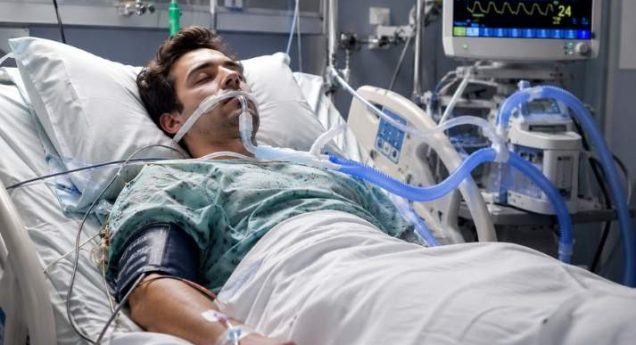
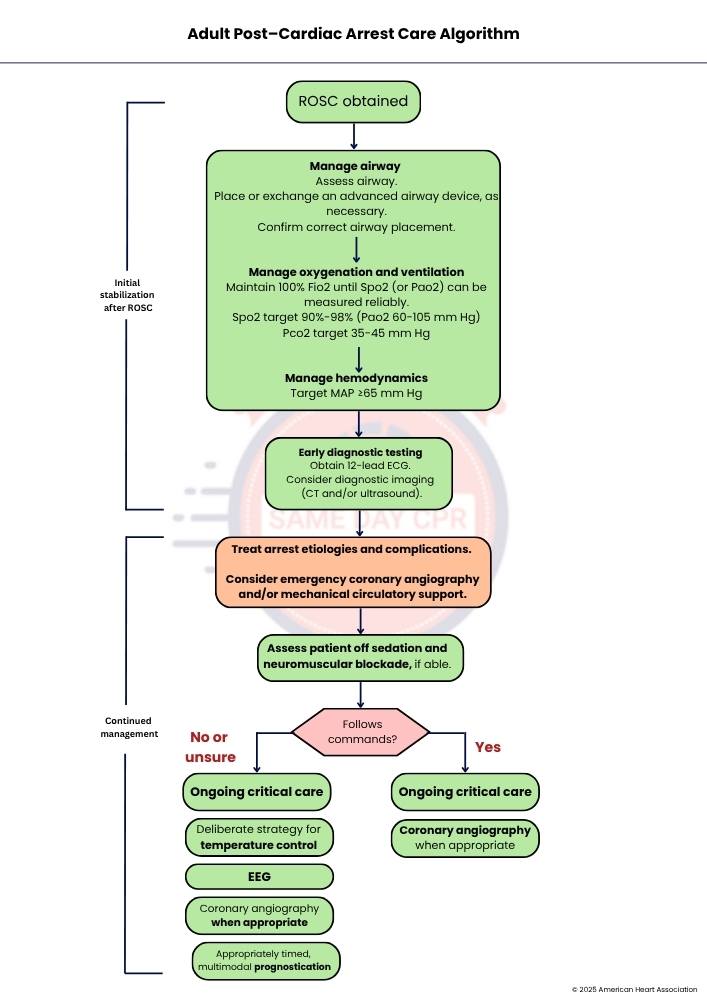
Post-cardiac arrest care begins immediately after ROSC and focuses on stabilizing the patient, minimizing further organ injury, identifying the cause of cardiac arrest, and supporting long-term recovery.
Step 1: ROSC Obtained
Return of spontaneous circulation (ROSC) means the patient’s heart has started beating effectively again after cardiac arrest. Once ROSC is achieved, treatment shifts from active resuscitation to stabilization, prevention of secondary injury, and investigation of the underlying cause of the arrest.
Step 2: Manage Airway, Oxygenation and Ventilation, and Hemodynamics
Managing the airway, breathing, and circulation is the immediate priority after ROSC. These interventions help restore adequate oxygen delivery, maintain organ perfusion, and reduce the risk of secondary injury.
i. Manage Airway
Assess the patient’s airway immediately after ROSC. If the patient cannot adequately maintain the airway or ventilation, place or exchange an advanced airway device, such as an endotracheal tube or supraglottic airway, as needed. After insertion, confirm correct airway placement using waveform capnography or capnometry to ensure effective ventilation and reduce the risk of airway complications.
ii. Manage Oxygenation and Ventilation
Initially provide 100% oxygen (FiO₂) until oxygen saturation can be measured reliably using SpO₂ or PaO₂. Once reliable measurements are available, titrate oxygen therapy to maintain an SpO₂ of 90%–98% (or a PaO₂ of 60–105 mm Hg), avoiding both hypoxemia and hyperoxia. Adjust ventilation to maintain a PCO₂ of 35–45 mm Hg unless severe acidemia requires an alternative ventilation strategy.
iii. Manage Hemodynamics
Maintain adequate circulation by targeting a mean arterial pressure (MAP) of at least 65 mm Hg. Intravenous fluids, vasopressor medications, or both may be required to maintain blood pressure and ensure adequate perfusion of vital organs, including the brain, heart, and kidneys.
Step 3: Early Diagnostic Testing
Obtain a 12-lead ECG (Electrocardiogram) as soon as possible to assess for myocardial ischemia or cardiac arrhythmias that may have contributed to the cardiac arrest. Consider additional diagnostic imaging, including CT (Computed Tomography) of the head, chest, abdomen, or pelvis when clinically indicated, to determine the cause of the arrest or identify injuries sustained during resuscitation. Point-of-care ultrasound or echocardiography may also help identify clinically significant conditions requiring immediate intervention.
Step 4: Treat Arrest Etiologies and Complications
Identify and treat the underlying cause of the cardiac arrest while managing complications that develop after ROSC. Consider emergency coronary angiography and/or mechanical circulatory support when appropriate. Emergency cardiac intervention should be considered in patients with persistent ST-segment elevation, cardiogenic shock, recurrent or refractory ventricular arrhythmias, or severe myocardial ischemia.
Step 5: Assess Patient Off Sedation and Neuromuscular Blockade
When clinically feasible, temporarily discontinue sedation and neuromuscular blocking medications to accurately evaluate the patient’s neurological status and determine whether they can follow commands.
Step 6: Follow Commands?
Assess whether the patient can follow simple commands, such as opening their eyes or squeezing a hand. Patients who follow commands proceed to Step 12. If the patient does not follow commands or neurological assessment remains uncertain, continue with Step 7.
Step 7: Ongoing Critical Care
Continue comprehensive intensive care management with close monitoring of airway, breathing, circulation, neurological status, and organ function while treating ongoing medical problems and preventing secondary complications.
Step 8: Deliberate Strategy for Temperature Control
If the patient is not following commands after sedation and neuromuscular blockade have been stopped, or neurological assessment is not possible, initiate a deliberate temperature control strategy as soon as possible. Maintain a target body temperature between 32°C and 37.5°C to reduce neurological injury and prevent fever.
Step 9: EEG
Evaluate the patient for clinical seizures and perform an electroencephalogram (EEG) in patients who remain unconscious or are not following commands. EEG helps detect seizure activity and supports neurological assessment after cardiac arrest.
Step 10: Coronary Angiography When Appropriate
Perform coronary angiography when clinical findings suggest coronary artery disease as the cause of cardiac arrest or when emergency coronary intervention is indicated.
Step 11: Appropriately Timed, Multimodal Prognostication
Assess neurological prognosis using a multimodal approach that includes clinical examination, neuroimaging, EEG findings, and other appropriate investigations. Whenever possible, delay prognostication until at least 72 hours after ROSC or after achieving normothermia to improve accuracy.
Step 12: Ongoing Critical Care
For patients who are awake and following commands, continue intensive care management by maintaining adequate oxygenation, ventilation, circulation, and blood glucose control while treating the underlying cause of the cardiac arrest and planning rehabilitation as appropriate.
Step 13: Coronary Angiography When Appropriate
Perform coronary angiography whenever clinically indicated to identify and treat coronary artery blockages that may have contributed to the cardiac arrest. This step appears in both branches of the algorithm because coronary angiography should be performed whenever appropriate, regardless of neurological status.
The section highlights important clinical considerations that support the main algorithm. Many stabilization measures occur simultaneously during the post-ROSC period, and clinical judgment should be used to prioritize interventions based on the patient’s condition.
In short, the Adult Post Cardiac Arrest Care Algorithm provides a clear and organized approach to caring for patients after return of spontaneous circulation. Each step focuses on protecting the brain and other vital organs while finding and treating the cause of the cardiac arrest. Careful monitoring, timely treatment, and ongoing support can greatly improve the chance of survival and recovery. By following this evidence based algorithm, healthcare teams can make informed decisions, deliver consistent care, and give patients the best possible opportunity for a meaningful recovery and a better quality of life.
Strengthen your ability to care for patients after cardiac arrest with Same Day CPR’s ACLS course. Enroll today to develop the knowledge, hands on skills, and confidence needed to deliver high quality care during cardiac emergencies.