



Yes. An AED can and should be used on a person with a pacemaker if they are experiencing sudden cardiac arrest. A pacemaker is never a reason to withhold or delay defibrillation.
AEDs analyze the heart’s rhythm before delivering a shock, activating only when they detect a life-threatening rhythm such as ventricular fibrillation (VF) or pulseless ventricular tachycardia (VT). A pacemaker does not interfere with this analysis. The shock itself is directed at the heart muscle, not the implanted device, so the risk of any device disruption is minor compared to the risk of delaying treatment during cardiac arrest. If a pacemaker is visible, shift the pad placement slightly away from it when possible, but never delay treatment to do so.
How an AED Works (and Why a Pacemaker Doesn’t Interfere)
An AED is built to detect one thing during cardiac arrest: a chaotic, disorganized electrical rhythm like VF or pulseless VT. It sends a low-energy signal through the chest to read the heart’s overall rhythm, scanning for total electrical disorder rather than individual beats.
A pacemaker operates on a completely different scale. It emits microscopic pulses, measured in microjoules, to trigger single, organized heartbeats in one chamber. The AED, by contrast, scans for large-scale chaos and delivers a high-voltage shock, measured in joules, to reset the entire heart. Because the two devices work at such different power levels and target different things, the pacemaker’s signals are invisible to the AED’s detection algorithm. The pacemaker will never cause an AED to misread the rhythm or wrongly withhold a needed shock.
Why a Pacemaker Can’t Substitute for Defibrillation
A pacemaker treats chronically slow heart rhythms (bradycardia) by nudging the heart to beat when its natural rate drops too low. It functions like a metronome, keeping time steady, but it cannot change the underlying rhythm if the heart spirals into VF or pulseless VT.
During cardiac arrest, a pacemaker is essentially a bystander. Its pulses are too small and localized to correct global electrical chaos. This is exactly why an AED is necessary even in pacemaker patients: the pacemaker manages rate, but only the AED can reset a chaotic rhythm.
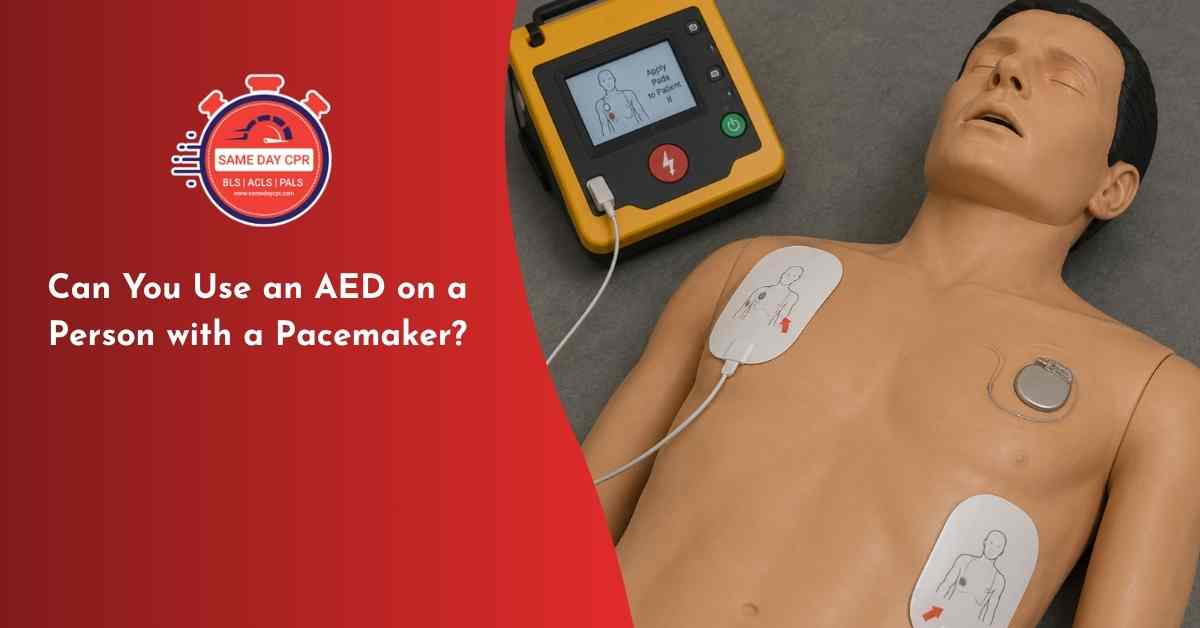
For a rescuer, the only practical relevance of the pacemaker is its physical location. It usually appears as a firm, coin-sized bulge just below the collarbone, on the upper left or right chest. Spotting it tells you where to avoid placing a pad — nothing more. It doesn’t change your urgency or your decision to shock.
Pad Placement With a Pacemaker Present
If you notice a pacemaker, place the AED pad at least one inch (about 2.5 cm) away from the device rather than directly on top of it. Direct placement over the device can slightly reduce shock effectiveness or affect the pacemaker. Standard placement is the upper right chest and lower left side of the chest; if the pacemaker sits in one of these spots, shift the pad slightly to the side while keeping the overall pattern intact.
Checking for a pacemaker should take only a few seconds and should never delay CPR or AED use. If you don’t have time to check, or a pad ends up placed over the device by accident, proceed anyway: continue following the AED’s prompts, and if you’re able to reposition the pad slightly before a shock is delivered without interrupting care, do so. If a shock has already been delivered, continue CPR and let the AED reanalyze the rhythm as normal. A pad placed over the device is still far better than a delayed or withheld shock.
Step-by-Step: Using an AED on Someone With a Pacemaker
The sequence is the same as for any cardiac arrest. A pacemaker or ICD does not change the AED procedure, only pad placement considerations.
Step 1: Call Emergency Services Immediately
Activate emergency medical help and send someone to bring an AED.
Step 2: Begin CPR
Start chest compressions immediately. Push hard and fast in the center of the chest, allow full recoil, and minimize interruptions.
Step 3: Turn on the AED
As soon as it arrives, turn it on and follow its voice/visual prompts. Continue CPR until the AED tells you to pause for analysis.
Step 4: Attach the Pads
Expose the chest and apply pads in the standard positions:
- Upper right chest
- Lower left side of the chest
If a pacemaker or ICD bulge is visible (usually near the upper chest below the collarbone), do not place a pad directly over it. Instead:
- Place the pad at least 1 inch (2.5 cm) away from the device, OR
- Use an anterior-posterior (front-and-back) placement if needed.
Step 5: Allow the AED to Analyze Rhythm
Ensure no one is touching the patient during analysis.
Step 6: Deliver Shock If Advised
If the AED instructs a shock, ensure everyone is clear and deliver it immediately.
Step 7: Resume CPR Immediately
Continue CPR right after the shock or if no shock is advised. Keep alternating CPR and AED prompts until emergency responders arrive.
Common Myths About AEDs and Pacemakers
Many people hear confusing information about AEDs and pacemakers during emergencies. Clear facts help you respond quickly and safely when someone needs life-saving care.
Myth: AEDs shouldn’t be used on pacemaker patients. False. AEDs are designed for use in cardiac arrest regardless of whether the patient has an implanted device. Medical guidelines are explicit that AED use should never be delayed or avoided because of a pacemaker.
Myth: The AED will destroy the pacemaker. A shock could temporarily affect or, rarely, damage a pacemaker, but this risk is minor compared to the danger of untreated cardiac arrest. The shock is directed primarily at the heart muscle rather than the device, and restoring the patient’s heartbeat takes priority regardless.
Myth: CPR alone is enough if someone has a pacemaker. CPR maintains circulation but cannot correct a lethal rhythm like VF. Only an AED can analyze the rhythm and deliver a corrective shock. CPR and AED use together produce far better outcomes than either alone.
What Medical Organizations Recommend
Resuscitation guidelines worldwide agree: AEDs should be used immediately on anyone in suspected cardiac arrest, regardless of implanted cardiac devices (ICD). A pacemaker is not a contraindication for defibrillation. If one is visible, minor pad-placement adjustments are reasonable, but they should never interfere with rapid AED application or ongoing CPR.
This guidance reflects a simple reality: survival from cardiac arrest depends heavily on how quickly defibrillation happens. Each minute of delay reduces the likelihood of a good outcome, while combining early CPR with prompt AED use substantially improves the odds of restoring a normal rhythm.
Key Takeaways
These key points explain how to use an AED safely when someone has a pacemaker. They focus on quick action, clear thinking, and what matters most in an emergency.
- A pacemaker is never a reason to delay an AED. The risk of doing nothing far outweighs any theoretical interaction with the device.
- Speed matters more than perfect placement. If you don’t have time to locate the pacemaker, apply the pads anyway — a pad over the device is better than a delayed shock.
- Adjust placement only if it doesn’t cost time. Shift the pad about an inch away from a visible pacemaker bulge when you can do so without slowing down care.
- CPR and AED work together. CPR maintains circulation; the AED corrects the rhythm. Use both, without interruption, until help arrives.
- Pacemaker patients are often higher-risk, not exceptions. Many have underlying heart conditions, which makes fast AED access more important, not less.
AED Use with Pacemaker: Act Without Delay
In short, you should use an AED right away, even if the person has a pacemaker, in a sudden cardiac arrest emergency. The device does not change the need for fast action because the AED is designed to detect dangerous heart rhythms and deliver a shock when needed. A pacemaker only helps manage slow heartbeats and cannot correct a chaotic rhythm, so it cannot replace defibrillation. You may notice a small bump under the skin where the pacemaker sits, and you can place the pads slightly away from that spot if time allows. What matters most is starting CPR quickly and following the AED instructions without hesitation. The risk of minor device interference is far smaller than the danger of delaying treatment. Acting quickly with confidence gives the person the best chance of survival.