



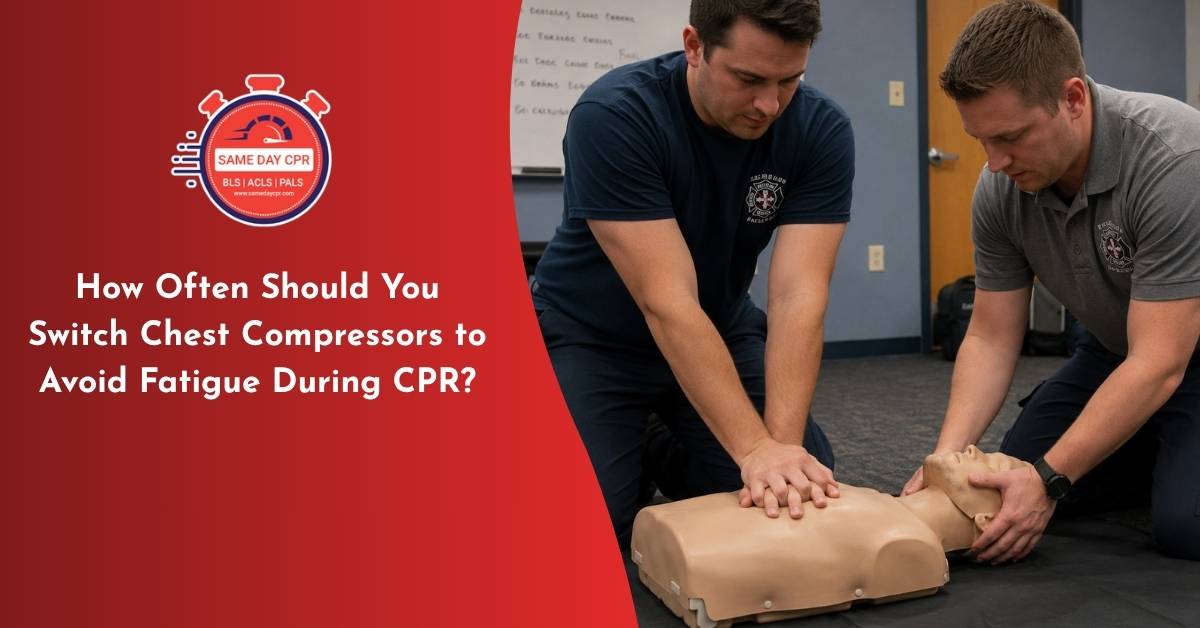
High-quality chest compressions are one of the most important parts of cardiopulmonary resuscitation (CPR). However, performing continuous chest compressions is physically demanding, and fatigue can develop quickly, even among trained rescuers. As fatigue increases, compression depth, rate, and consistency often decline, reducing the effectiveness of CPR.
Current resuscitation guidelines recommend switching the person performing chest compressions every 2 minutes (about every 5 cycles of CPR) or sooner if the rescuer becomes fatigued or can no longer maintain high-quality compressions. Regular rotation helps ensure adequate compression depth, proper rate, complete chest recoil, and minimal interruptions during resuscitation.
By rotating compressors at recommended intervals, rescuers can maintain effective blood circulation to the brain and other vital organs, improving the chances of survival during cardiac arrest.
Quick Answer
To avoid fatigue and maintain high-quality CPR, chest compressors should be switched every 2 minutes or sooner if compression quality begins to decline. Rescuer changes should be completed as quickly as possible, ideally with interruptions lasting less than 10 seconds.
Why Is It Important to Switch Chest Compressors?
Chest compressions require significant physical effort. Rescuers must compress the chest at a rate of 100–120 compressions per minute while achieving adequate depth and allowing full chest recoil between compressions.
Research has shown that compression quality often begins to deteriorate after only a short period of continuous CPR. As fatigue develops, rescuers may unintentionally deliver shallower compressions, slower rates, or incomplete chest recoil. These changes reduce blood flow to the heart and brain and can negatively affect resuscitation outcomes.
Regular compressor rotation helps prevent fatigue-related declines in performance and ensures that CPR remains effective throughout the resuscitation effort.
Understanding Rescuer Fatigue During CPR
Rescuer fatigue refers to the physical exhaustion that develops while performing chest compressions. Because CPR requires continuous force and proper technique, fatigue can occur quickly and may affect performance before the rescuer realizes it.
How Fatigue Affects CPR Quality
As fatigue increases, several aspects of CPR quality may decline:
- Shallower chest compressions
- Slower or inconsistent compression rates
- Incomplete chest recoil
- Increased interruptions during CPR
- Reduced the overall effectiveness of circulation
These problems can decrease blood flow to vital organs and lower the likelihood of successful resuscitation.
Signs of Rescuer Fatigue
Common signs of fatigue include:
- Shortness of breath
- Rapid breathing
- Muscle soreness or weakness
- Difficulty maintaining compression depth
- Trouble keeping a consistent rhythm
- Reduced concentration
When any of these signs appear, rescuers should switch compressors as soon as possible.
What Do CPR Guidelines Recommend?
Current CPR guidelines from organizations such as the American Heart Association (AHA) recommend changing compressors every 2 minutes or sooner if fatigue affects compression quality.
This timing often coincides with rhythm checks or AED (automated external defibrillator) analysis, allowing teams to switch providers while minimizing interruptions. The primary goal is to maintain high-quality compressions with adequate depth, proper rate, and full chest recoil throughout the resuscitation effort.
Whenever possible, pauses during compressor changes should remain under 10 seconds.
Benefits of Switching Compressors Every 2 Minutes
Rotating compressors every two minutes offers several important benefits:
- Maintains Compression Quality: Fresh rescuers are more likely to maintain the recommended compression depth and rate, helping preserve effective circulation.
- Reduces Fatigue: Scheduled rotations prevent exhaustion from affecting CPR performance during prolonged resuscitation efforts.
- Supports Continuous Blood Flow: Consistent, high-quality compressions help maintain blood flow to the brain, heart, and other vital organs.
- Minimizes Interruptions: Planned rotations allow teams to switch roles quickly and efficiently while keeping pauses to a minimum.
- Improves Team Performance: In team-based CPR, regular rotation helps rescuers sustain performance and maintain coordination throughout the emergency.
Best Practices for Smooth Compressor Rotation
To ensure effective transitions between rescuers:
- Switch compressors every 2 minutes or sooner if needed.
- Communicate clearly before each rotation.
- Position the next compressor in advance.
- Coordinate changes during rhythm checks or AED analysis when possible.
- Keep interruptions under 10 seconds.
- Resume compressions immediately after the switch.
- Maintain proper hand placement, compression depth, and rate.
- Practice compressor rotations during CPR training.
Following these steps helps maintain CPR quality while reducing fatigue-related declines in performance.
How CPR Rotation Differs Between One and Two Rescuers
Knowing how CPR works with one or two rescuers can help you respond more effectively during an emergency. The main difference is how tasks are shared and how often chest compression duties can change to maintain quality.
One-Rescuer CPR
When only one rescuer is present, compressor rotation is not possible. The rescuer performs both chest compressions and rescue breaths while attempting to minimize interruptions. CPR should continue until additional help arrives, an AED becomes available, or the rescuer can no longer continue safely.
Two-Rescuer CPR
When two rescuers are available, one performs chest compressions while the other manages breathing support, retrieves equipment, or operates the AED.
To maintain high-quality compressions, rescuers should switch compressor roles approximately every 2 minutes. The transition should occur quickly to avoid unnecessary interruptions in circulation.
Common Mistakes to Avoid
Even experienced CPR teams can make mistakes during rescuer rotations. Reviewing 7 common mistakes to avoid in CPR can help teams know what to avoid, maintain strong compressions, and support better patient care.
- Waiting Too Long to Switch: Many rescuers underestimate the rapid development of fatigue. Delaying rotation can lead to shallow and ineffective compressions.
- Prolonged Interruptions: Extended pauses during compressor changes reduce blood flow and can negatively affect patient outcomes.
- Poor Communication: Failing to plan rotations can create confusion and unnecessary delays.
- Ignoring Signs of Fatigue: Compression quality may decline before a rescuer feels exhausted. Teams should monitor performance and rotate early when needed.
- Focusing on Speed Instead of Quality: Effective CPR requires both proper compression rate and adequate depth. Maintaining quality is more important than simply compressing faster.
Does Compressor Rotation Affect Survival Outcomes?
Compressor rotation does not directly guarantee survival, but it plays an important role in maintaining high-quality CPR. Because fatigue can quickly reduce compression depth and consistency, regular rotation helps rescuers maintain guideline-recommended performance throughout cardiac arrest care.
High-quality chest compressions are strongly associated with improved circulation, increased likelihood of return of spontaneous circulation (ROSC), and better survival outcomes. By reducing fatigue and preserving compression quality, regular compressor rotation supports the overall chain of survival.
Importance of Timely Rescuer Rotation During CPR
In short, chest compressors should be switched every 2 minutes during CPR or sooner if fatigue begins to affect compression quality. Continuous chest compressions require significant physical effort, and even experienced rescuers can experience declines in performance after only a short period of time. Regular rotation helps maintain proper compression depth, rate, and chest recoil while minimizing interruptions in care. By following guideline-recommended rotation intervals and coordinating smooth transitions, rescuers can deliver more effective CPR and improve the chances of survival for people experiencing cardiac arrest.