-
 30,000+ Students Sucessfully Trained Annually
-
30,000+ Students Sucessfully Trained Annually

-
30,000+ Students Sucessfully Trained Annually

 30,000+ Students Sucessfully Trained Annually
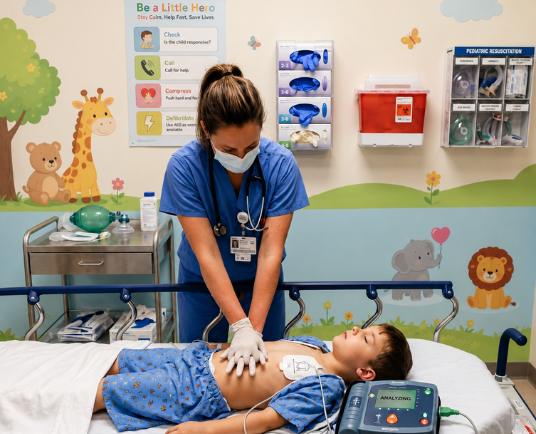
Medical emergencies involving children require both speed and accuracy, and understanding the Pediatric BLS Single Rescuer process allows healthcare professionals to provide the right treatment from the very beginning. Pediatric Basic Life Support (BLS) for Health Care Professionals Single Rescuer is a structured emergency response protocol for a trained provider caring for an infant or child up to puberty who is experiencing cardiac arrest, respiratory arrest, or another life-threatening condition. It focuses on recognizing the situation promptly, activating the emergency response system, performing high-quality CPR, and using an automated external defibrillator (AED) as soon as one is available. Because pediatric cardiac arrest is often caused by breathing problems, Pediatric BLS places equal importance on effective ventilation and chest compressions. Using the correct sequence of actions improves blood flow, oxygen delivery, and the patient’s chances of survival until advanced medical assistance becomes available.
The Pediatric BLS Single Rescuer Algorithm, developed by the American Heart Association and the American Academy of Pediatrics, follows a specific sequence of actions that begins with assessing the child’s responsiveness, breathing, and pulse. If needed, the rescuer starts CPR, provides rescue breaths, and uses an AED as soon as it becomes available. The rescuer continues these interventions while monitoring the child’s condition and providing care until additional help arrives or the situation changes. Following each step in the correct order helps ensure timely actions, prevents missed interventions, and supports effective resuscitation during pediatric emergencies.
Note: This pediatric basic life support (infants to puberty) for health care professionals-single rescuer algorithm guideline remains valid for the period 2025–2030.
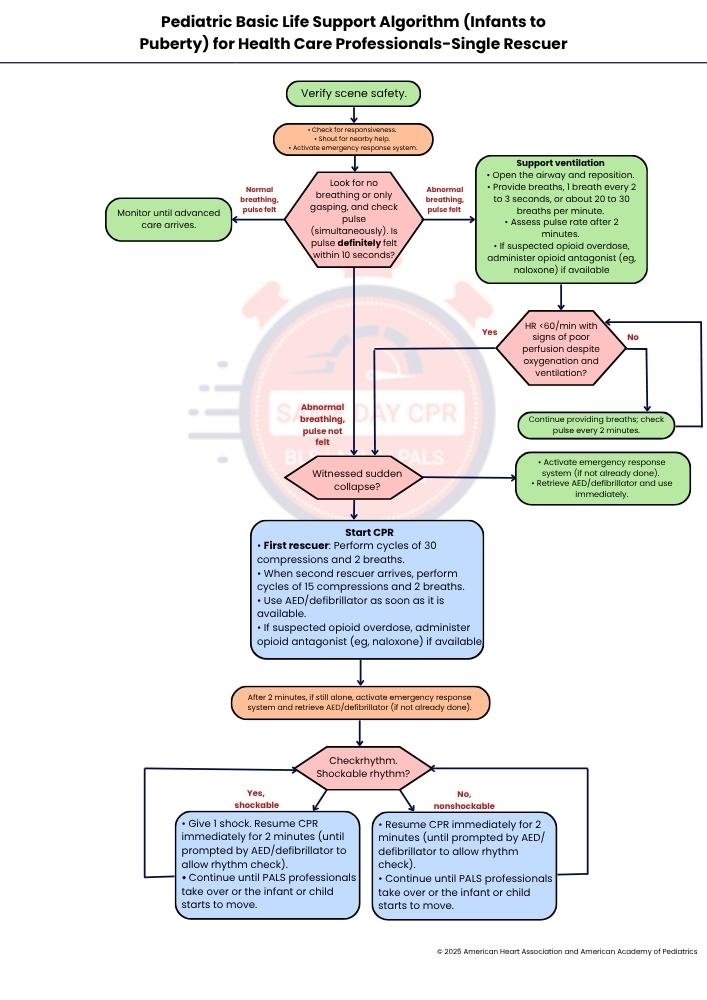
Step 1: Verify Scene Safety
Before helping an infant or child, ensure the area is safe for both you and the child. Look around for any dangers, such as traffic, fire, electrical hazards, or other unsafe conditions. Entering a dangerous scene can put you at risk and prevent you from providing effective care. Once you confirm that the environment is safe, you can move closer to the child and begin the emergency assessment.
Step 2: Check for Responsiveness
Start by checking whether the infant or child responds when you gently tap them and speak loudly. If there is no response, shout for nearby help to alert others that an emergency is happening. As soon as possible, activate the emergency response system so trained medical professionals are on the way. These early actions help ensure that advanced care arrives quickly while CPR is being started.
Step 3: Check Breathing and Pulse
Look for normal breathing, no breathing, or only gasping while checking for a pulse. Spend no more than 10 seconds deciding whether a pulse is definitely present. If the child has normal breathing and a pulse, proceed to Step 3a. If the child has abnormal breathing but still has a pulse, proceed to Step 3b. If the child has abnormal breathing and no pulse, immediately proceed to Step 5 to begin the next lifesaving actions.
Step 3a: Monitor Until Help Arrives
If the infant or child is breathing normally and has a pulse, continue to watch them closely until advanced medical care arrives. Keep monitoring their breathing, pulse, and level of responsiveness because their condition may change at any time. Be prepared to begin CPR immediately if they stop breathing normally or lose their pulse.
Step 3b: Support Ventilation
If the child has a pulse but is not breathing normally, provide rescue breathing to support ventilation. Open the airway and reposition the head if needed to help air move into the lungs. Give 1 breath every 2 to 3 seconds, which equals about 20 to 30 breaths each minute. Reassess the pulse after 2 minutes to make sure the heart is still beating. If an opioid overdose is suspected and naloxone is available, administer it according to local protocols while continuing supportive care.
Step 4: Assess Heart Rate
After providing oxygenation and ventilation, determine whether the heart rate is less than 60 beats per minute and whether there are signs of poor blood circulation. If the heart rate remains below 60 despite effective ventilation, proceed to Step 5 because CPR is needed. If the heart rate is 60 beats per minute or higher, proceed to Step 4a and continue monitoring the child’s condition.
Step 4a: Continue Rescue Breathing
Continue providing rescue breaths while checking the pulse every 2 minutes. This helps ensure the child’s condition remains stable and allows you to recognize any changes quickly. If the heart rate falls below 60 beats per minute with signs of poor perfusion, return to Step 4 and reassess whether CPR should be started.
Step 5: Determine Whether the Collapse Was Witnessed
Find out if someone saw the infant or child suddenly collapse. If the collapse was witnessed, proceed to Step 5a because the emergency response system should be activated immediately if it has not already been done. If no one witnessed the collapse, proceed directly to Step 6 and begin CPR without delay.
Step 5a: Activate Emergency Response and Retrieve the AED
If the collapse was witnessed, activate the emergency response system if it has not already been done. Then retrieve an automated external defibrillator (AED) or defibrillator and use it as soon as it is available. After these actions are completed, continue to Step 6 to begin CPR.
Step 6: Start CPR
Begin CPR immediately using the correct compression-to-ventilation ratio. If only one rescuer is present, perform cycles of 30 chest compressions followed by 2 breaths. When a second rescuer arrives, switch to cycles of 15 compressions and 2 breaths to improve CPR quality. Use the AED or defibrillator as soon as it becomes available. If an opioid overdose is suspected, administer naloxone if it is available while continuing CPR.
Step 7: Activate Emergency Response if Alone
If you are still alone after performing CPR for about 2 minutes, activate the emergency response system if it has not already been done. Retrieve the AED or defibrillator if one is available and bring it back to the child as quickly as possible. Then continue providing CPR until additional help arrives or the AED is ready for use.
Step 8: Check the Heart Rhythm
Once the AED or defibrillator is attached, allow it to analyze the heart rhythm. Determine whether the rhythm is shockable or nonshockable. If the AED identifies a shockable rhythm, proceed to Step 9. If it identifies a nonshockable rhythm, proceed to Step 10 and continue CPR.
Step 9: Treat a Shockable Rhythm
If the AED advises a shock, deliver 1 shock immediately. Resume CPR right away for 2 minutes without delay and continue until the AED prompts another rhythm check. Repeat this cycle until pediatric advanced life support professionals take over or the infant or child begins to move and show signs of life.
Step 10: Treat a Nonshockable Rhythm
If the AED determines that the rhythm is nonshockable, do not deliver a shock. Instead, resume CPR immediately for 2 minutes until the AED prompts another rhythm check. Continue alternating CPR with rhythm checks until pediatric advanced life support professionals take over or the infant or child begins to move and shows signs of life.
In short, knowing the Pediatric BLS Single Rescuer algorithm helps healthcare professionals respond quickly and provide effective care during pediatric emergencies. By following each step in the correct order, you can support breathing, maintain blood flow, and use an AED when needed while waiting for advanced medical care. Regular practice and staying familiar with the latest guidelines help build confidence and improve performance in stressful situations. A calm, organized response can make a meaningful difference and give infants and children the best possible chance of recovery.
Ready to build your skills? Same Day CPR offers BLS Certification classes with blended learning that combines online coursework and hands-on training, helping you gain the knowledge and confidence to respond when it matters most.