-
 30,000+ Students Sucessfully Trained Annually
-
30,000+ Students Sucessfully Trained Annually

-
30,000+ Students Sucessfully Trained Annually

 30,000+ Students Sucessfully Trained Annually
Medical emergencies involving infants and young patients require a rapid, organized, and coordinated response to improve survival outcomes. Pediatric Basic Life Support (BLS) for Health Care Professionals with two or more rescuers is a structured emergency approach prepared for infants and children up to puberty who experience cardiac arrest or severe breathing difficulties. It follows evidence-based guidelines that help healthcare providers evaluate the patient, call for assistance, deliver effective chest compressions, provide rescue breaths, and use an automated external defibrillator or manual defibrillator when available. When multiple trained rescuers are present, responsibilities can be divided efficiently to strengthen teamwork, limit pauses, and support continuous CPR until advanced care is provided.
The Pediatric BLS Two or More Rescuers Algorithm, developed by the American Heart Association and the American Academy of Pediatrics, offers a clear framework for managing pediatric cardiac emergencies. Instead of depending only on memory, healthcare professionals use this guide to make prompt decisions, organize team roles, and maintain effective resuscitation efforts. It outlines each phase of emergency care while encouraging clear communication and smooth coordination, allowing teams to provide reliable treatment during stressful situations.
Note: This pediatric basic life support (infants to puberty) for health care professionals—2 or more rescuers algorithm guideline remains valid for the period 2025–2030.
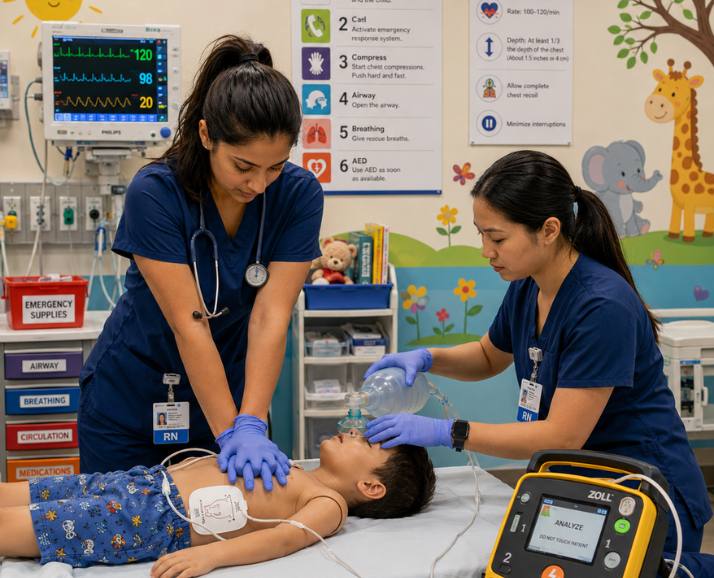
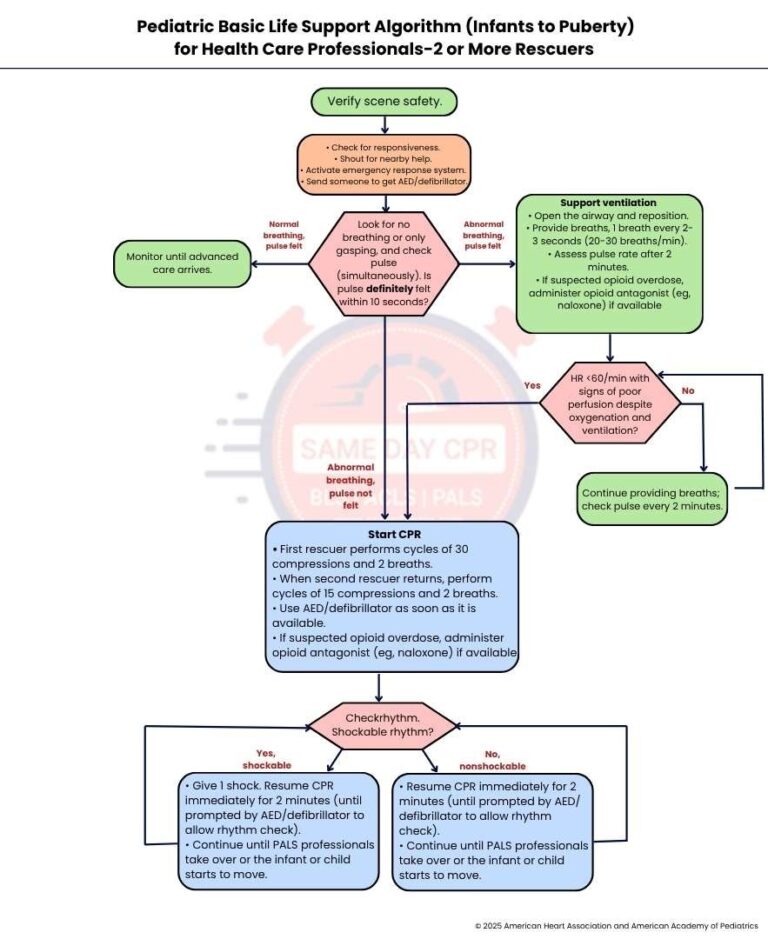
Understanding the Pediatric Basic Life Support algorithm helps healthcare professionals respond quickly and confidently during emergencies involving infants and children. Following each step in the correct order improves teamwork, supports timely care, and gives the child the best chance of a positive outcome.
Step 1: Verify Scene Safety
Before helping an infant or child, make sure the area is safe for both you and the victim. Look around for dangers such as traffic, fire, electrical hazards, or anything that could cause harm. Never rush into an unsafe environment because you could become another victim. Once you confirm the scene is safe, you can begin providing emergency care with confidence.
Step 2: Check for Responsiveness and Call for Help
Check if the infant or child responds by gently tapping and speaking loudly. If there is no response, shout for nearby help immediately and activate the emergency response system. If another person is present, ask them to bring an AED or defibrillator while you stay with the victim. These actions help ensure that advanced medical care and lifesaving equipment arrive as quickly as possible.
Step 3: Check Breathing and Pulse
Look for normal breathing or only gasping while checking the pulse. Complete both assessments within 10 seconds. If the child is breathing normally and has a pulse, move to Step 3a and continue monitoring. If the child has abnormal breathing but still has a pulse, proceed to Step 3b to provide rescue breaths. If the child has abnormal breathing and no pulse is felt, immediately continue to Step 5 and begin CPR.
Step 3a: Monitor the Child
If the infant or child is breathing normally and has a pulse, continue to observe their condition until advanced medical care arrives. Watch for any changes in breathing, responsiveness, or pulse. Be prepared to act quickly if the child’s condition worsens. Continuous monitoring helps ensure that emergency care can begin immediately if needed.
Step 3b: Support Ventilation
If the child has a pulse but is not breathing normally, open the airway and reposition the head if necessary to improve airflow. Provide one breath every 2 to 3 seconds, which equals about 20 to 30 breaths each minute. After 2 minutes, reassess the pulse to see if the condition has changed. If an opioid overdose is suspected and naloxone is available, administer it according to local guidelines while continuing to support breathing.
Step 4: Check the Heart Rate
After providing ventilation, determine whether the heart rate is less than 60 beats per minute and if there are signs of poor perfusion despite adequate oxygenation and ventilation. Poor perfusion may include weak pulses, pale skin, or poor circulation. If the heart rate is below 60 with these signs, move to Step 5 and start CPR. If the heart rate is above 60 and perfusion is adequate, continue to Step 4a.
Step 4a: Continue Rescue Breaths
If the heart rate remains above 60 beats per minute, continue giving rescue breaths while checking the pulse every 2 minutes. Keep monitoring the child’s condition because it can change quickly. Repeat this process by returning to Step 4 after each pulse check. Continue until the child improves or advanced medical care takes over.
Step 5: Start CPR
If the child has no pulse or the heart rate remains critically low with poor perfusion, begin CPR immediately. A single rescuer should perform cycles of 30 chest compressions followed by 2 rescue breaths. When a second rescuer arrives, switch to cycles of 15 compressions and 2 breaths. Use the AED or defibrillator as soon as it becomes available. If an opioid overdose is suspected and naloxone is available, administer it while continuing CPR.
Step 6: Check the Heart Rhythm
After performing CPR, use the AED or defibrillator to analyze the heart rhythm. The device will determine whether the rhythm is shockable or nonshockable. If the rhythm is shockable, continue to Step 7. If the rhythm is nonshockable, proceed to Step 8. Following the AED prompts helps ensure the correct treatment is given.
Step 7: Treat a Shockable Rhythm
If the AED identifies a shockable rhythm, deliver one shock as instructed by the device. Immediately resume CPR for 2 minutes without delay until the AED prompts another rhythm check. Continue repeating this cycle until pediatric advanced life support professionals take over or the infant or child begins to move and show signs of life. Prompt CPR after each shock improves the chances of successful resuscitation.
Step 8: Treat a Nonshockable Rhythm
If the AED identifies a nonshockable rhythm, do not deliver a shock. Instead, resume CPR immediately and continue for 2 minutes until the AED prompts another rhythm check. Keep repeating this cycle while following the device’s instructions. Continue providing CPR until pediatric advanced life support professionals arrive or the infant or child starts to move and shows signs of life.
In short, the Pediatric BLS Two or More Rescuers Algorithm gives healthcare professionals a clear and reliable path to follow during pediatric emergencies. By acting quickly, sharing responsibilities, and following each step in the correct order, rescuers can provide high-quality CPR, support breathing, and use a defibrillator without unnecessary delays. Strong teamwork and clear communication help every member stay focused and perform important tasks with confidence. Regular practice and familiarity with this algorithm prepare healthcare teams to respond calmly in stressful situations and provide the best possible care for infants and children until advanced medical support arrives.
Complete your training with Same Day CPR, where BLS Certification classes combine online coursework with hands-on training for a flexible learning experience. Enroll today and build the skills and confidence you need to respond effectively during pediatric emergencies.