



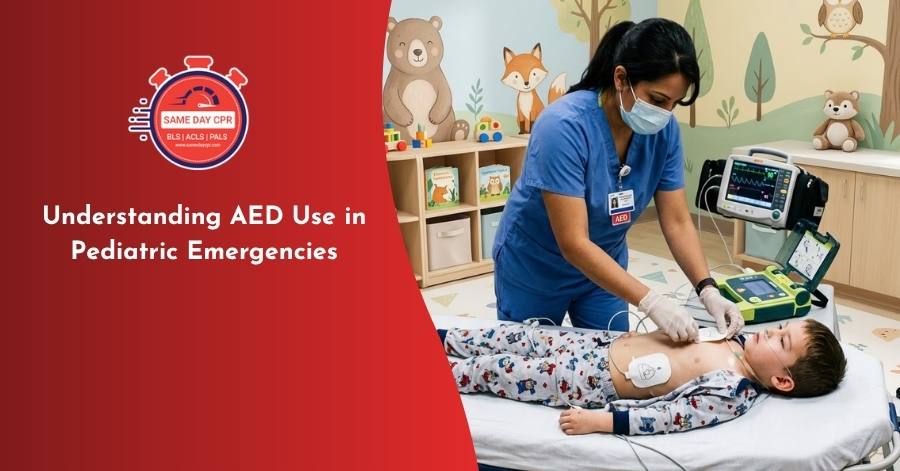
When a child experiences sudden cardiac arrest (SCA), immediate action can save their life. An Automated External Defibrillator (AED) is used to analyse the heart’s rhythm and, when necessary, deliver a controlled electric shock to restore a normal heartbeat. Although many people associate AEDs with adults, they are also safe and effective for children when used according to current resuscitation guidelines.
Understanding when and how to use an AED during a pediatric emergency can help parents, teachers, caregivers, coaches, and bystanders respond quickly while waiting for emergency medical services. This guide explains what an AED is, when it should be used on children, age-specific recommendations, proper pad placement, and important safety considerations.
What is an AED?
An Automated External Defibrillator (AED) is a portable medical device used to treat sudden cardiac arrest. It analyses the heart’s electrical rhythm and determines whether a defibrillation shock is required. If a shockable rhythm is detected, the AED guides the rescuer through the process of delivering the shock safely.
Modern AEDs are intended for use by both healthcare professionals and members of the public. They provide clear voice and visual prompts, making them easy to operate even with limited training. AEDs are commonly found in schools, sports facilities, shopping centres, airports, workplaces, and other public locations.
When Should an AED Be Used on a Child?
An AED should be used immediately if a child:
- Is unresponsive
- Is not breathing normally or is only gasping
- Shows no signs of circulation
Once emergency services have been contacted and CPR has begun, an AED should be applied as soon as it becomes available. The device will analyse the heart rhythm and advise whether a shock is necessary.
Early defibrillation, combined with prompt CPR, significantly improves the chances of survival in children experiencing sudden cardiac arrest.
Can AEDs Be Used on Children?
Yes. AEDs are safe and recommended for infants and children experiencing sudden cardiac arrest.
Although pediatric cardiac arrest is more commonly caused by respiratory problems than heart disease, some children develop shockable heart rhythms that require defibrillation. Current resuscitation guidelines recommend using an AED as soon as possible whenever a child is unresponsive, not breathing normally, and an AED is available.
The AED delivers a shock only when medically appropriate, preventing unnecessary shocks.
Before using an AED, it’s important to understand how a child is defined in terms of CPR/AED care, as the recommended pads and energy settings vary by age and size.
Pediatric AED Pads Age and Weight Guidelines
The choice between pediatric and adult AED settings depends on the child’s age, size, and available equipment.
| Age Group | AED Guidance |
|---|---|
| Infants Under 1 Year | A manual defibrillator is preferred when available. However, if only an AED is accessible, it should be used without delay. Pediatric pads or a pediatric energy attenuator are recommended. If unavailable, standard adult pads should be used rather than delaying treatment. |
| Children Aged 1–8 Years | Children between 1–8 years of age should ideally use pediatric AED pads or an AED with a pediatric mode, as these reduce the energy delivered. If pediatric equipment is unavailable, adult pads may be used immediately. |
| Children Over 8 Years or Over 25 kg (55 lbs) | Children older than 8 years or weighing more than approximately 25 kg (55 lbs) can generally be treated using standard adult AED pads and settings. When unsure, always follow the manufacturer’s instructions supplied with the AED. |
How to Use an AED During a Pediatric Emergency
Follow these steps if a child experiences sudden cardiac arrest:
- Ensure the Scene Is Safe: Check that there are no immediate dangers before approaching the child.
- Assess the Child: Confirm that the child is unresponsive and not breathing normally.
- Call Emergency Services: Call emergency medical services immediately or ask someone nearby to call while another person retrieves the AED.
- Begin CPR: Start CPR immediately and continue until the AED is ready.
- Turn On the AED: Power on the device and carefully follow the voice prompts.
- Attach the Pads: Expose the child’s chest and place the pads exactly as illustrated on the AED or pad packaging.
- Allow Rhythm Analysis: Ensure no one touches the child while the AED analyses the heart rhythm.
- Deliver the Shock If Advised: If instructed, ensure everyone is clear before pressing the shock button.
- Resume CPR: Immediately continue CPR after the shock or if no shock is advised. Follow the AED prompts until emergency responders arrive or the child recovers.
Correct AED Pad Placement for Children
Correct pad placement allows the AED to accurately analyse the heart rhythm and deliver effective defibrillation.
Anterior-Lateral Placement
Use this placement when the child’s chest is large enough.
- One pad below the right collarbone.
- One pad on the lower left side of the chest.
Anterior-Posterior Placement
Use this method when the child’s chest is too small for both pads to fit on the front.
- One pad in the centre of the chest.
- One pad on the back between the shoulder blades.
The pads should never touch or overlap.
Pediatric vs Adult AED Pads
Pediatric AED pads reduce the amount of energy delivered and are recommended for infants and young children.
If pediatric pads are unavailable, adult pads should be used immediately rather than delaying defibrillation. Rapid treatment is more important than waiting for specialised equipment.
AED Safety Tips for Children
To use an AED safely during a pediatric emergency:
- Apply pads to a bare, dry chest.
- Remove medication patches before placing the pads.
- Avoid placing pads directly over implanted medical devices such as pacemakers.
- Ensure nobody is touching the child during rhythm analysis or shock delivery.
- Follow all voice and visual prompts provided by the AED.
- Continue CPR immediately after every analysis or shock.
AEDs are equipped with built-in safety features and will only deliver a shock when a shockable rhythm is detected.
Common Mistakes to Avoid
Avoid these common errors when using an AED on a child:
- Delaying AED use while searching for pediatric pads.
- Incorrect pad placement.
- Touching the child during rhythm analysis.
- Failing to restart CPR immediately after the AED advises.
- Waiting for healthcare professionals before using an available AED.
Prompt action gives the child the best chance of survival.
Why Early AED Use Matters
Every minute without defibrillation reduces the likelihood of survival in sudden cardiac arrest. Using an AED as soon as possible, together with high-quality CPR, increases the chance of restoring a normal heart rhythm and improves neurological outcomes.
Because AEDs provide clear instructions and automatically determine whether a shock is needed, they enable even lay rescuers to respond confidently during pediatric emergencies.
Responding with Confidence in a Pediatric Emergency
In summary, knowing how to use an AED during a pediatric emergency can make a real difference when time is critical. Acting quickly, starting CPR, and using an AED as soon as it is available can give a child the best chance of survival before emergency teams arrive. The device is simple to use, gives clear instructions, and only delivers a shock when it is needed. Learning these basic steps helps parents, teachers, caregivers, coaches, and other community members feel more prepared to respond with confidence. A little knowledge today could help save a young life in the future.