




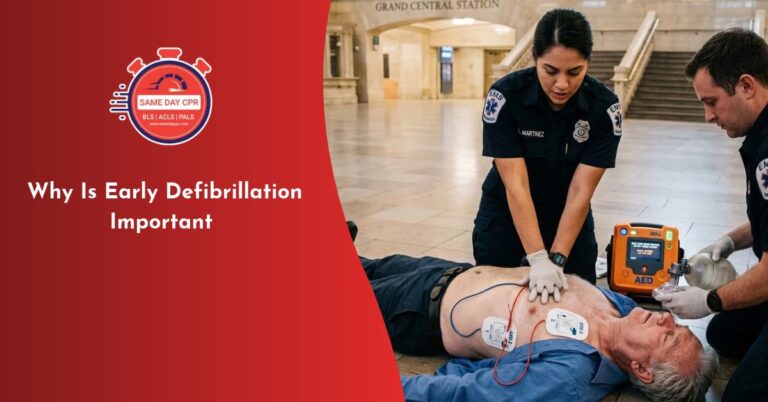
Early defibrillation is important because sudden cardiac arrest is a time-critical emergency in which the heart stops pumping blood effectively. Without immediate treatment, the brain and other vital organs receive inadequate blood flow and oxygen, increasing the risk of serious injury. When cardiac arrest results from a shockable rhythm, such as ventricular fibrillation (VF) or pulseless ventricular tachycardia (pVT), defibrillation can help restore an effective heart rhythm.
The sooner rescuers deliver an appropriate shock, the greater the opportunity to terminate the abnormal electrical rhythm and restore circulation. This is why rapid recognition of cardiac arrest, immediate high-quality CPR, activation of emergency medical services, and prompt use of an automated external defibrillator (AED) are essential parts of the cardiac arrest response.
Why Does Timing Matter During Cardiac Arrest?
Cardiac arrest causes blood flow to the brain and other vital organs to fall rapidly. Without adequate circulation, these organs do not receive the oxygen and nutrients they need to function. The longer the heart fails to maintain effective circulation, the greater the risk of permanent neurological and organ injury.
Rescuers should begin treatment as soon as possible. High-quality CPR helps maintain some blood flow while rescuers obtain an AED, and defibrillation can directly treat a shockable rhythm when one exists. As the time to effective treatment increases, the likelihood of successful resuscitation and favorable recovery generally decreases.
The importance of timing does not mean that a single survival percentage applies to every minute of delay. Outcomes vary according to the initial rhythm, whether bystander CPR is provided, CPR quality, the cause and duration of cardiac arrest, time to defibrillation, and subsequent medical care. The key principle is to minimize avoidable delays.
How Does Defibrillation Help?
Defibrillation treats certain life-threatening abnormal heart rhythms that can cause cardiac arrest. These are called shockable rhythms because an electrical shock may terminate the abnormal electrical activity and allow the heart’s normal electrical system to re-establish an organized rhythm.
Two common shockable rhythms are ventricular fibrillation (VF) and pulseless ventricular tachycardia (pVT).
In VF, the ventricles have chaotic electrical activity and quiver instead of contracting effectively. In pVT, the ventricles beat so rapidly that they cannot produce effective blood flow or a detectable pulse.
During defibrillation, the AED delivers an electrical shock through pads placed on the person’s chest. The shock briefly depolarizes the heart muscle and may terminate the abnormal rhythm. If successful, organized electrical activity can resume and may produce effective circulation.
Defibrillation is not appropriate for every cardiac arrest rhythm. An AED analyzes the heart rhythm and determines whether the person needs a shock. If the AED detects a non-shockable rhythm, it will not recommend a shock and will instead provide instructions for continuing the resuscitation response.
Why Is Early Defibrillation Critical for Shockable Rhythms?
Early defibrillation is particularly important when VF or pVT is present because the effectiveness of treatment depends strongly on the time between cardiac arrest and the first appropriate shock.
When a shockable rhythm persists, the person does not have effective circulation. As cardiac arrest continues, prolonged lack of blood flow can cause increasing injury to the brain and other vital organs. Delaying defibrillation therefore reduces the opportunity for successful rhythm conversion and recovery.
Rapid access to an AED can shorten the time between cardiac arrest and defibrillation. However, rescuers should use an AED as part of a coordinated response rather than as a replacement for CPR or professional medical care.
When cardiac arrest is suspected, rescuers should recognize the emergency, activate emergency medical services, begin high-quality CPR, and use an AED as soon as it is available. CPR helps maintain circulation while rescuers obtain the AED, while defibrillation addresses the shockable electrical rhythm when one exists.
How Do AEDs Make Early Defibrillation Possible?
Automated external defibrillators (AEDs) make early defibrillation possible by allowing rescuers to assess and, when appropriate, treat a person’s heart rhythm before emergency medical services arrive.
After rescuers place the electrode pads on the person’s chest, the AED analyzes the heart rhythm. If it detects a shockable rhythm such as VF or pVT, it will instruct the rescuer to deliver a shock or deliver the shock automatically, depending on the device. If the rhythm is not shockable, the AED will not recommend a shock and will provide instructions for continuing CPR.
AED availability and accessibility therefore play an important role in early defibrillation. An AED that is nearby, clearly identified, accessible without unnecessary delay, and properly maintained can help reduce the time to the first appropriate shock.
Public-access AED programs make these devices available in locations such as workplaces, schools, airports, sports facilities, and other public areas where cardiac arrest can occur.
Why Are CPR and Defibrillation Both Important?
CPR and defibrillation serve different but complementary purposes during cardiac arrest.
High-quality CPR provides chest compressions that help circulate blood to the brain and other vital organs while the heart is not pumping effectively. CPR does not terminate VF or pVT, but it can help maintain circulation while rescuers locate, prepare, and use an AED.
Defibrillation, in contrast, delivers an electrical shock intended to terminate a shockable rhythm and allow organized electrical activity to return. It is not effective for non-shockable rhythms such as asystole or pulseless electrical activity (PEA).
For this reason, rescuers should not view CPR and defibrillation as interchangeable. When cardiac arrest is suspected, rescuers should begin CPR, activate emergency medical services, and use an AED as soon as it is available.
What Happens When Defibrillation Is Delayed?
When rescuers delay defibrillation during a shockable cardiac arrest, the person remains without effective circulation for longer. This prolongs inadequate blood flow to the brain and other vital organs and can increase the risk of neurological and organ injury.
A prolonged cardiac arrest can also reduce the opportunity for successful resuscitation. For VF or pVT, defibrillation is the treatment that directly addresses the abnormal electrical rhythm. The longer rescuers delay an effective shock, the less likely successful rhythm conversion generally becomes.
Even when defibrillation successfully restores an organized heart rhythm, the person’s recovery depends on factors such as how long the person lacked effective circulation, how quickly rescuers started CPR, the underlying cause of the arrest, and the quality and timing of subsequent medical care.
Therefore, rescuers should combine rapid defibrillation with immediate CPR and prompt professional medical treatment whenever they suspect cardiac arrest.
Early Defibrillation and the Chain of Survival
Immediate defibrillation is an important part of the Chain of Survival, in which several coordinated actions work together to improve outcomes after sudden cardiac arrest.
- Recognition: Recognize cardiac arrest quickly when a person is unresponsive and not breathing normally or is only gasping.
- Emergency activation: Activate emergency medical services immediately so professional help can be dispatched.
- CPR: Start high-quality CPR promptly to help maintain blood flow to the brain and other vital organs.
- Rapid defibrillation: Use an AED as soon as it is available. If the AED detects a shockable rhythm, deliver the indicated shock promptly.
- Advanced care: Emergency medical professionals provide advanced resuscitation and identify and treat potentially reversible causes of cardiac arrest.
- Post-cardiac-arrest care: After medical professionals restore circulation, continued medical care helps stabilize the person, protect vital organs, monitor for complications, and address the underlying cause.
Early defibrillation does not work in isolation. The best response to cardiac arrest combines rapid recognition, emergency activation, high-quality CPR, prompt AED use, advanced resuscitation, and appropriate post-cardiac-arrest care.
The Role of Early Defibrillation in Cardiac Arrest
In short, early defibrillation is important because cardiac arrest is highly time-sensitive, and a shockable rhythm can become more difficult to treat successfully as time passes. When VF or pVT is present, an appropriate electrical shock can terminate the abnormal rhythm and give the heart an opportunity to regain an organized rhythm.
Using an AED as soon as it is available, while providing high-quality CPR and activating emergency medical services, helps minimize treatment delays. The central principle is simple: recognize cardiac arrest quickly, start CPR immediately, and provide defibrillation as soon as possible when a shockable rhythm is present.
If you want to build your CPR skills and feel more prepared for emergencies, Same Day CPR offers AHA-certified CPR courses in BLS, ACLS, and PALS through a convenient blended learning format. You’ll complete the coursework online, then come in for hands-on training where you can practice and demonstrate your skills in person.