


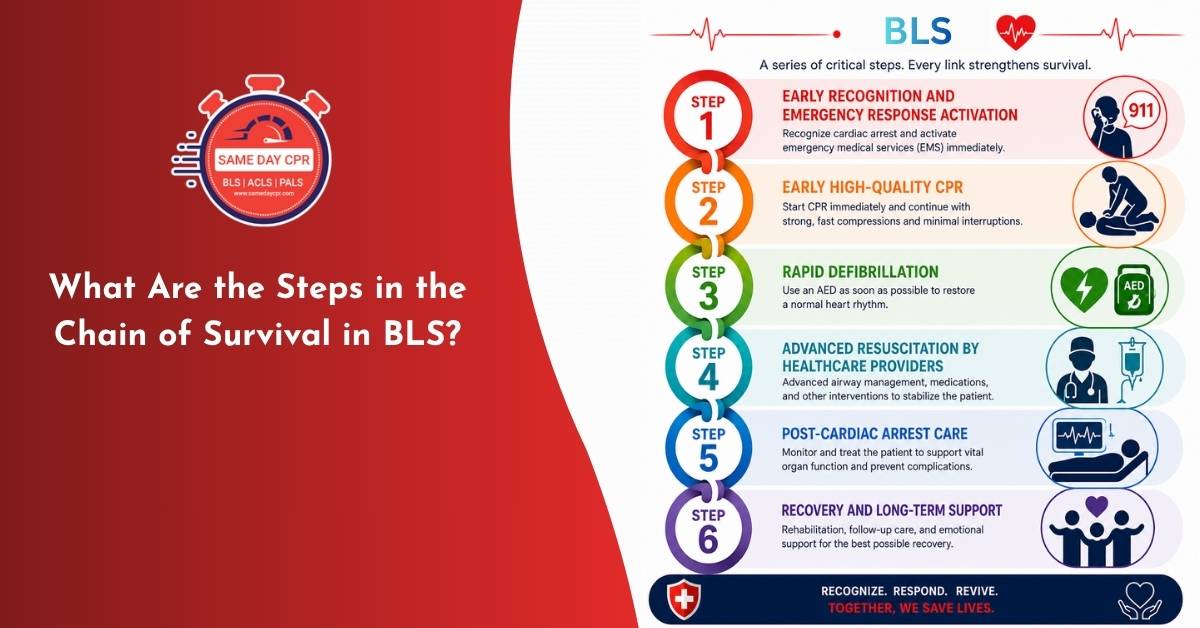
The Chain of Survival in Basic Life Support (BLS) describes a series of important actions that improve the chance of survival for a person who suffers a sudden cardiac arrest. These actions are promoted by the American Heart Association (AHA), and the 2025 guidelines update them to reflect the most effective ways to save lives.
Cardiac arrest happens when the heart suddenly stops pumping blood. When this occurs, the brain and other organs do not get oxygen. Without quick help, the person can die within minutes. This framework helps people understand what to do in order and why each step matters. Every link in the chain supports the next one. If one link is delayed or missing, the chance of survival drops.
In this article, we will explore each step of this life-saving process in a simple and friendly way. We will also look at both out-of-hospital and in-hospital settings so you can understand how emergency care works in different situations.
Understanding the Chain of Survival
The BLS Chain of Survival is a model used in emergency care to guide actions during cardiac arrest. It focuses on quick recognition, fast response, and continuous care. The idea is simple. The faster a person receives help, the better their chance of survival and recovery.
This emphasizes that everyone can be part of this chain. It is not only for doctors or nurses. Bystanders, family members, and community members can all play a role.
Let us now go through each step in detail.
Step 1: Early Recognition and Emergency Response Activation
The first step is to recognize that a cardiac arrest is happening. This means checking if the person is unresponsive and not breathing normally. They may be gasping or not moving at all.
Once you recognize the emergency, you must call for help immediately. This means contacting emergency medical services without delay. Quick action is very important because every minute without help reduces survival chances.
In many cases, dispatchers can guide you through the next steps while help is on the way. Staying calm and following instructions can make a big difference.
Step 2: Early High-Quality CPR
The second step is starting cardiopulmonary resuscitation, often called CPR. It helps to keep blood and oxygen moving through the body when the heart has stopped.
Chest compressions are the most important part of CPR. You push hard and fast in the center of the chest. This helps maintain circulation to the brain and heart.
The goal is to begin CPR as soon as possible. Even if you are not trained, doing chest compressions can still help save a life. The key idea is to avoid delay. Continuous compressions help keep vital organs alive until more advanced care arrives.
Step 3: Rapid Defibrillation
The third step is rapid defibrillation. This involves using an automated external defibrillator, a device that checks the heart rhythm and gives an electric shock if needed.
Many cardiac arrests are caused by an abnormal heart rhythm that can sometimes be corrected with a shock. The faster this shock is delivered, the higher the chance that the heart can return to a normal rhythm.
Automated external defibrillators, or AEDs, are designed to be simple. They give voice instructions, so even people without medical training can use them. Public places such as airports, schools, and shopping centers often have these devices available.
Quick access to defibrillation is one of the strongest predictors of survival.
Step 4: Advanced Resuscitation by Healthcare Providers
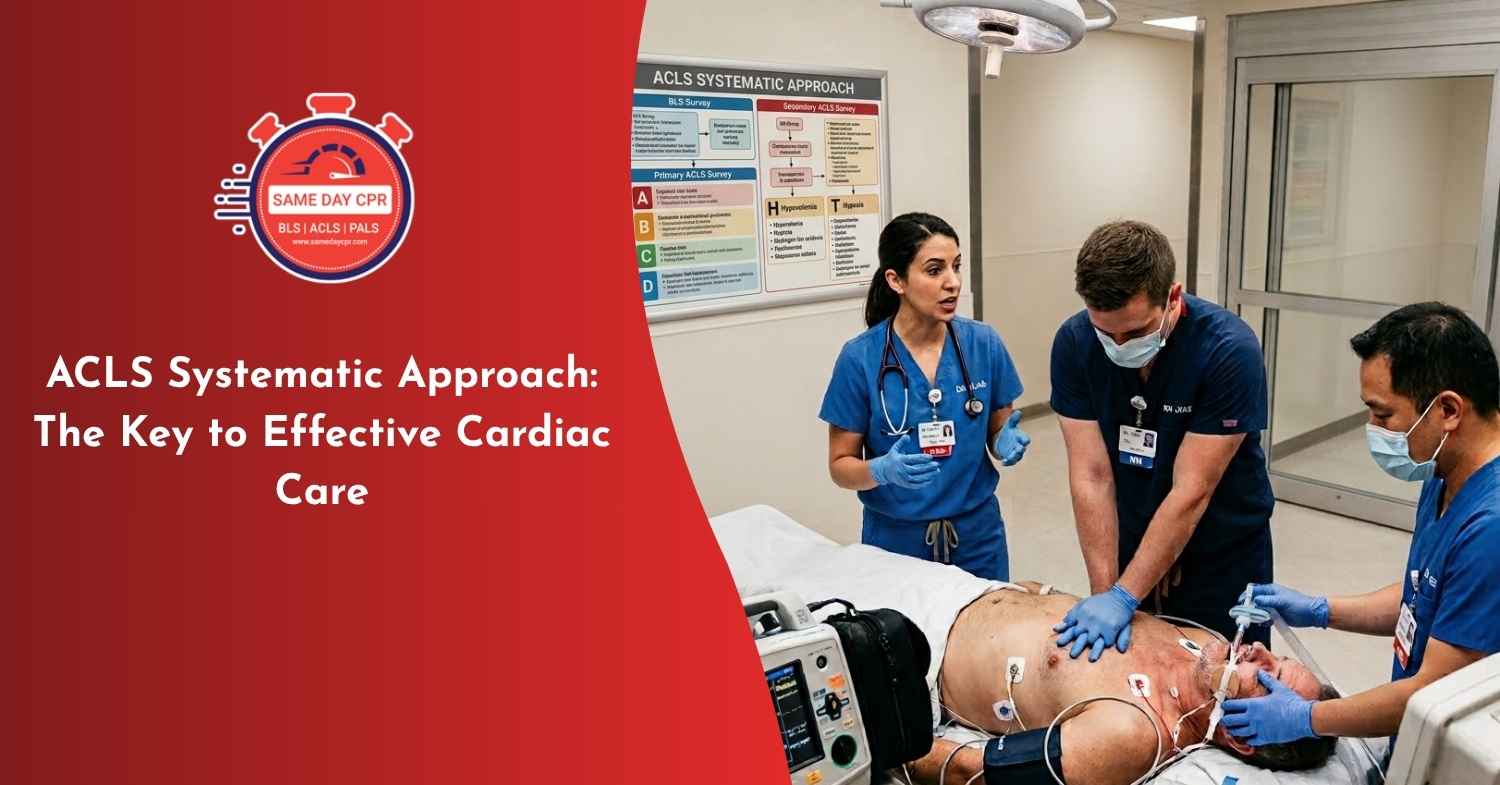
The fourth step involves advanced care provided by trained medical professionals. This includes paramedics, emergency doctors, and hospital teams.
At this stage, healthcare providers continue CPR, give medications, and use advanced tools to support breathing and circulation. They also try to identify the cause of the cardiac arrest.
Advanced resuscitation focuses on stabilizing the patient and restoring heart function. It builds on the early actions taken by bystanders and first responders.
Step 5: Post-Cardiac Arrest Care
If the heart starts beating again, the next step is post-cardiac arrest care. This phase is very important for recovery.
The patient is usually taken to a hospital where doctors monitor brain function, heart activity, and other vital signs. They may use specialized treatments to reduce damage caused by a lack of oxygen.
Care teams also work to prevent another cardiac arrest. They treat the underlying cause and support the patient’s organs as they recover.
This step is critical because survival is not just about restarting the heart. It is also about protecting brain function and improving long-term health.
Step 6: Recovery and Long-Term Support
The final step is rehabilitation and ongoing support. This includes physical healing, emotional care, and lifestyle adjustment.
Many survivors need therapy to regain strength and improve daily functioning. Some may also need counseling to cope with emotional stress after the event.
Family members often play an important role during this phase. Education about heart health, medications, and lifestyle changes can help reduce the risk of future cardiac events. Recovery does not end when the patient leaves the hospital. It continues at home and in the community.
In-Hospital Emergency Response
While the steps above apply mainly to out-of-hospital emergencies, hospitals follow a similar sequence. Since patients already have access to medical care, response times can be faster.
The in-hospital process includes early recognition of deterioration, immediate response by rapid response teams, prompt CPR, rapid defibrillation, advanced resuscitation, and post-cardiac arrest care. Hospitals focus heavily on monitoring patients so that cardiac arrest can be prevented whenever possible.
Why the BLS Chain of Survival Matters
Surviving cardiac arrest depends on timing and teamwork. Each step strengthens the next. Early recognition enables quick action, CPR keeps blood flowing, defibrillation restores rhythm, advanced care stabilizes the patient, and rehabilitation supports full recovery.
Survival rates improve significantly when these steps are followed without delay. Communities that train more people in CPR and AED use consistently see better outcomes.
The Role of Everyday People
One of the most powerful messages of Basic Life Support is that ordinary people can save lives. You do not need to be a healthcare worker to make a difference.
If you recognize cardiac arrest, you can call for help. If you know CPR, you can start chest compressions. If an automated external defibrillator is nearby, you can use it. These simple actions can double or even triple survival chances.
Training and awareness are key. Many organizations offer short courses that teach CPR and emergency response skills.
Saving Lives Through the BLS Chain of Survival
In short, the Chain of Survival in Basic Life Support shows how fast and organized action can save a life during sudden cardiac arrest. It starts with noticing the emergency early and calling for help right away, then moves to strong and continuous chest compressions to keep blood flowing. The next step is using an automated external defibrillator as soon as possible to help restart a normal heart rhythm. After that, trained medical teams take over with advanced care to stabilize the person and treat the cause. Recovery continues in the hospital and at home with support, rehabilitation, and healthy lifestyle changes. Each step works together to give the person the best chance to survive and heal. When people act quickly and confidently, they help protect the brain, improve recovery, and greatly increase the chance of survival.