



Choking is a medical emergency that can become life-threatening within minutes if an object completely blocks the airway. When a person cannot breathe, speak, or cough, immediate action is essential. The Heimlich maneuver, also called abdominal thrusts, is a first-aid technique that helps remove an object blocking the airway in a responsive person with severe choking. Knowing when and how to perform the Heimlich maneuver can help restore breathing while emergency medical services are on the way.
This guide explains what the Heimlich maneuver is, how to recognize severe choking, when to use it, the correct steps for different age groups, situations when it should not be used, and ways to help prevent choking.
What Is the Heimlich Maneuver?
The Heimlich maneuver is a first-aid technique designed to remove a foreign object blocking a person’s airway. It uses quick inward and upward abdominal thrusts to increase pressure inside the chest, helping force the object out of the airway.
Use the Heimlich maneuver only for responsive adults and children older than 1 year who have severe choking and cannot breathe, speak, or cough effectively. Although it can save a life, performing it unnecessarily or incorrectly may cause injury. Do not use abdominal thrusts for infants younger than 1 year. Instead, use infant choking first aid with back blows and chest thrusts.
How to Recognize Severe Choking
Before performing the Heimlich maneuver, determine whether the person’s airway is completely blocked. A person with mild choking can usually cough forcefully or speak and should continue coughing to clear the obstruction naturally.
Signs of severe choking include:
- Inability to speak or make sounds
- Inability to cough or only weak, ineffective coughing
- Difficulty breathing or inability to breathe
- Clutching the throat with one or both hands (the universal choking sign)
- Bluish lips, face, or fingertips due to lack of oxygen
- Panic or visible distress
- Loss of consciousness if the blockage is not removed
Infants younger than 1 year may not show the universal choking sign. Instead, they may have a weak cry, difficulty breathing, bluish skin or lips, limpness, or become unresponsive.
If the person cannot breathe, speak, or cough, treat the situation as a severe choking emergency and act immediately.
When to Perform the Heimlich Maneuver
Use the Heimlich maneuver only when a responsive person older than 1 year has a complete airway obstruction caused by a foreign object.
Before performing the maneuver:
- Determine whether the person can cough, speak, or breathe.
- Encourage forceful coughing if they can still cough effectively.
- If they cannot cough, speak, or breathe, call 911 or ask someone nearby to call while you begin first aid.
- Perform abdominal thrusts immediately if the airway is completely blocked.
For pregnant people or people with severe obesity, use chest thrusts instead of abdominal thrusts. For infants younger than 1 year, use alternating back blows and chest thrusts rather than the Heimlich maneuver.
Steps to Perform the Heimlich Maneuver
When someone is choking, quick action can make a big difference. Learning the right steps helps you respond with confidence and give safe first aid until emergency help arrives.
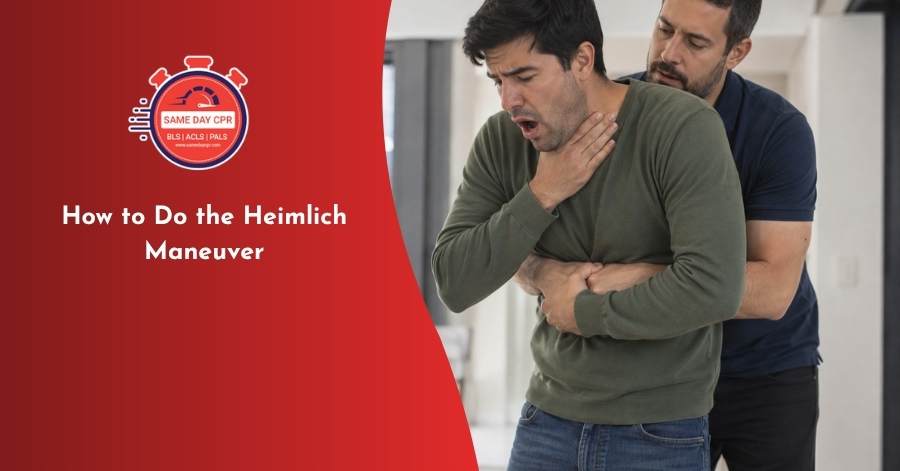
How to Perform the Heimlich Maneuver on Adults and Children Older Than 1 Year
If the person has severe choking:
- Stand behind the person and wrap your arms around their waist.
- Make a fist with one hand and place the thumb side just above the navel and below the breastbone.
- Grasp your fist with your other hand.
- Deliver quick, firm inward and upward thrusts into the upper abdomen.
- Repeat abdominal thrusts until the object is expelled or the person becomes unconscious.
- If the person becomes unconscious, call 911 if this has not already been done and begin CPR (cardiopulmonary resuscitation) if you are trained.
Chest Thrusts for Pregnant People
Do not use abdominal thrusts during pregnancy.
Instead:
- Stand behind the person.
- Place your arms beneath the armpits.
- Position your hands on the center of the breastbone.
- Deliver quick chest thrusts straight backward.
- Continue until the object is expelled or the person becomes unconscious.
- Begin CPR if appropriate while waiting for emergency medical services.
How to Help a Choking Infant Younger Than 1 Year
Do not perform the Heimlich maneuver on infants.
Instead:
- Hold the infant face-down along your forearm while supporting the head and neck.
- Give five firm back blows between the shoulder blades.
- Turn the infant face-up while continuing to support the head.
- Give five chest thrusts using two fingers placed in the center of the chest just below the nipple line.
- Alternate five back blows and five chest thrusts until the object is removed or the infant becomes unresponsive.
- If the infant becomes unconscious, begin infant CPR if you are trained and call 911 immediately.
How to Perform the Heimlich Maneuver on Yourself
If you are alone and choking:
- Call 911 if possible.
- Place a fist above your navel and below your breastbone.
- Grasp your fist with your other hand.
- Deliver quick inward and upward abdominal thrusts on yourself.
- If needed, lean forcefully over the back of a sturdy chair, countertop, or another firm object so it presses against your upper abdomen.
- Continue until the object is expelled or help arrives.
After a choking episode, it’s important to monitor for lingering symptoms. Read our guide on what to do after a choking incident for the next steps and recovery advice. Seek medical evaluation if you continue to have throat pain, chest pain, difficulty swallowing, or breathing problems.
When Not to Use the Heimlich Maneuver
Do not use the Heimlich maneuver when:
- The person can cough forcefully or speak.
- The airway is only partially blocked.
- The choking person is an infant younger than 1 year.
- The person is pregnant (use chest thrusts instead).
- The person is unconscious (begin CPR instead).
- Breathing difficulty results from swelling, an allergic reaction, or another medical condition rather than a foreign object blocking the airway.
Using abdominal thrusts unnecessarily may cause injury without providing any benefit.
What If the Person Becomes Unconscious?
If a choking person becomes unconscious:
- Call 911 immediately or have someone nearby call.
- Carefully lower the person onto their back.
- Begin CPR if you are trained.
- Each time you open the airway during CPR, look for a clearly visible object. If you can see and easily remove it, do so. Do not perform a blind finger sweep because it can push the object deeper into the airway.
- Continue CPR until the person begins breathing, the obstruction is removed, or emergency medical personnel take over.
Even if the person regains consciousness after the object is removed, they should receive a medical evaluation to check for possible injuries or a remaining airway obstruction.
When to Seek Emergency Care
Call 911 immediately if:
- The person cannot breathe, speak, or cough.
- The airway remains blocked despite first-aid efforts.
- The person becomes unconscious.
- The lips or face turn blue or gray.
- The object cannot be removed.
Seek medical evaluation after the choking episode if the person:
- Continues to cough or wheeze.
- Has ongoing difficulty swallowing.
- Feels that something is still stuck in the throat.
- Experiences chest, throat, or abdominal pain after abdominal thrusts.
- Develops fever, persistent cough, or breathing problems after the incident.
Prompt medical assessment can identify injuries or a persistent airway obstruction that requires treatment.
Causes of Choking
Choking occurs when food, liquids, or another object blocks the airway and prevents air from reaching the lungs.
Common causes include:
- Eating too quickly
- Taking large bites of food
- Talking or laughing while chewing
- Foods such as large pieces of meat, grapes, hot dogs, nuts, popcorn, and hard candy
- Alcohol or medications that impair swallowing or alertness
Certain medical conditions can also increase the risk of choking, including:
- Swallowing disorders (dysphagia)
- Stroke or neurological disorders
- Poorly fitting dentures or missing teeth
- Tumors or swelling that narrow the airway
Recognizing these risk factors can help reduce the likelihood of choking emergencies.
Prevention of Choking
Many choking incidents can be prevented by practicing safe eating habits and taking simple precautions.
To reduce the risk of choking:
- Chew food thoroughly before swallowing.
- Take small bites and eat slowly.
- Avoid talking or laughing while chewing.
- Sit upright during meals.
- Cut foods such as grapes, cherry tomatoes, and hot dogs into small pieces for young children.
- Avoid giving hard candy, whole nuts, popcorn, chewing gum, or other high-risk foods to children younger than 4 years.
- Keep coins, batteries, buttons, marbles, and other small objects out of children’s reach.
- Ensure dentures fit properly if you wear them.
- Follow medical advice if you have a swallowing disorder.
- Learn basic first aid and CPR so you can respond confidently during a choking emergency.
Knowing how to recognize severe choking and perform the Heimlich maneuver correctly can save a life. Acting quickly, calling 911, and providing the appropriate first aid can improve the chances of a successful outcome while reducing the risk of serious complications.
Be Ready to Act During a Choking Emergency
In short, the Heimlich maneuver is a simple first aid skill that can make a big difference during a choking emergency. Knowing the signs of severe choking and using the correct steps for the person’s age and situation can help restore breathing until emergency help arrives. It is also important to remember when not to use this technique and when to start CPR or use other first aid methods instead. Learning these skills and staying calm during an emergency can help you respond with confidence. With quick action, proper training, and safe eating habits, you can help protect yourself and others from the serious dangers of choking.