




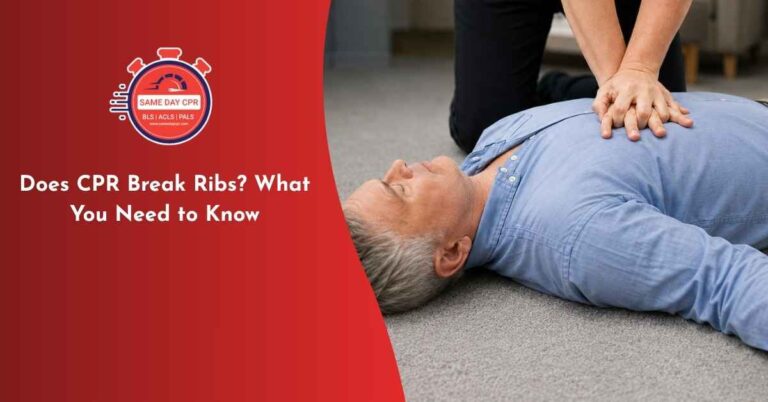
Yes, CPR (Cardiopulmonary Resuscitation) can cause a rib fracture or a fracture of the breastbone (sternum). This is a recognized complication of chest compressions because CPR requires firm, repeated pressure on the chest to circulate blood during cardiac arrest. A broken rib does not automatically mean CPR was performed incorrectly.
During cardiac arrest, starting effective CPR quickly is far more important than avoiding a possible chest injury. Without CPR, the brain and other vital organs can quickly be deprived of oxygen and blood flow.
If you hear or feel a crack during CPR, do not deliberately make the compressions shallower or stop solely because you are concerned about a broken rib. Continue providing effective CPR according to current guidance unless there is another valid reason to stop.
This article explains why ribs can break during CPR, how common these injuries are, whether a broken rib means CPR was performed incorrectly, what to do if you suspect a fracture, and what may happen after resuscitation.
Why Does CPR Sometimes Break Ribs?
Ribs can break during CPR because chest compressions place substantial mechanical force on the chest. That force is necessary to help circulate blood when the heart is no longer pumping effectively, but it can also place stress on the ribs and sternum.
Chest Compressions Put Pressure on the Chest
During CPR, the rescuer repeatedly presses on the center of the chest, over the lower half to lower third of the sternum. These compressions help generate blood flow during cardiac arrest.
Because compressions need to be sufficiently deep and consistent, they can place significant stress on the ribs and breastbone. A fracture can therefore occur even when the rescuer is using appropriate technique.
A rib fracture by itself is not proof that the rescuer pushed too hard or performed CPR incorrectly.
Age and Bone Strength May Affect Injury Risk
The likelihood of a rib injury can vary from person to person. Factors such as age, bone strength, chest structure, and the characteristics of the resuscitation may affect the risk of fracture.
Older adults and people with more fragile bones may be particularly susceptible to chest injury. However, rib fractures can occur in people who do not have known bone weakness.
This means that the same chest compressions may cause a fracture in one person but not another.
How Common Are Rib Fractures During CPR?
Rib fractures are a well-recognized injury following CPR. Reported rates vary between studies because researchers use different patient populations, resuscitation circumstances, and methods for identifying injuries.
A 2024 systematic review and meta-analysis of 74 studies involving 16,629 patients found that rib fractures occurred in about 55% of patients who underwent CPR for non-traumatic cardiac arrest. The same review found that any CPR-related injury occurred in about 60% of patients and that sternal fractures occurred in about 24%. Source: PubMed Central (PMC)
These figures should not be interpreted as meaning that every CPR attempt causes a fracture. The reported rate varies substantially between studies, and the likelihood of detecting an injury can depend on how and when patients are examined.
The important point is that rib fractures are a recognized consequence of chest compressions and can occur even when CPR is performed appropriately.
Does a Broken Rib Mean CPR Was Done Wrong?
No. A broken rib does not necessarily mean CPR was performed incorrectly.
Effective CPR requires firm, repeated chest compressions. The mechanical force needed to generate blood flow can place substantial stress on the ribs and sternum. Fractures can therefore occur even when the rescuer follows appropriate technique.
A crack or popping sensation is not proof that the rescuer used excessive force. It may indicate that the chest structures sustained an injury during otherwise appropriate compressions.
There is an important difference between a recognized complication and poor CPR technique. CPR can be performed correctly and still cause a rib fracture. Poor technique, by contrast, can include incorrect hand placement, inadequate or excessive compression depth, an inappropriate compression rate, incomplete chest recoil, or unnecessary interruptions.
The possibility of a fracture should not cause rescuers to intentionally reduce the quality of chest compressions.
What Should You Do If You Hear or Feel a Rib Crack During CPR?
Hearing or feeling a crack, pop, or sudden change in chest resistance during CPR can be alarming. However, a suspected rib fracture is not, by itself, a reason to stop CPR.
If the person remains in cardiac arrest, continue chest compressions. Do not deliberately make compressions shallower or stop because you are concerned about causing a fracture.
Maintain appropriate hand placement over the center of the chest and continue using the recommended compression rate, depth, and technique. Avoid repeatedly checking the chest or changing hand position because of a suspected fracture, as unnecessary interruptions can reduce the effectiveness of CPR.
Continue CPR until an appropriate reason to stop arises, for example, the person shows signs of life, a trained responder takes over, you become unable to continue, the scene becomes unsafe, or emergency personnel or a dispatcher directs you otherwise.
If an automated external defibrillator (AED) is available, turn it on and follow its voice or visual instructions. Resume CPR as directed.
The priority during ongoing cardiac arrest is maintaining effective circulation and oxygen delivery. Possible chest injuries can be assessed after professional medical care becomes available.
What Does a Rib Fracture From CPR Feel Like?
A person who survives cardiac arrest and regains consciousness may experience chest pain or tenderness after CPR. Discomfort may be more noticeable when moving, coughing, sneezing, or taking a deep breath.
Possible symptoms of a rib fracture include:
- Sharp or aching chest pain
- Tenderness when the affected area is touched
- Pain that increases with deep breathing, coughing, or movement
- Difficulty taking a full breath because of pain
- Swelling or bruising around the chest in some cases
A person experiencing cardiac arrest is generally unconscious and cannot describe pain while CPR is being performed. Symptoms related to a rib injury are therefore more likely to become apparent after the person regains consciousness.
However, chest pain or breathing difficulty after resuscitation should not automatically be attributed to a broken rib. Cardiac arrest and resuscitation can involve other medical conditions and injuries that may also cause chest discomfort or difficulty breathing.
Anyone who has been successfully resuscitated requires appropriate medical assessment. Healthcare professionals can determine the likely cause of symptoms and assess for complications.
Severe chest pain, significant difficulty breathing, worsening symptoms, coughing up blood, confusion, or other concerning changes require prompt medical attention.
What Happens After CPR If Ribs Are Broken?
If a rib fracture is suspected after successful resuscitation, the person should receive appropriate medical assessment.
A rib fracture may be painful but is not necessarily life-threatening on its own. However, significant chest trauma can occur alongside other injuries or complications, so healthcare professionals should assess the person’s overall condition rather than assuming that all post-CPR chest pain is caused by a broken rib.
Medical Assessment
After resuscitation, healthcare professionals may assess the chest for:
- Rib or sternal fractures
- Bruising and tenderness
- Breathing difficulties
- Other signs of chest injury
Assessment may involve a physical examination and, when clinically appropriate, imaging or other diagnostic tests.
This is important because chest pain and breathing difficulty after CPR can have several possible causes. Medical professionals may need to determine whether the symptoms are related to the chest wall, lungs, heart, or another condition.
Treatment and Recovery
Treatment for a CPR-related rib fracture depends on the location and severity of the injury, the person’s breathing, any other injuries, and their overall medical condition.
Many uncomplicated rib fractures can be managed with appropriate pain control, monitoring, and time for healing. Pain management is important because severe pain can make deep breathing and coughing difficult.
If breathing is significantly affected, additional respiratory support or closer monitoring may be necessary.
Recovery varies from person to person. Healthcare professionals may provide individualized advice about pain management, breathing, activity, and follow-up.
Potential Complications
Most rib fractures do not cause serious complications, but significant chest trauma can sometimes interfere with breathing or injure structures inside the chest.
A 2024 systematic review found that pulmonary contusion was the most common pulmonary injury reported after CPR, with a pooled prevalence of about 20%. Source: PubMed Central (PMC)
Seek prompt medical attention for symptoms such as:
- Worsening chest pain
- Significant shortness of breath or difficulty breathing
- Coughing up blood
- Confusion
- Fainting or marked deterioration
- Other new or worsening symptoms
The purpose of medical assessment is not only to identify a possible broken rib but also to make sure the person is breathing adequately and that more serious complications have not been overlooked.
Can You Perform CPR Without Breaking Ribs?
There is no way to guarantee that CPR will not cause a rib fracture. Chest compressions place substantial mechanical force on the chest, and some people may be more susceptible to injury.
The goal should not be to make compressions gentler simply to avoid breaking a rib. Effective CPR depends on compressions that are sufficiently deep and consistent to circulate blood.
Instead, rescuers should focus on the fundamentals of high-quality CPR.
For an average adult, current AHA guidance recommends:
- Correct hand position: Place the heel of one hand in the center of the chest, over the lower half to lower third of the sternum, with the other hand on top.
- Appropriate compression depth: Compress the chest at least 5 cm (2 inches), while avoiding excessive depth greater than 6 cm (2.4 inches).
- Appropriate compression rate: Perform compressions at 100–120 compressions per minute.
- Full chest recoil: Allow the chest to return fully between compressions rather than leaning on it.
- Minimal interruptions: Keep pauses in chest compressions as short as possible.
Even with appropriate technique, a rib or sternal fracture may occur. The possibility of injury should not prevent a rescuer from providing effective CPR when cardiac arrest occurs.
How to Perform Chest Compressions Correctly
High-quality chest compressions are intended to provide effective blood flow during cardiac arrest. Rescuers should focus on CPR quality rather than trying to avoid injury by reducing compression force.
1. Use Correct Hand Placement
Place the heel of one hand on the center of the person’s chest, over the lower half to lower third of the sternum. Place the other hand on top and overlap the hands.
2. Use the Appropriate Compression Depth
For an average adult, compress the chest at least 5 cm (2 inches), while avoiding excessive compression depths greater than 6 cm (2.4 inches).
Do not intentionally make compressions shallow because you are worried about breaking ribs.
3. Maintain the Appropriate Compression Rate
Perform chest compressions at a rate of 100–120 per minute. Maintaining an appropriate rate helps provide effective circulation during cardiac arrest.
4. Allow Full Chest Recoil
After each compression, allow the chest to return fully to its normal position. Do not lean on the chest between compressions.
5. Minimize Interruptions
Avoid unnecessary pauses in chest compressions. Current AHA (American Heart Association) guidance emphasizes keeping interruptions as short as possible because pauses reduce the effectiveness of CPR.
Correct technique cannot eliminate the possibility of rib or sternal fractures. The objective is to provide effective, consistent CPR, not to guarantee that no injury occurs.
Because resuscitation recommendations can change as evidence develops, rescuers should follow current guidance from recognized resuscitation authorities and consider completing certified, hands-on CPR training.
Should You Avoid CPR Because of the Risk of Broken Ribs?
A broken rib can be painful and may require medical treatment, but during cardiac arrest the immediate threat is the absence of effective circulation.
For this reason, concern about breaking a rib should not prevent someone from starting CPR when it is needed. Chest compressions should not be intentionally weakened or stopped simply because the rescuer is worried about causing an injury.
The goal is to provide high-quality CPR while following current resuscitation guidance.
A Broken Rib Does Not Mean CPR Was Done Wrong
In short, a broken rib does not mean CPR was done wrong. Chest compressions must be firm and deep enough to keep blood moving, and that force can sometimes cause rib or chest injuries even when the technique is correct. If you hear or feel a crack during CPR, do not stop or weaken the compressions because of the concern about a fracture. The priority is to keep providing effective CPR until help takes over, the person shows signs of life, you cannot continue, or the situation becomes unsafe. After resuscitation, any chest pain or breathing problems should be checked by a healthcare professional.
Good CPR focuses on giving the person the best chance of survival, even when an injury may occur as an unavoidable complication. Knowing what to expect and having the confidence to continue CPR comes with proper training and practice. At Same Day CPR, we offer CPR (BLS, ACLS, and PALS) certification training with blended learning, so you can build the skills and confidence to respond effectively in an emergency.