


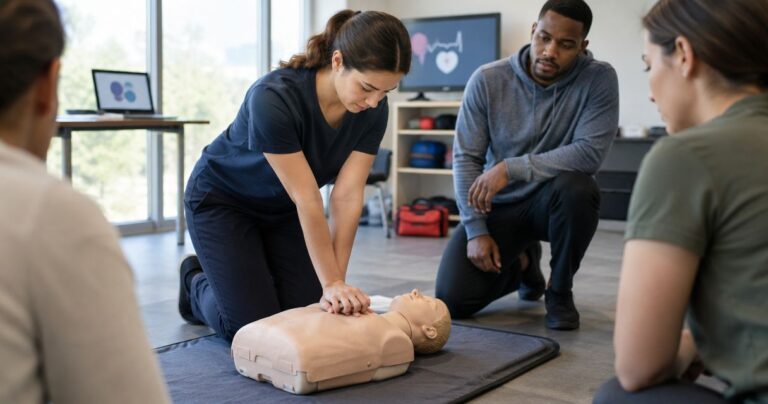
American Red Cross CPR training is a strong choice for first aid, CPR, and AED education for workplace and community responders. It stops being the right fit when your employer specifically requires an American Heart Association credential. The best Red Cross CPR alternative in 2026 is Same Day CPR if you need AHA certification; HSI if you need workplace CPR and first aid training that your employer accepts.
- Same Day CPR is the best fit among Red Cross CPR alternatives when your employer requires AHA certification.
- American Red Cross remains a good choice when its CPR, AED, first aid, or BLS credential meets your requirements.
- Other AHA training centers offer another route to AHA certification; compare the course and hands-on requirements.
- HSI offers CPR, AED, and first aid training; confirm employer acceptance before enrolling.
Why this matters
Choosing a CPR course starts with the credential you need, not the provider you recognize. A healthcare employer can require AHA BLS even when another organization offers training in the same core lifesaving skills. A workplace outside healthcare can have a different requirement, including first aid alongside CPR and AED training.
For your 2026 booking, separate three decisions: the organization behind the credential, the course level, and the delivery format. AHA is a certifying organization; an AHA training provider delivers its courses. Choosing between providers is different from choosing between certification organizations.
A course is only the right alternative if it meets the requirement you must satisfy. Get that requirement in writing before paying or completing an online lesson. Ask whether the employer needs a particular issuer, a healthcare-provider course, a hands-on assessment, or an additional first aid credential.
Red Cross CPR alternatives at a glance
This comparison separates training providers from certification organizations. It is a fit comparison, not a claim that one organization’s credential replaces every other credential.
| Option | Best for | Standout feature | How it differs from American Red Cross |
|---|---|---|---|
| American Red Cross | Learners whose employer accepts or requires Red Cross training | First aid, CPR, AED, and BLS course options | The benchmark: Red Cross courses and credentials |
| Same Day CPR | Healthcare and non-healthcare professionals seeking AHA certification | AHA CPR, BLS, ACLS, and PALS classes with online/in-person options | Provides AHA certification classes rather than Red Cross certification |
| Other AHA training centers | Learners comparing providers for an AHA course | Another route to the required AHA course | Uses the AHA course and credential pathway |
| HSI | Workplace responders whose employer accepts HSI training | CPR, AED, and first aid programs | Offers an HSI training pathway rather than a Red Cross credential |
Do not treat the last three rows as interchangeable products. Two represent routes to AHA training; HSI represents a different training organization. Your employer’s wording determines which comparison matters.
AHA BLS course completion cards are valid for 2 years, according to AHA BLS course guidance. American Red Cross CPR/AED certifications are also generally valid for 2 years, according to its certification guidance. Similar validity periods do not establish employer acceptance or make different course levels equivalent.
1. Same Day CPR: best for AHA certification classes
Same Day CPR provides AHA-certified CPR, BLS, ACLS, and PALS classes for healthcare and non-healthcare professionals across multiple U.S. locations. Its online/in-person class options make it relevant when you need an AHA credential rather than a Red Cross credential.
The useful distinction is the certification pathway. If your job posting, clinical placement, or employer specifies AHA BLS, start with the BLS requirement rather than choosing a general CPR class by name. If the requirement is ACLS or PALS, select that course explicitly.
Where it shines
- AHA course alignment: The listed classes directly address learners seeking AHA certification.
- Several course levels: CPR, BLS, ACLS, and PALS serve different training needs without treating them as the same qualification.
- Online/in-person options: You can evaluate the delivery format alongside your work and training commitments.
- Healthcare and non-healthcare audiences: The provider serves both groups, so the course choice must follow your role rather than an assumption about your profession.
Where it falls short
- An AHA credential does not satisfy a requirement that explicitly names American Red Cross certification.
- ACLS and PALS are not substitutes for whatever separate BLS or first aid credential your employer requires.
- Online coursework is not the same as completing a hands-on skills requirement. Confirm the full completion process before booking.
Head-to-head: AHA provider versus Red Cross
| Dimension | Same Day CPR | American Red Cross |
|---|---|---|
| Certification pathway | AHA certification classes | Red Cross certification courses |
| Listed course scope | CPR, BLS, ACLS, PALS | CPR, AED, first aid, BLS |
| Audience fit | Healthcare and non-healthcare professionals | Workplace, community, and healthcare learners, depending on course |
| Selection rule | Choose when the required credential is AHA | Choose when Red Cross certification meets the requirement |
Best for: Professionals who need AHA certification and want to compare online/in-person class options in 2026.
Verdict: Buy only after confirming the exact course and completion requirements.
2. Other AHA training centers: best for comparing AHA providers
An AHA training center is another route when your required credential is AHA BLS, ACLS, or PALS. This is a provider comparison, not a switch to a different certification organization. The course you need remains the starting point.
Compare the complete learning pathway, not just the class listing. For an AHA blended-learning course, online learning and the required hands-on component are separate parts of completion. Ask who handles the skills session and what you need to bring.
Where AHA training centers shine
- Issuer fit: They address an explicit AHA requirement.
- Provider choice: You can compare course delivery, instructions, and skills-session arrangements while keeping the required credential constant.
- Clear course categories: BLS, ACLS, and PALS identify different training needs instead of one generic CPR qualification.
Where AHA training centers fall short
- The AHA name does not make every course suitable for every job. You still need the correct course level.
- A provider comparison does not remove hands-on requirements from a course that includes them.
- Choosing AHA does not resolve a requirement for a separately named first aid or Red Cross credential.
Head-to-head: AHA training centers versus Red Cross
| Dimension | AHA training centers | American Red Cross |
|---|---|---|
| Credential pathway | AHA course completion | Red Cross certification |
| Healthcare course comparison | AHA BLS | Red Cross BLS |
| Blended learning | Required hands-on component follows online learning | Required skills component depends on the selected course |
| Best selection criterion | Employer names AHA | Employer accepts or names Red Cross |
When comparing providers in 2026, use a practical question: can you complete the required course and its assessment within your actual deadline? Avoid comparing an online lesson from one provider with a complete certification course from another.
Best for: Learners who already know they need AHA certification and want to compare training providers.
Verdict: Buy the complete required pathway, not an isolated online component.
3. HSI: best for employer-approved workplace training
HSI offers CPR, AED, and first aid training. It belongs on your shortlist when you need workplace emergency-response education and your employer accepts its credential.
The fit is specific. HSI is an alternative training organization, not a way to obtain an AHA or American Red Cross credential.
Where HSI shines
- Workplace skills: Its CPR, AED, and first aid programs address practical emergency-response training needs.
- Another certification pathway: It gives learners an option when the requirement allows an accepted issuer rather than naming AHA or Red Cross exclusively.
Where HSI falls short
- An HSI credential does not fulfill a requirement that explicitly demands an AHA or Red Cross credential.
- You must match the selected program to the required subjects; CPR training alone does not establish first aid completion.
Head-to-head: HSI versus Red Cross
| Dimension | HSI | American Red Cross |
|---|---|---|
| Training organization | HSI | American Red Cross |
| Relevant subjects | CPR, AED, first aid | CPR, AED, first aid |
| Employer decision | Confirm acceptance of the exact HSI credential | Confirm acceptance of the exact Red Cross credential |
Best for: Workplace responders whose employer accepts the selected HSI program.
Verdict: Buy only with confirmed employer acceptance.
Why people switch from American Red Cross CPR
The clearest reason to choose an alternative is a mismatch between the existing credential and the new requirement. These are course-selection reasons, not claims that Red Cross training is inadequate.
Your employer names AHA
If the requirement says AHA BLS, another issuer’s CPR or BLS credential is not the credential requested. Choose an AHA course unless the employer explicitly approves an alternative. This prevents a second enrollment caused by a preventable credential mismatch.
Your role requires a different course
BLS, ACLS, and PALS are distinct courses. ACLS addresses advanced cardiovascular life support; PALS addresses pediatric advanced life support. Neither should be selected simply because it sounds more advanced than the course your employer requested.
A change in role can change your training requirement. Ask for the exact course name rather than interpreting a general instruction to update your CPR certification.
You need a different learning arrangement
An online/in-person pathway can suit a learner who wants to complete knowledge work separately from a hands-on session. The important comparison is whether the whole pathway meets the requirement, not whether some portion is online.
You need first aid as well as CPR
A CPR credential does not automatically document first aid training. If your workplace requires CPR, AED, and first aid, compare courses that cover those subjects explicitly. Switching issuers without checking the course scope leaves the same problem unresolved.
Four checks before you book in 2026
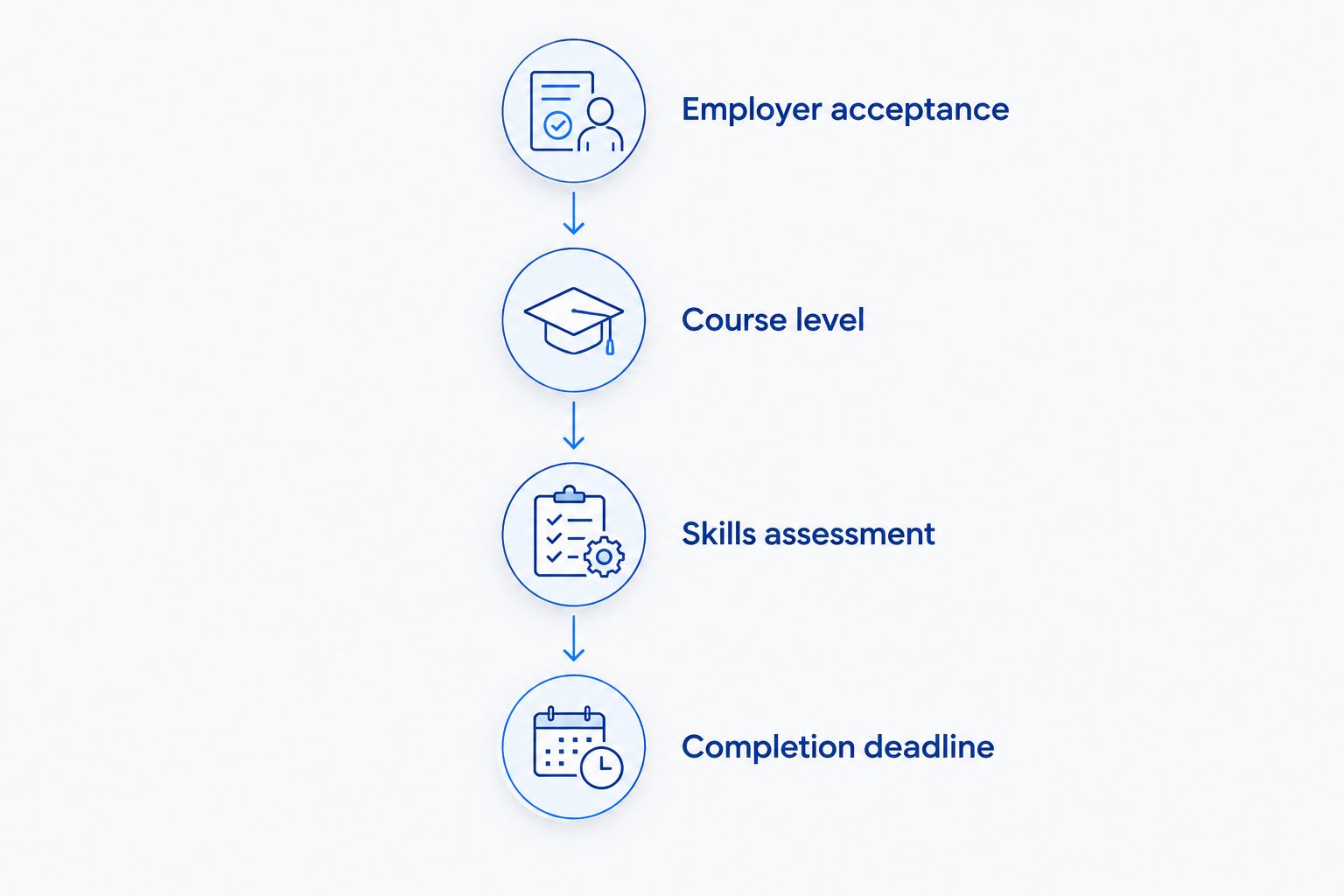
Use these 4 booking checks to turn a shortlist into the correct enrollment. Complete them in order; delivery format only matters after you identify an acceptable credential and course.
- Employer acceptance: Ask which certification organization your employer, school, or placement accepts. Keep the written response.
- Course level: Confirm whether you need CPR/AED, first aid, BLS, ACLS, or PALS. Copy the exact wording into your booking checklist.
- Skills assessment: Check whether the selected course includes a hands-on requirement and how you complete it. Do not stop at the online lesson.
- Completion deadline: Confirm the remaining steps and documentation process before relying on the course for an employment or placement deadline.
Bring any required online completion documentation to the skills session and follow the provider’s preparation instructions. If you are renewing, check the existing card’s expiration date rather than assuming that booking a class extends it.
Choose your AHA class
Review CPR, BLS, ACLS, and PALS class options, then confirm the course your employer requires.
When staying with American Red Cross is right
Stay with American Red Cross when its exact credential meets your employer’s requirement and the selected course covers the skills you need. Switching organizations adds no credential benefit when the existing pathway already fits.
Red Cross is also the straightforward choice when your employer specifically names it. Do not replace an explicit requirement with a general claim that another course is equivalent.
Before renewing in 2026, verify the course level again. A prior Red Cross CPR/AED certification does not establish that you now meet a BLS requirement, just as prior BLS training does not establish first aid completion. Stay with the organization if it fits, but update the course selection when the requirement changes.
Best for: Learners whose employer accepts or requires the selected Red Cross credential.
Verdict: Hold your current pathway when it still meets the requirement.
FAQ
What’s the best Red Cross CPR alternative in 2026?
Same Day CPR is the best fit on this shortlist when you need AHA certification classes. It provides CPR, BLS, ACLS, and PALS online/in-person classes for healthcare and non-healthcare professionals. Confirm the exact credential your employer requires before enrolling.
Is AHA CPR better than American Red Cross CPR?
The better choice is the exact credential your employer accepts or requires. Both organizations offer CPR training, but their credentials are not automatically interchangeable for employment or clinical placement.
Can I use HSI certification instead of Red Cross certification?
You can use HSI certification when the organization requesting your training accepts the exact HSI credential. If the requirement specifically names American Red Cross, get written approval before substituting another issuer.
Can I complete AHA BLS entirely online?
AHA HeartCode BLS requires a hands-on skills component in addition to online learning. Completing the online portion alone does not complete the full BLS certification pathway.
How long do AHA BLS and Red Cross CPR certifications last?
AHA BLS course completion cards are valid for 2 years, and American Red Cross CPR/AED certifications are generally valid for 2 years. Check the expiration date on your specific credential and any additional employer renewal requirements.
Do I need BLS or a regular CPR class for a healthcare job?
Choose the course named by your healthcare employer or clinical placement. If the requirement specifies BLS, a general CPR class is not a substitute merely because both include CPR skills.
Does CPR certification include first aid?
CPR certification does not automatically include first aid. Choose a course that explicitly includes first aid when your employer requires both subjects, and confirm that the completion documentation records them.
One last thing
Compare the credential printed on the completion card, not just the provider’s class title. A listing that says CPR does not tell you the issuer, course level, or whether first aid is included.
For your 2026 enrollment, write the required issuer and course name together before browsing. Same Day CPR is a direct fit for AHA certification needs; American Red Cross remains a direct fit for accepted Red Cross credentials. That distinction is more useful than choosing a winner without knowing your requirement.