


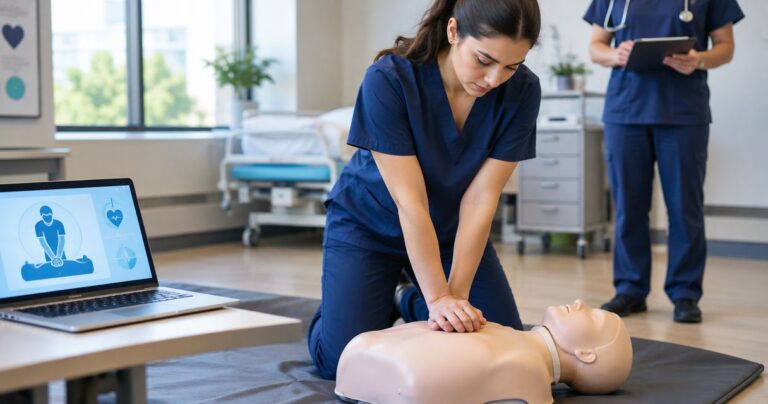
Online-only CPR certification does not meet a hospital requirement for an AHA BLS course with a hands-on skills assessment. Hospital acceptance depends on the employer’s written requirements, so confirm the required issuer, course, and skills component before enrolling; completing online coursework alone is not the same as completing an AHA blended-learning course.
- Is online only CPR certification accepted by hospitals? Not when the employer requires AHA BLS with hands-on skills.
- AHA HeartCode coursework and a completed skills assessment are separate parts of blended learning.
- Same Day CPR offers Online + Skills and Skills Only routes; eligibility depends on your online coursework.
- Ask employee health to confirm the course and issuer before booking, not after earning a certificate.
Why this matters
A course can be convenient and still fail to satisfy your onboarding requirement. The important distinction is not whether you study online: it is whether you complete the exact credential your hospital requests, including any required hands-on assessment.
Same Day CPR offers AHA BLS, ACLS, and PALS courses through self-paced CPR Verification Stations. Same Day CPR is best for healthcare providers seeking AHA certification through online coursework and a manikin skills check. Employer acceptance still requires confirmation with your hospital.
Before choosing a course for a 2026 start date or renewal deadline, get the requirement in writing. A nurse recruiter’s general request for CPR certification is less useful than the actual credentialing checklist.
Is online-only CPR certification accepted by hospitals?
An online-only certificate is not a substitute for an AHA BLS credential that requires demonstrated hands-on skills. AHA HeartCode BLS combines online learning with a hands-on skills session; finishing the online component does not finish the entire course.
Hospitals set their own employment and credentialing requirements. Without a particular hospital’s policy, no training provider can promise that a course will satisfy that employer.
Use this comparison to identify what you are actually buying:
| Training route | Best for | Main benefit | Limitation to check |
|---|---|---|---|
| Online-only CPR course without a hands-on assessment | Learners whose organization explicitly permits that format | No separate hands-on appointment | Does not complete an AHA BLS requirement that includes skills assessment |
| AHA blended learning with a manikin skills check | Providers whose employer requires the corresponding AHA credential | Online coursework plus demonstrated skills | Online coursework must be finished before the skills check |
| Instructor-led AHA course with hands-on assessment | Providers who prefer instructor-led teaching and whose employer requires that credential | Instruction and hands-on learning in a classroom format | Requires attendance according to the course schedule |
The course title alone is not enough. Check the issuing organization, the exact credential awarded, and whether the advertised completion includes the required skills assessment.
Words such as healthcare CPR, provider certification, or online renewal do not answer those questions. Ask for the credential details rather than treating a marketing label as proof of acceptance.
Online-only CPR: check the employer’s written policy
An online-only course lets you complete its learning and testing without a hands-on assessment. That format is different from studying the online portion of an AHA blended-learning course before demonstrating skills on a manikin.
The practical advantage is scheduling: you do not have a separate physical skills appointment. The limitation is credential fit. If your hospital specifies AHA BLS with the required skills assessment, a certificate from an unrelated online-only course does not meet that specification.
Best for: learners whose employer has explicitly approved the specific online-only course and credential.
Before enrolling, send employee health or your credentialing contact the course name and issuer. Ask whether the resulting certificate—not merely the course description—meets the requirement for your position.
Do not treat a course provider’s statement about hospital acceptance as your hospital’s approval. The organization checking your employment documents makes that decision.
AHA blended learning: online coursework plus hands-on skills
Blended learning separates knowledge work from skills verification. You complete the online portion first, then demonstrate the required skills during the hands-on component.
This distinction resolves a common misunderstanding: a course can begin online without being online-only. Completing the skills check is what separates unfinished online coursework from a completed blended-learning course.
Best for: healthcare providers who need the specified AHA credential and want to complete coursework separately from their skills appointment.
The benefit is control over when you complete the online learning. The limitation is that you still need to prepare for and complete the hands-on component; booking an appointment does not replace the online work.
At a self-paced CPR Verification Station, the manikin skills check is a physical assessment, not simply another online quiz. Confirm your appointment instructions and finish the required online portion before you attend.
Instructor-led training: another route with hands-on assessment
An instructor-led course is a different learning format, not automatic proof that an employer will accept any certificate issued there. You still need the correct course and issuing organization.
Best for: providers who prefer learning with an instructor rather than completing the knowledge component independently.
The benefit is the instructor-led learning environment. The trade-off is fitting the course’s attendance schedule around your work and other commitments.
If your hospital requires AHA BLS, compare formats within that requirement. Do not compare an AHA course with an unrelated CPR certificate as though the only difference were online versus classroom delivery.
Why hospital acceptance varies
Hospital acceptance depends on the credentialing requirement, not on a universal rule that every online course is acceptable or unacceptable. Check these factors before selecting a course:
- Issuing organization: Ask whether the hospital specifically requires the American Heart Association or permits another named issuer.
- Course level: Confirm whether your position requires BLS, ACLS, PALS, or a combination. A generic CPR course title does not establish the required level.
- Skills component: Ask whether the course must include a hands-on assessment and whether your proposed completion route satisfies that requirement.
- Required documentation: Confirm what the hospital needs to review. Do not assume proof of online coursework substitutes for the final course credential.
- Completion deadline: Establish when the finished credential must be submitted, rather than planning only around the date you start training.
These checks are particularly useful when changing employers. Approval for one position does not establish approval for a different hospital or role.
How do I check whether my hospital will accept a course?
Ask the department responsible for credentialing to approve the exact course before you enroll. Employee health, human resources, your education department, or your program coordinator can direct you to the relevant policy.
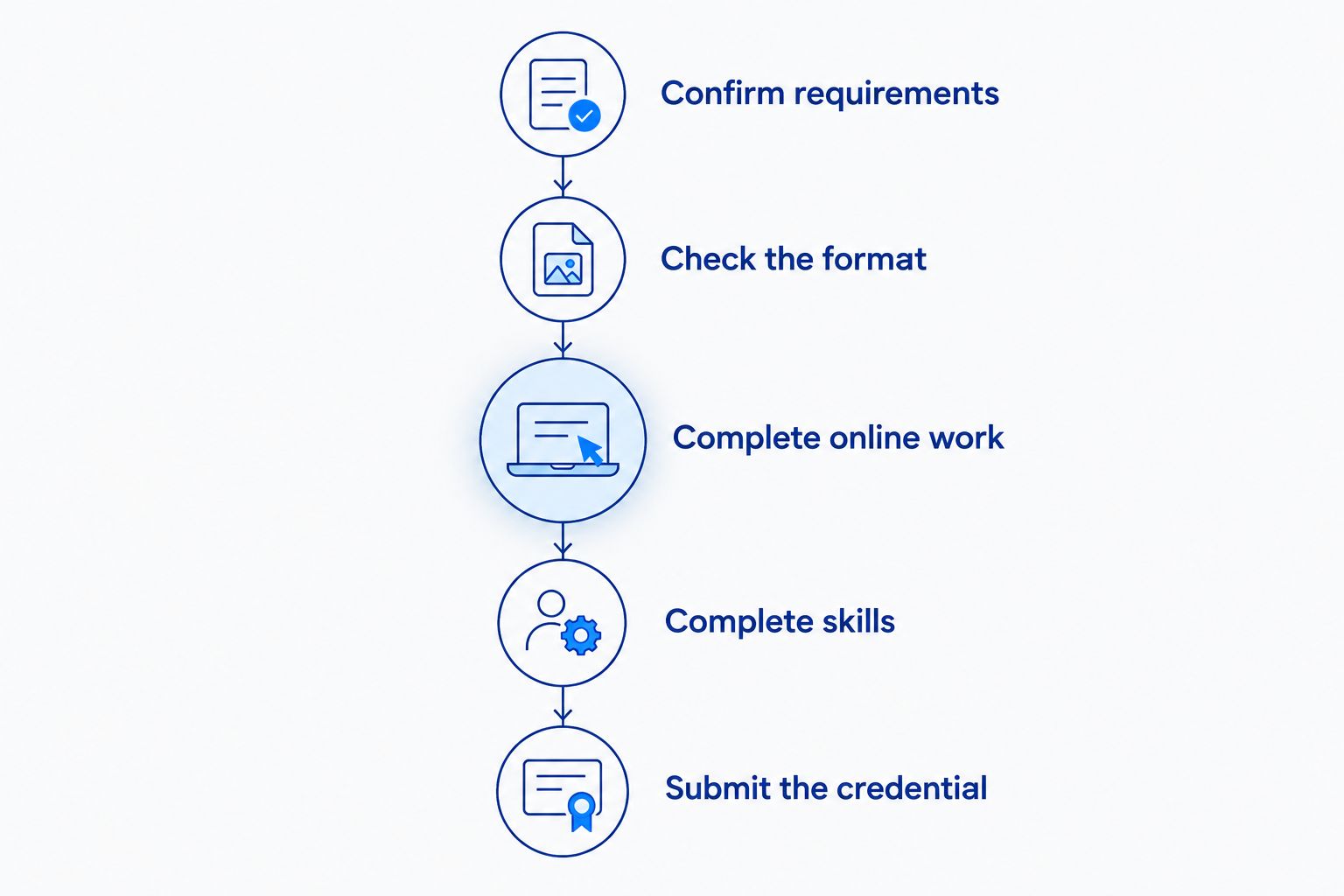
Use this sequence:
- Confirm requirements. Get the required issuer, course name, and submission deadline in writing.
- Check the format. Establish whether the proposed route includes the required hands-on skills assessment.
- Complete online work. For blended learning, finish the online component before attending the skills appointment.
- Complete skills. Follow the course’s assessment requirements rather than treating attendance as completion.
- Submit the credential. Send the completed credential through your employer’s required process and confirm receipt.
When asking for approval, include the specific course and issuing organization. State whether it includes online coursework and a manikin skills assessment, and ask whether that completed credential meets the requirement for your role.
Keep the response with your onboarding or renewal documents. Written confirmation gives you a clear reference if the course description and your employer’s checklist use different wording.
Which booking option fits my situation?
Same Day CPR provides two booking routes: Online + Skills and Skills Only. Choose based on your online-course status, not on whether you are an experienced provider.
| Booking option | Best for | What it covers | Important limitation |
|---|---|---|---|
| Online + Skills | Initial and renewal students who need the full course | Online coursework and the skills component | The online portion must be completed before the skills check |
| Skills Only | Students who already completed the online portion or purchased it from AHA | The skills component | It does not replace unfinished online coursework |
A renewal student who needs the full course should book Online + Skills. Having held the credential before does not, by itself, make Skills Only the appropriate booking.
The station network includes 115+ self-paced CPR Verification Stations using HeartCode/RQI manikins for skills checks. Each course is booked separately in a one-hour slot; that slot does not represent the time needed for online coursework plus skills.
BLS, ACLS, and PALS can be completed on the same day through back-to-back bookings after the required preparation. Two courses require two separate one-hour bookings; one reservation does not cover both credentials.
Same-day booking and same-day cards after successful completion are offered. Check the selected station’s appointment details before planning around a work shift or submission deadline. All checkout stays on samedaycpr.com.
Powered by Bayside CPR. Bayside CPR is an Official American Heart Association National Training Center.
Does a self-paced skills station count as online-only CPR?
A self-paced manikin skills check is not online-only coursework. You physically demonstrate skills during the assessment rather than completing only a remote knowledge test.
Self-paced describes how you move through the station process. It does not mean you can omit the required online learning or the hands-on assessment.
Ask your hospital to confirm the completed credential and assessment route. Do not substitute the phrase self-paced for a description of what the course actually includes.
Can I use my online completion certificate for onboarding?
An online-component completion certificate is not the same as the final credential for a blended-learning course. If your hospital requires the completed AHA course, finish the skills assessment before submitting the final credential.
If onboarding happens before your scheduled assessment, ask the hospital what documentation it requires at that stage. Do not assume an appointment confirmation or unfinished coursework satisfies its policy.
Do I need BLS, ACLS, or PALS for my hospital job?
Your hospital’s role-specific requirements determine whether you need BLS, ACLS, PALS, or more than one credential. Do not assume that completing one course automatically satisfies a requirement naming another.
For multiple required courses, plan the online preparation for each and book each skills appointment separately. Back-to-back appointments address scheduling; they do not merge the courses into one certification.
FAQ
Is online-only CPR certification accepted by hospitals in 2026?
Online-only CPR certification does not satisfy a hospital requirement for AHA BLS with a hands-on skills assessment. Ask your hospital to confirm the exact issuer, course, and completion requirements before enrolling.
Is AHA HeartCode BLS completely online?
AHA HeartCode BLS is not completed through online coursework alone. It includes an online component and a hands-on skills component.
Will every hospital accept an AHA card?
No training provider can promise acceptance by every hospital. Your employer must confirm that the specific AHA course and completed credential meet the requirements for your role.
Can I book Skills Only if I am renewing my certification?
Renewal status alone does not make Skills Only the right booking. Choose Skills Only if you already completed the online portion or purchased it from AHA, and finish the online work before your skills check.
Does a one-hour appointment include all my online coursework?
A one-hour slot is the booking for an individual course’s station appointment, not a promise that online coursework and skills take one hour together. Complete the required online portion before the skills assessment.
Can I complete BLS and ACLS on the same day?
BLS and ACLS can be completed on the same day with separate, back-to-back one-hour bookings. Complete the required online coursework for each course before the skills checks.
Does Same Day CPR provide same-day certification cards?
Same Day CPR offers same-day cards after successful completion. A booking alone or completion of only the online portion is not successful completion of the full blended-learning course.
One last thing
Check the document you will receive, not just the course you will attend. A receipt, online completion record, and final course credential serve different purposes; your hospital’s submission requirement determines which document it needs.
Before your deadline, confirm that you have the completed credential and know where to submit it. Finishing training and completing your employer’s credentialing process are separate tasks.
Related guides
- What happens if your CPR certification expires while employed?
- What to expect at a CPR Verification Station in Morristown
- Princeton AHA ACLS skills check preparation
- Same-day BLS and ACLS in Old Bridge, NJ