


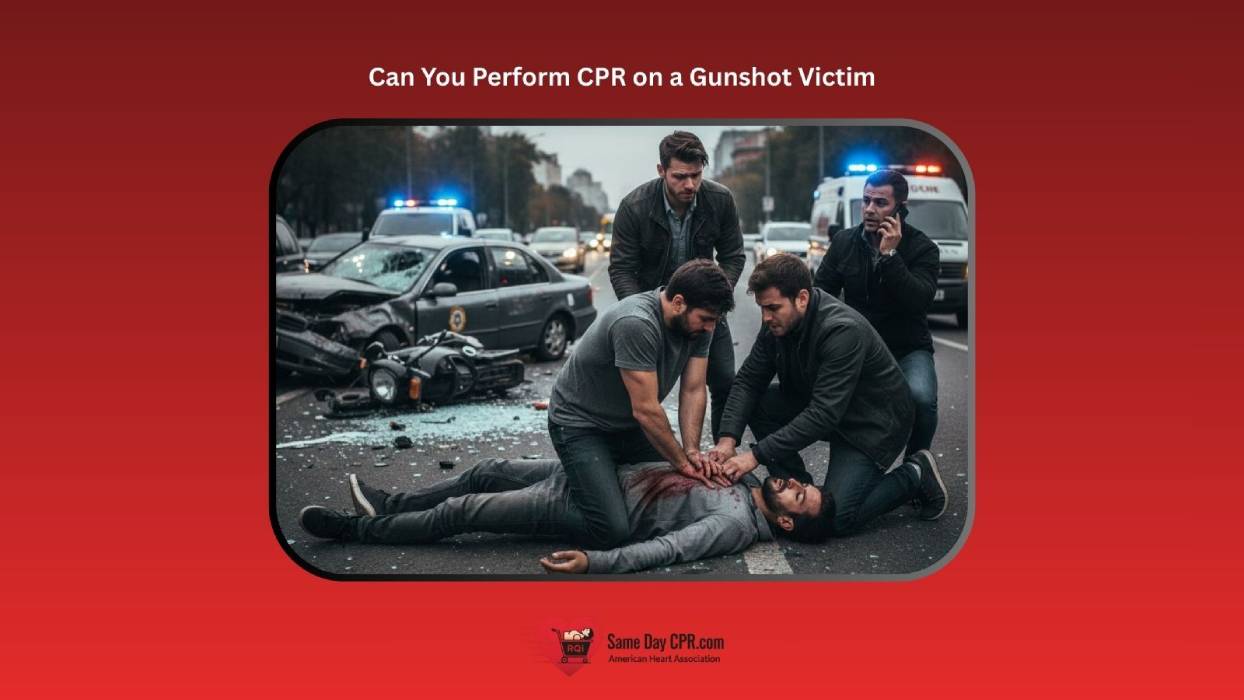
Gunshot injuries can happen in an instant, and when a victim becomes unresponsive and does not breathe normally, immediate action is critical. Yes, you can perform CPR (cardiopulmonary resuscitation) on a gunshot victim when CPR is indicated. However, gunshot wounds create additional challenges, particularly life-threatening bleeding, so scene safety and hemorrhage control also remain critical.
A gunshot victim may have severe external or internal bleeding, damage to vital organs, or traumatic cardiac arrest. CPR cannot stop bleeding or repair these injuries, but it can help maintain circulation and oxygen delivery until emergency medical services (EMS) arrive.
If you encounter a gunshot victim, first make sure the scene is safe, call your local emergency number, follow the dispatcher’s instructions, and address life-threatening bleeding. If the person is unresponsive and does not breathe normally or only gasps, begin CPR as directed by the emergency dispatcher.
How Gunshot Injuries Affect CPR
Gunshot wounds can cause different types of injuries, and the victim’s condition can change rapidly. Understanding the immediate threats can help you prioritize your actions.
Penetrating and Perforating Wounds
A penetrating gunshot wound occurs when a projectile enters the body but does not exit. A perforating wound occurs when it enters and exits the body.
Either type can damage blood vessels, organs, bones, or other structures. The appearance of the wound does not necessarily indicate how severe the internal injuries are.
Common Complications
Gunshot injuries may cause:
- Severe bleeding: Rapid blood loss can become fatal within minutes.
- Internal bleeding: Damage to internal blood vessels or organs may cause substantial blood loss without obvious external bleeding.
- Organ and tissue damage: A projectile can injure vital organs and major blood vessels.
- Shock: Severe blood loss and trauma can impair circulation and oxygen delivery to the body’s tissues.
- Cardiac arrest: In severe trauma, the heart may stop beating effectively.
The Immediate Threats
Two major concerns when responding to a gunshot victim are life-threatening bleeding and cardiac arrest.
Severe external bleeding should be addressed immediately when it is safe to do so. If the victim is unresponsive and not breathing normally, CPR is also critical.
The priorities can overlap. Do not assume that bleeding must be completely controlled before CPR can begin. If possible, have another person control severe bleeding while you begin CPR, or follow the emergency dispatcher’s instructions about what to do first.
When Should You Perform CPR on a Gunshot Victim?
The presence of a gunshot wound does not automatically mean CPR should be performed. CPR is appropriate when the victim is unresponsive and is not breathing normally or is only gasping.
For an unresponsive adult who is not breathing normally, a bystander should:
- Make sure the scene is safe.
- Call emergency services or have someone call.
- Follow the dispatcher’s instructions.
- Begin CPR if instructed or if the person is clearly in cardiac arrest.
- Use an AED if one is available.
Do You Need to Check for a Pulse?
For most untrained bystanders, do not delay CPR by trying to find a pulse. If an adult is unresponsive and not breathing normally or is only gasping, treat the situation as cardiac arrest and begin CPR while following emergency-dispatch instructions.
Healthcare professionals may assess a pulse according to their training and applicable protocols.
What Should You Do Before CPR?
Before starting CPR, make sure the area is safe and get emergency help right away. Understand the legal requirements before touching someone in an emergency, then assess the situation and begin appropriate first aid. If someone has been shot, focus first on immediate dangers and severe bleeding while you prepare to provide CPR.
Ensure Scene Safety
Do not approach a gunshot victim while an active threat remains.
Move to safety and call emergency services if the scene is unsafe. Consider hazards such as an active shooter, weapons, traffic, fire, or unstable surroundings.
Your safety comes first.
Call Emergency Services
Call your local emergency number as soon as possible. Tell the dispatcher:
- That someone has been shot
- The victim’s location
- The number of victims
- Whether the victim is conscious
- Whether the victim is breathing normally
- Whether there is severe bleeding
- Any continuing danger at the scene
Keep the phone on speaker if possible so you can follow the dispatcher’s instructions while helping the victim.
Control Life-Threatening Bleeding
Severe bleeding is a major cause of preventable death after traumatic injury.
If you can safely do so:
- Apply firm, continuous pressure to severe external bleeding.
- Use a tourniquet for life-threatening bleeding from an arm or leg when appropriate and when you have one available and know how to use it.
- If bleeding is from an area where a tourniquet cannot be applied, use appropriate wound-packing and firm pressure if you are trained to do so.
- Continue applying pressure or follow the emergency dispatcher’s instructions until EMS arrives.
Do not delay emergency activation while trying to manage the wound yourself.
If another person is present, one person can focus on bleeding control while another calls emergency services or performs CPR.
How to Perform CPR on a Gunshot Victim
If the victim is unresponsive and not breathing normally or is only gasping, begin CPR according to emergency dispatcher instructions.
Step 1: Check Responsiveness and Breathing
Tap the victim and shout to see whether they respond.
Look for normal breathing. Occasional gasping or abnormal breaths are not normal breathing and should be treated as a sign of cardiac arrest.
If the victim is unresponsive and not breathing normally, call for help and begin CPR.
Step 2: Begin Chest Compressions
For an adult:
- Place both hands in the center of the chest.
- Push hard and fast.
- Aim for 100–120 compressions per minute.
- Allow the chest to fully recoil after each compression.
- Minimize interruptions.
For an untrained bystander, hands-only CPR is an appropriate option when rescue breaths are not desired or cannot be provided.
Step 3: Provide Rescue Breaths if Appropriate
If you are trained and willing to provide rescue breaths, use a 30:2 compression-to-breath ratio for an adult.
After 30 compressions, provide 2 breaths, then immediately resume chest compressions.
A barrier device can be used if available.
Important Consideration for Gunshot Victims
Do not stop CPR simply because the victim has a gunshot wound. CPR may cause additional injuries, but when a person is in cardiac arrest, the potential benefit of maintaining circulation generally outweighs the risk of CPR-related injury.
At the same time, remember that CPR does not treat the underlying gunshot injury or stop severe bleeding. The victim needs emergency medical treatment as quickly as possible.
What If the Victim Is Still Breathing?
If the victim is conscious or unconscious but breathing normally, do not perform CPR.
Instead:
- Call emergency services.
- Control life-threatening external bleeding when safe.
- Monitor breathing and responsiveness.
- Follow the emergency dispatcher’s instructions.
- Avoid unnecessary movement unless moving the person is necessary for safety.
If the victim stops breathing normally, be prepared to begin CPR.
Using an AED on a Gunshot Victim
If an automated external defibrillator (AED) is available, turn it on and follow its instructions.
An AED can determine whether a shockable cardiac rhythm is present and will instruct you whether a shock is recommended.
When using an AED:
- Expose the chest as necessary.
- Attach the pads according to the diagrams on the device.
- Follow the AED’s voice or visual instructions.
- Make sure nobody is touching the victim when the AED analyzes the rhythm or delivers a shock.
- Resume CPR when instructed.
If the chest is wet, dry it quickly before applying the AED pads.
Do not place an AED pad directly over a wound or other obstruction that prevents proper pad placement. Follow the device’s instructions and dispatcher guidance.
What About Shock?
A gunshot victim may develop shock because of severe blood loss or traumatic injury.
The most important actions are to:
- Call emergency services.
- Control life-threatening bleeding.
- Monitor the victim’s breathing and responsiveness.
- Keep the victim appropriately warm.
- Reassure the victim if they are conscious.
- Follow the emergency dispatcher’s instructions.
Do not give the victim food or drink.
Avoid unnecessary movement, particularly when serious injuries are suspected, unless movement is required to escape an unsafe environment or to provide lifesaving care.
Limitations of CPR in Gunshot Cases
CPR is an emergency intervention, not a treatment for the gunshot wound itself.
A victim may have injuries that CPR cannot correct, such as:
- Massive internal bleeding
- Severe damage to the heart or major blood vessels
- Extensive injury to vital organs
- Traumatic injuries incompatible with survival
Even when CPR cannot ultimately save the victim, starting appropriate emergency care promptly gives them the best possible chance while professional help is on the way.
The outcome also depends on factors such as the location and severity of the injuries, the amount of blood lost, the time until treatment, and whether the cardiac arrest is reversible. In these situations, understanding the H’s and T’s, which represent the reversible causes, can help explain why some cases may be treatable while others are not.
Why CPR Can Matter for a Gunshot Victim
When a gunshot victim goes into cardiac arrest, CPR can temporarily maintain blood circulation until professional treatment is available.
- It Maintains Blood Flow: Chest compressions help circulate blood to vital organs, including the brain and heart.
- It Buys Time Until EMS Arrives: CPR can provide temporary circulatory support while emergency responders are traveling to the scene.
- It May Help Preserve Brain Function: When the heart stops, the brain is deprived of oxygen. Effective CPR can help maintain some blood flow to the brain until circulation can be restored.
- An AED May Restore a Shockable Rhythm: If the cardiac arrest is caused by a shockable rhythm, an AED may be able to deliver a potentially lifesaving shock.
CPR and AED use are therefore important components of the chain of survival when cardiac arrest occurs.
Key CPR Takeaways for Gunshot Victims
- Safety first: Never approach an active or otherwise unsafe scene.
- Call emergency services: Get professional help on the way immediately.
- Control life-threatening bleeding: Apply appropriate bleeding-control measures as soon as it is safe.
- Know when CPR is needed: If the victim is unresponsive and not breathing normally or is only gasping, begin CPR according to emergency-dispatch instructions.
- Do not delay CPR by checking for a pulse if you are an untrained bystander.
- Use an AED if available: Follow its prompts and resume CPR as directed.
- Keep monitoring the victim: Be prepared to restart CPR if normal breathing stops.
- Remember CPR’s limitations: CPR can support circulation during cardiac arrest, but it cannot repair the underlying gunshot injury or stop internal bleeding.
Act Quickly, Stay Safe, and Give the Victim the Best Chance of Survival
So, can you perform CPR on a gunshot victim? Yes—if the victim is unresponsive and not breathing normally or is only gasping, CPR may be necessary.
The presence of a gunshot wound does not automatically rule out CPR. The priorities are to stay safe, activate emergency medical services, control life-threatening bleeding, and begin CPR when cardiac arrest is suspected.
If an AED is available, use it as soon as possible and follow its instructions. Continue lifesaving care until EMS takes over, the victim begins breathing normally, or you are unable to continue.
Knowing what to do in a traumatic emergency can make it easier to respond calmly and effectively. Hands-on training can give you the confidence to put that knowledge into practice when it matters most. Same Day CPR offers AHA-certified CPR courses in BLS, ACLS, and PALS through a convenient blended learning format. You’ll complete the coursework online, then come in for hands-on training where you can practice and demonstrate your skills in person.
Whether you’re preparing for work, maintaining your certification, or simply want to be better prepared for an emergency, CPR and bleeding-control training can help you respond more effectively when someone’s life is at risk.