


In a cardiac emergency, the difference between life and death is often measured in minutes, sometimes seconds. When a patient collapses, and a team responds, there is no time for hesitation or error. The professionals who act with confidence in these moments are trained in Advanced Cardiovascular Life Support (ACLS).
ACLS certification is the gold standard for clinicians managing cardiovascular emergencies. It is designed for registered nurses, paramedics, physicians, respiratory therapists, and other healthcare providers involved in resuscitation for conditions like cardiac arrest and stroke. In many high-acuity settings such as emergency departments, ICUs, and operating rooms, ACLS is often required rather than optional.
For healthcare professionals in Salisbury, NC, and the surrounding Rowan County area, local training is especially valuable. It reduces travel time, eases scheduling, and allows providers to train alongside colleagues from facilities such as Novant Health Rowan Medical Center and regional EMS services.
This guide outlines what to expect from ACLS certification in Salisbury, NC, including course structure, learning outcomes, prerequisites, and renewal requirements.
What is ACLS certification?
Advanced Cardiovascular Life Support is a certification program developed and maintained by the American Heart Association. It sets the clinical benchmark for how healthcare providers recognize and respond to life-threatening cardiovascular emergencies, including cardiac arrest, acute coronary syndrome, stroke, respiratory failure, and serious arrhythmias. If you work in a clinical environment where patients can crash, ACLS is not a nice-to-have. It is the standard of care. The AHA updates its guidelines every five years based on the latest resuscitation science, meaning the protocols you learn in an ACLS course reflect current evidence, not decade-old habits.
How ACLS Differs From BLS
Most healthcare providers arrive at ACLS already holding a Basic Life Support card, and it is worth understanding exactly where one ends and the other begins.
BLS is the foundation. It covers high-quality CPR for adults, children, and infants, AED use, and relief of airway obstruction. This course is for any trained responder, including lay rescuers, medical assistants, dental hygienists, and fitness instructors. It assumes a relatively simple scenario: someone has collapsed, you start CPR, you use the AED, and help arrives.
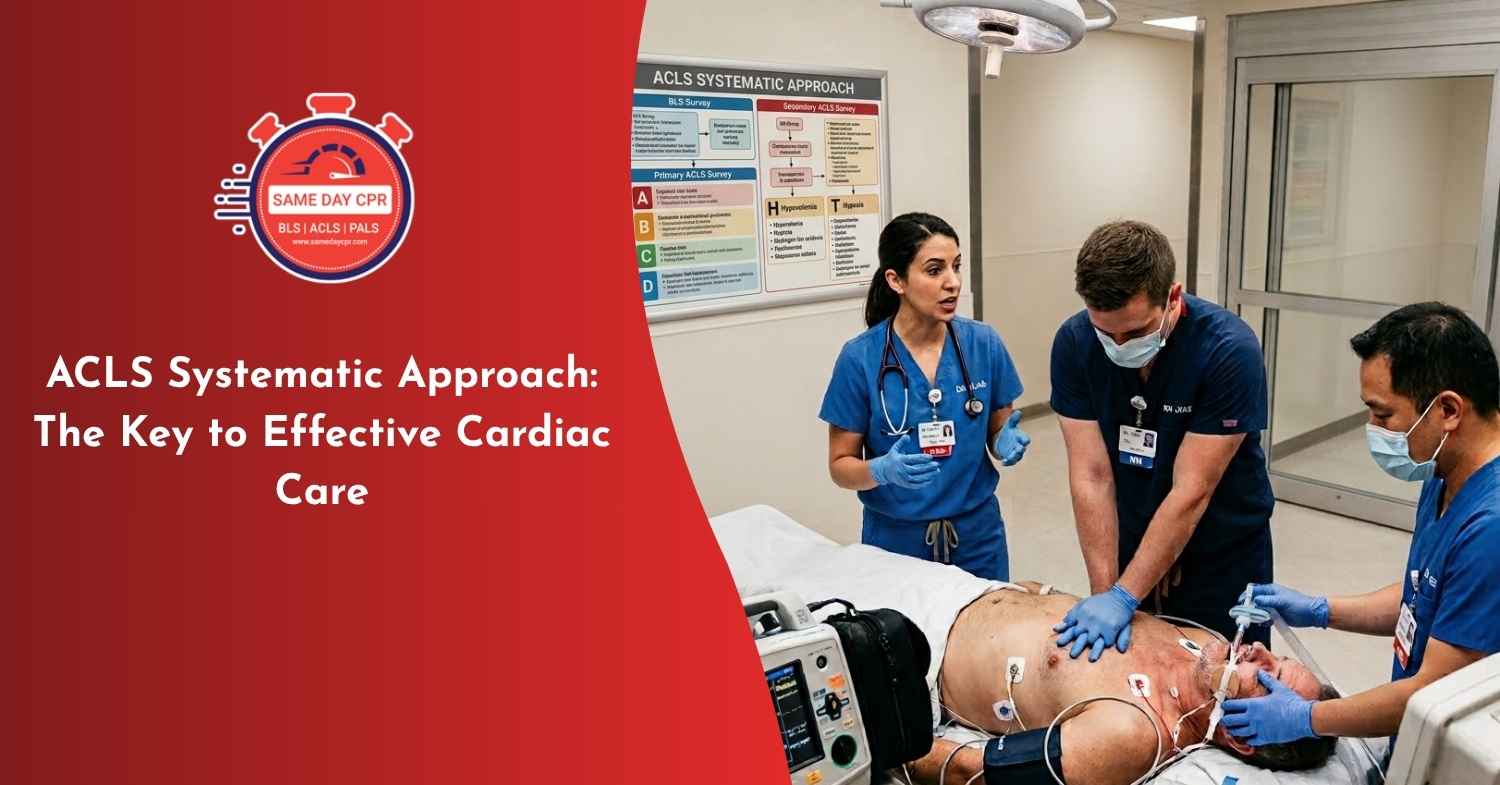
ACLS picks up where that scenario ends. It assumes you are the help that arrived, and it prepares you for everything that comes next. That means reading and interpreting cardiac rhythms on a monitor, selecting and administering resuscitation medications like epinephrine and amiodarone, managing advanced airways, leading or contributing to a structured resuscitation team, and making real-time decisions through a series of AHA algorithms, one for each type of emergency. The cognitive load is considerably higher, the stakes in the room are immediate, and the expectation is that you can function under pressure without waiting to be told what to do next.
In short, BLS keeps someone alive until advanced help arrives. ACLS is what advanced help looks like.
Who Is Required to Hold ACLS
ACLS is not required for every clinician, but for those working in high-acuity environments, it is typically non-negotiable. The roles most commonly required to maintain current ACLS certification include:
- Intensive care unit nurses and critical care technicians are frequently the first responders to a deteriorating patient before a physician reaches the bedside.
- Emergency department nurses and physicians, who manage undifferentiated acutely ill patients where a cardiac event can develop without warning.
- Hospitalists and rapid response team members, whose entire function is to intervene before a patient reaches full arrest.
- Flight nurses and flight paramedics, who operate in transport environments where backup is not immediately available and every intervention must be performed competently and independently.
- Anesthesiologists, CRNAs, and respiratory therapists, who manage airways and sedation in settings where cardiovascular compromise is an ever-present risk.
- Code response team members across any inpatient unit, including telemetry floors, step-down units, and progressive care areas, where a code blue can be called at any moment.
Some outpatient settings, such as cardiac catheterization labs, electrophysiology suites, endoscopy centers, and oral surgery practices,s also require ACLS depending on the procedures performed and the level of sedation involved.
Why Salisbury-Area Employers Require It
Locally, the expectation is clear. Novant Health Rowan Medical Center, as a full-service acute care hospital with surgical, critical care, and emergency services, requires ACLS for clinical staff in roles that place them on code teams or in high-dependency units. Rowan County EMS providers operating at the advanced life support level are similarly expected to maintain current certification as part of their credentialing requirements.
Beyond the individual employer, Joint Commission accreditation standards and state nursing board guidance both reinforce ACLS as a benchmark competency for certain clinical roles. If your position description includes responding to codes, managing critically ill patients, or providing advanced airway or cardiovascular care, your employer almost certainly has ACLS listed as a condition of employment or annual credentialing, and if it is not listed yet, it likely will be the next time your job description is reviewed.
The bottom line is straightforward: if your work puts you in the room when someone’s heart stops, ACLS certification is what qualifies you to be there.
What the ACLS Curriculum Covers
The ACLS curriculum teaches you how to respond to serious heart and breathing emergencies. It helps you build skills to act quickly and work with a team to save lives in critical situations.
- Core rhythms focus on helping you spot life-threatening heart rhythms on a monitor. You learn to quickly tell the difference between shockable and non-shockable patterns so you can act fast.
- ACLS Megacode scenarios let you practice real emergencies in a safe training setting. You either lead or join a code blue response and learn how to think and act under pressure.
- ACLS algorithms guide you step by step through major emergencies like cardiac arrest, fast heart rhythms, slow heart rhythms, stroke, and chest pain from blocked arteries. They help you choose the right action at the right time without confusion.
- Airway management teaches you how to keep a patient breathing well during an emergency. You practice using a bag valve mask, placing breathing tubes, and handling advanced airway devices.
- IV and IO access training shows you how to quickly get medication routes in critical patients. You also learn how and when to give key drugs like epinephrine, amiodarone, and atropine.
- High-quality CPR focuses on strong and steady chest compressions with minimal pauses. Team dynamics and closed-loop communication help everyone work together clearly, so no instruction is missed and care stays organized.
Initial Certification vs. Renewal
The AHA HeartCode ACLS program follows a blended learning format that mixes self-directed online study with an in-person practical skills assessment. While both initial certification and renewal lead to the same credential, they differ in requirements, course duration, and the level of preparation needed.
| Feature | Initial Certification | Renewal |
|---|---|---|
| Prerequisites | None. Intended for first-time providers or those whose card has expired for more than 6 months. | Must hold a current (unexpired) AHA ACLS Provider card. |
| Online Coursework (Part 1) | More extensive; includes all cognitive modules, interactive patient cases, and the pre-course assessment. | Includes review materials, cognitive modules, and a pre-course self-assessment. |
| In-Person Skills Session (Part 2) | Skills testing includes high-quality CPR & AED use, airway management, and megacode scenarios. | Skills testing includes high-quality CPR & AED use, airway management, and megacode scenarios. |
| Study Effort | Higher cognitive load; focuses on learning algorithms, rhythms, and pharmacology from the ground up. | Lower cognitive load; focuses on refreshing existing knowledge and incorporating guideline updates. |
Course Formats Available in Salisbury, NC
One of the first questions people ask when they decide to get ACLS certified is a practical one: how does the course actually work? The good news is that in the Salisbury area, you have real options, and the format you choose can make a noticeable difference in how prepared you feel on test day.
Blended Learning: HeartCode ACLS
The American Heart Association’s HeartCode ACLS program splits the course into two parts:
Part 1: Online HeartCode ACLS
The first is a self-paced online module that you complete before attending the in-person session. It covers rhythm recognition, pharmacology, and core ACLS algorithms at your own pace and on your own schedule.
Part 2: In-Person ACLS Skills
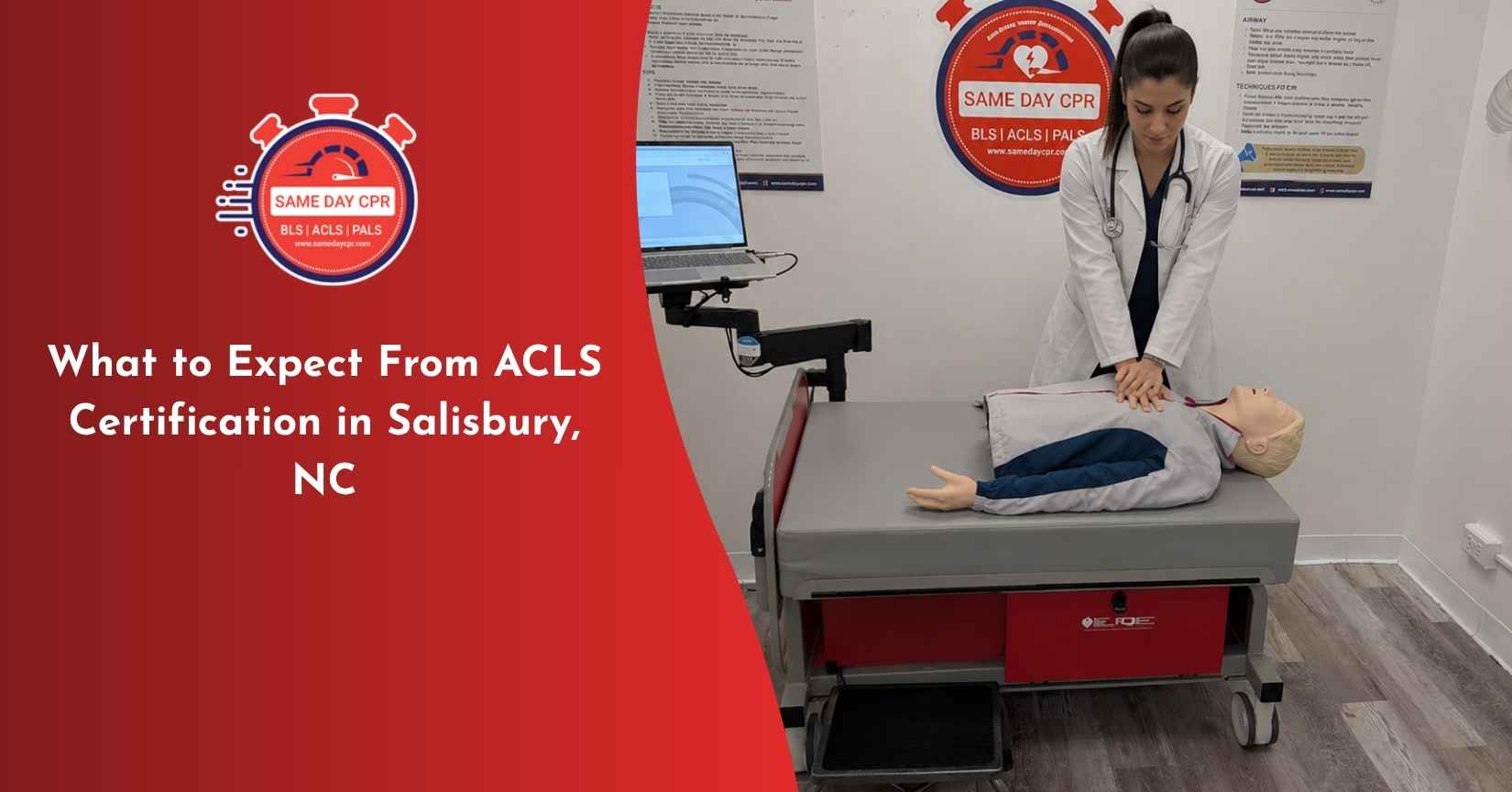
The second part is an in-person skills session, which is short and flexible, where an AHA Voice-Assisted Manikin (VAM) guides and evaluates your hands-on performance as part of the skills assessment required for certification.
For busy clinicians in the Salisbury area, traveling nurses, emergency physicians working long shifts, and paramedics with irregular schedules, the blended format is often the most practical option. You complete the cognitive portion at home and use in-person time solely for skills practice. Most local training sites accept the HeartCode completion certificate in place of the first-day classroom portion.
How to Choose an ACLS Provider in Salisbury, NC
Choosing an ACLS provider in Salisbury, North Carolina, can feel simple when you know what to look for. You can find trusted training options that match your schedule and learning style.
Check AHA Certification Requirements
To choose an ACLS provider, make sure the course is officially approved by the American Heart Association. The training center should issue a valid AHA ACLS provider card after you finish both the online work and hands-on skills session. This helps you meet hospital and employer standards without any issues.
Choose How You Want to Learn
You can pick a blended option that combines online study with an in-person skills check. Blended learning is often more flexible because you can study at your own pace before attending the skills session.
Check the Requirements
Before enrolling, review what you need to bring, such as proof of BLS certification and completion of any online pre-coursework. Most ACLS programs also require you to understand basic ECG rhythms and emergency cardiovascular care concepts.
See If Your Employer Will Cover the Cost
Many hospitals and healthcare employers in the Salisbury area may pay for ACLS training or reimburse the fee. It is a good idea to ask your supervisor or HR team before you register so you can save money or get approved coverage.
How Much Does ACLS Certification Cost in Salisbury, NC
The cost of ACLS certification in Salisbury varies depending on the course format you choose.
ACLS Online + Skills – $295
This option includes completing the theory portion online at your own pace, followed by an in-person skills session for hands-on practice and evaluation. It is the complete course and is best suited for first-time participants or those who want a full refresher before the skills check.
ACLS Skills Only – $150
This option is for the in-person skills assessment and practice only. It is ideal for renewal candidates who are already comfortable with the material and want a quicker certification process without repeating the coursework.
ACLS Certification Validity and Expiration
AHA ACLS certification is generally issued for a limited time and must be renewed periodically to stay valid.
Validity and Expiration
- An ACLS certification is typically valid for 2 years from the issue/completion date shown on the provider card.
- This standard is used by major issuing organizations such as the American Heart Association.
- After expiration, you are generally no longer considered current for clinical or employer requirements that mandate ACLS certification.
Renewal options
Before or near expiration, you can:
- Take an ACLS renewal course (shorter than the initial course in many cases)
- Or retake the full ACLS provider course if your certification has already lapsed.
Important notes
- Many hospitals and employers require you to remain continuously current, meaning no gap after expiration.
- Some institutions allow a short “grace period,” but this is policy-dependent, not universal.
- Online-only certificates without a hands-on skills check are often not accepted by employers.
Where to Enroll in an ACLS Certification Course in Salisbury, NC
You can sign up for an ACLS certification course in Salisbury, NC, through Same Day CPR. Earning your ACLS certification with them is a straightforward experience, designed to help you gain confidence in life-saving techniques while progressing at a pace that suits you.
Step 1: Select Your Course Format and Reserve Your Spot
Visit the website, choose the ACLS course that matches your needs, and select a date and time that works for you. Once registered, your spot is reserved.
Step 2: Complete the Online Coursework
If you select the blended learning option, you will complete the online portion first. This covers essential ACLS topics such as ECG interpretation, emergency medications, and advanced cardiac life support algorithms, allowing you to learn at your own pace.
Step 3: Attend the In-Person Skills Session
Visit our Salisbury training location for hands-on practice using AHA Voice-Assisted Manikin technology. You will work through real-life emergency scenarios, practice ACLS protocols, and receive guided feedback to ensure skill mastery.
Step 4: Complete Training and Receive Certification
After completing the skills evaluation, you will receive your official AHA ACLS certification card. You will leave fully prepared to apply your skills confidently in clinical and emergency settings.
Strengthening Emergency Response Through ACLS Training
ACLS certification in Salisbury, NC, prepares healthcare professionals to respond with skill and confidence during serious cardiac emergencies. It builds strong knowledge of rhythms, medications, airway care, and team coordination so you can act quickly in moments where time is extremely limited. Training in a local setting makes it easier to balance learning with work and connect with others in the same field. You leave the course with practical abilities that support safe decisions and clear communication during high-pressure situations. This preparation helps you meet employer expectations while also improving the care you give to patients in critical moments. With regular renewal every two years, you stay current with updated guidelines and best practices in emergency care. Overall, ACLS training strengthens both your readiness and your impact in the clinical environment.