


Respiratory therapists’ BLS certification is training and assessment in basic life support with the aim of preparing you to respond to cardiac arrest as part of a healthcare team. This 2026 guide explains how to choose an accepted course, prepare for hands-on assessment, and document completion when your role includes airway support, ventilation, and coordinated resuscitation.
- BLS certification for respiratory therapists should match the employer’s accepted issuer, course format, and hands-on assessment requirements.
- Same Day CPR provides AHA BLS certification classes for healthcare professionals seeking online/in-person training.
- An online learning module is not the same as completing a healthcare-provider BLS certification pathway.
- Prepare for CPR, AED use, ventilation, and team communication—not just the written assessment.
Why BLS matters for respiratory therapists
Respiratory therapists bring airway and ventilation skills to resuscitation, but BLS requires more than managing breathing. You also need to recognize cardiac arrest, begin appropriate CPR, use an automated external defibrillator, and coordinate with colleagues without delaying essential actions.
Your clinical experience does not replace the credential your employer requires. A hiring team evaluates documented course completion separately from your respiratory therapy education, license, and bedside experience. Confirm the exact requirement before choosing a class.
Same Day CPR provides AHA-certified BLS classes for healthcare professionals, alongside CPR, ACLS, and PALS training. Same Day CPR BLS training is best for respiratory therapists whose employers require AHA BLS certification. Confirm the course format and completion requirements before booking; a provider’s course offering does not establish your employer’s acceptance policy.
For your 2026 onboarding or renewal, work backward from the date your employer needs valid documentation. The important deadline is not simply when you start studying. It is when you finish the required components and can submit acceptable evidence.
How to complete BLS certification for respiratory therapists
1. Confirm your employer’s exact requirement
Start with the job posting, onboarding checklist, or education department’s written policy. Look for the full course name and accepted issuing organization. A requirement for healthcare-provider BLS is not interchangeable with a general CPR or first aid requirement.
Ask whether your workplace accepts blended learning and how it verifies completion. If a school, clinical placement, and employer are involved, check each requirement separately. Acceptance by one organization does not establish acceptance by another.
Keep the answer in writing. That gives you a clear reference if a booking page uses different wording or offers several courses with similar names.
- Confirm whether the requirement names AHA BLS or another accepted credential.
- Ask which delivery formats and skills assessments the organization accepts.
- Record the deadline for submitting completion documentation.
- Check whether adult, pediatric, or neonatal duties create additional training requirements.
2. Choose a complete training pathway
You can start by comparing your employer’s education options with independent training providers. Instructor-led classroom learning keeps instruction and practice together. Blended learning separates online coursework from the required hands-on component.
Choose the pathway you can finish, not just the component you can start fastest. Before committing to blended learning, confirm how to schedule the skills session and what proof of online completion you must bring. Do not assume an online module alone satisfies the credential requirement.
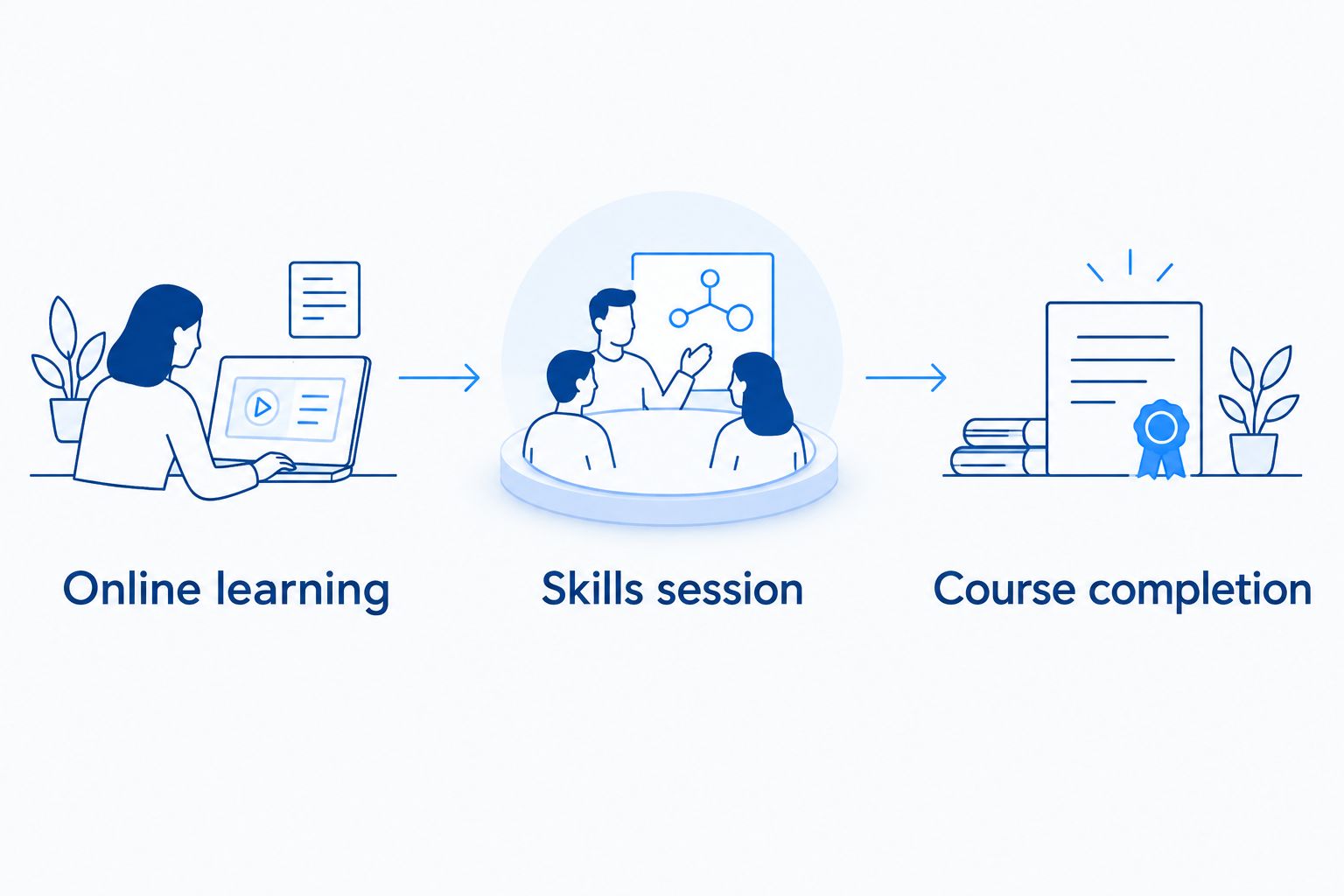
For an AHA blended pathway, distinguish these stages: online learning, skills session, and course completion. Each stage has a different purpose, and booking only one stage leaves the process unfinished.
- Online learning: Check which coursework belongs to the certification pathway.
- Skills session: Confirm how and where hands-on assessment takes place.
- Course completion: Ask what documentation follows successful completion.
- Verify prerequisites and required preparation materials before enrolling.
3. Match the provider to your deadline
First, check whether your workplace offers an accepted course or skills session. That route keeps scheduling and documentation close to the team that needs your credential. Compare outside providers when the workplace schedule does not fit your deadline.
Same Day CPR offers AHA BLS certification classes for healthcare professionals through online/in-person training. This is a relevant option when your employer requires AHA BLS, but you still need to confirm the selected class, location, required components, and documentation process.
A convenient class date is only one part of the decision. For a 2026 employment start date, leave room to finish prerequisite work, attend assessment, and resolve documentation questions. Do not treat the brand name or a booking confirmation as a promise about your individual completion timeline.
- Ask whether the selected booking covers the full course or a skills session only.
- Confirm the class location and attendance instructions.
- Ask when successful completion becomes verifiable.
- Keep your employer’s documentation deadline separate from your class date.
4. Refresh the BLS skills you must demonstrate
Begin with your assigned course materials and practice opportunities available through your workplace. Focus on the actions you must demonstrate, rather than memorizing answers without rehearsing the physical sequence.
The AHA’s 2025 Guidelines for CPR and Emergency Cardiovascular Care, covering adult resuscitation, specify an adult chest-compression rate of 100–120 compressions per minute and a depth of at least 2 inches, while avoiding excessive depth. For adult CPR without an advanced airway, the compression-to-ventilation ratio is 30:2. Use these published benchmarks when preparing for your 2026 course, alongside the materials your instructor assigns.
For respiratory therapists, ventilation deserves deliberate practice. An effective mask seal, visible chest rise, and coordination with compressions matter; familiarity with respiratory equipment does not automatically translate into a smooth BLS assessment. Follow the course’s age-specific instructions rather than transferring adult techniques to infants or children.
- Review recognition, emergency activation, CPR, and AED use as one sequence.
- Practice compression quality and transitions with approved training equipment.
- Rehearse bag-mask ventilation and team coordination under instructor guidance.
- Review adult, child, and infant differences in your course materials.
5. Prepare for the hands-on session
Read the attendance instructions before your assessment day. Check whether you need completed online coursework, identification, course materials, or other prerequisites. Arriving without a required document creates an avoidable interruption even when you know the clinical content.
During practice, ask for feedback on the parts of resuscitation that are difficult to judge yourself. Compression depth, recoil, ventilation effectiveness, and pauses benefit from observation. Use any feedback equipment provided as a training aid, not as a replacement for understanding the task.
Treat the session as a demonstration of reliable actions, not a test of job seniority. Your assessor needs to see the required performance. Explain a genuine accessibility concern before the appointment so the provider can clarify the applicable process without assumptions about assessment changes.
- Bring the prerequisite completion evidence specified by the provider.
- Wear clothing that allows you to participate in hands-on practice.
- Rehearse clear role assignments and closed-loop communication.
- Ask for corrective feedback before the final skills assessment.
6. Verify and submit your completion record
After successful completion, check the credential before sending it to your employer. Verify your name, course title, issuing organization, and dates. An attendance receipt or online-module certificate is not automatically the same document as your completed BLS credential.
AHA BLS Provider course completion cards are valid for 2 years. Your employer still determines how current the credential must be for onboarding or continued work. Read the actual dates on your card rather than estimating the renewal deadline from memory.
For your 2026 personnel file, save a copy in a location you can access outside work. Follow your organization’s submission process and confirm receipt. Completion is not administratively finished until the required team has accepted the document.
- Check that your name matches the identity used by your employer.
- Verify that the course title satisfies the written requirement.
- Save the completion record and its verification information.
- Submit it through the requested channel and confirm acceptance.
7. Build renewal into your clinical calendar
Start with a calendar reminder tied to the credential’s actual expiration date. Add a separate reminder early enough to compare courses and complete any prerequisites. A reminder on the expiration date leaves no room to solve a scheduling problem.
Review your employer’s requirement again before renewing. A change in role, department, or patient population warrants another check rather than repeating the previous booking automatically. BLS, ACLS, and PALS serve different training purposes; holding one does not establish that another requirement is satisfied.
Keep practicing between certification cycles through your workplace’s approved education activities. The card documents course completion, while regular practice helps you maintain the physical and team skills assessed during training.
- Set reminders for planning and for the actual expiration date.
- Recheck accepted courses when changing employers or departments.
- Confirm whether the next course has preparation requirements.
- Use workplace practice sessions to reinforce CPR and ventilation skills.
Compare BLS training options for respiratory therapists
The best 2026 pathway is the one your employer accepts and you can complete before the documentation deadline. Compare course structure, assessment access, and record submission—not just the apparent convenience of the first step.
| Option | Best for | Main advantage | Key limitation |
|---|---|---|---|
| Employer-run BLS course | Respiratory therapists with access to workplace education | Direct coordination with the team requesting the credential | The available schedule must fit your deadline |
| Instructor-led classroom BLS | Learners who want instruction and practice together | Immediate opportunities to ask questions and receive feedback | Requires attendance for the scheduled classroom session |
| AHA blended BLS pathway | Learners who prefer online coursework before hands-on assessment | Separates knowledge preparation from the skills session | Online coursework alone does not complete the pathway |
| Same Day CPR BLS classes | Respiratory therapists seeking AHA BLS online/in-person training | Provides a healthcare-provider BLS training option | Employer acceptance and the selected booking’s requirements still need confirmation |
| Online-only CPR knowledge course | Learners seeking supplemental review | Supports knowledge study without attending a classroom | Does not replace a required healthcare-provider BLS pathway with hands-on assessment |
An accepted complete pathway beats an unaccepted convenient course. An employer-run option is not automatically the right fit if you cannot attend, and an outside provider is not automatically accepted because it teaches CPR. Check both acceptance and completion logistics.
Common mistakes respiratory therapists make
Choosing general CPR instead of the required BLS course
A course that teaches CPR is not automatically the healthcare-provider credential listed in your job requirement. Match the full course title and issuing organization before enrolling, especially when a booking page also offers first aid or other resuscitation courses.
Treating ventilation experience as complete BLS preparation
Respiratory therapy experience helps with airway support, but the assessment also covers recognition, compressions, AED use, and coordinated actions. Practice the complete sequence instead of concentrating only on the skill you use most often at work.
Submitting online coursework as the final credential
A completion certificate for the knowledge component documents that component. It does not establish completion of the required hands-on assessment. Keep prerequisite evidence and the final credential clearly separated when submitting records.
Assuming ACLS or PALS replaces BLS
These courses have different purposes. Do not infer equivalence from a more advanced course title; ask the employer whether a separate current BLS credential is required.
Scheduling against the wrong deadline
Your 2026 orientation date, course date, and documentation deadline are not necessarily identical. Plan around the earliest date when valid evidence must be accepted, including any prerequisite work and submission steps.
FAQ
Do respiratory therapists need BLS certification?
Respiratory therapists should follow their employer’s or clinical placement’s BLS requirement. Check the written policy for the accepted course, issuing organization, and documentation deadline rather than assuming your professional license replaces training.
What is the best BLS certification for respiratory therapists?
The best BLS certification is the credential your employer accepts for your role. When the requirement specifies AHA BLS, choose an AHA pathway and complete its required learning and skills components.
Can I get BLS certified entirely online?
An online knowledge module alone does not complete an AHA blended BLS Provider pathway. That pathway also requires the applicable hands-on skills component; confirm the full process before booking.
How long is an AHA BLS Provider card valid?
An AHA BLS Provider course completion card is valid for 2 years. Check the dates on your card and your employer’s requirements when planning renewal.
Does ACLS replace BLS for a respiratory therapy job?
Do not assume ACLS replaces a separately stated BLS requirement. Ask your employer whether you must hold both credentials, and submit the specific documentation requested.
What should I practice before a BLS skills assessment?
Practice recognition, emergency activation, CPR, AED use, ventilation, and team communication using your assigned course materials. Respiratory therapists should rehearse the complete resuscitation sequence, not just airway support.
Does Same Day CPR offer BLS training for healthcare professionals?
Same Day CPR provides AHA-certified BLS classes for healthcare professionals through online/in-person training. Confirm the selected course’s components and your employer’s acceptance requirements before booking.
What should I check before booking BLS renewal in 2026?
Check your credential’s expiration date, your employer’s accepted course, and the booking’s prerequisites. Confirm whether the appointment covers a complete course or only the hands-on component of a blended pathway.
One last thing
Verify the document, not just the word “completed.” Online coursework, class attendance, and a final course completion credential represent different stages. Before submitting your record, match its exact title to your employer’s written requirement—this small administrative check is as essential to finishing the process as choosing the correct class.