



Online CPR coursework offers flexible study, which makes My CPR Certification Online a starting point for comparing certification options. That convenience stops being enough when your employer requires a particular issuing organization, course level, or hands-on skills assessment. The best My CPR Certification Online alternative in 2026 is Same Day CPR if you need AHA certification classes; American Red Cross training if your employer accepts that credential.
- For my cpr certification online alternatives, choose Same Day CPR for AHA certification classes.
- An AHA training center is another option when your employer specifically requires an AHA credential.
- Choose American Red Cross CPR training when its certificate matches your workplace requirements.
- Check certificate acceptance and hands-on skills requirements before choosing an online CPR course.
Why this matters
A CPR course can teach useful skills and still fail to meet your job requirement. Your employer decides which credential satisfies its policy; a course title alone does not settle that question.
For a healthcare role, the requirement might be Basic Life Support, usually shortened to BLS, rather than general CPR training. Advanced Cardiovascular Life Support, or ACLS, and Pediatric Advanced Life Support, or PALS, serve different training needs. They are not interchangeable labels for the same certificate.
Start your 2026 search with the exact requirement from your employer, school, or licensing program. Then compare the issuing organization, assessment format, and completion steps. The right alternative is the course that meets your requirement, not simply the course that is easiest to purchase.
My CPR Certification Online alternatives at a glance
Use My CPR Certification Online as your baseline, then compare alternatives against the same questions. Confirm the actual course and credential before treating any provider as a substitute.
| Option | Best for | Standout feature or decision point | Difference to check against My CPR Certification Online |
|---|---|---|---|
| My CPR Certification Online | Evaluating your original course choice | Whether the specific certificate meets your requirement | Confirm the issuer, course level, and skills assessment |
| Same Day CPR | AHA certification classes for healthcare and non-healthcare professionals | CPR, BLS, ACLS, and PALS classes with online/in-person options | Compare the required AHA course and its completion steps |
| An AHA training center | Finding an AHA course through a training center | AHA course delivery and skills assessment | Confirm which learning formats and courses the center offers |
| American Red Cross | CPR training where a Red Cross credential is accepted | CPR, AED, and first aid training | Compare credential acceptance and the selected course format |
Do not compare only the words printed on the course listing. A general CPR certificate and a healthcare BLS credential can have different intended audiences, even when both courses cover resuscitation skills.
1. Same Day CPR: best for AHA certification classes
Same Day CPR provides AHA-certified CPR, BLS, ACLS, and PALS classes for healthcare and non-healthcare professionals across multiple U.S. locations. Its online/in-person options make it relevant when you need to match a specific AHA requirement rather than buy a generic CPR certificate.
The decision starts with your required course. Choose BLS, ACLS, PALS, or CPR based on your employer’s instructions, then confirm the format and completion requirements for that class.
Where this provider shines
- Course range: CPR, BLS, ACLS, and PALS are explicitly part of the offering.
- AHA focus: The classes serve people who need an AHA credential.
- Different audiences: Healthcare and non-healthcare professionals can check the appropriate class.
- Online/in-person options: You can assess which format fits your training requirement.
Where this provider falls short
- An AHA course is not automatically the right choice when your organization requires a different credential.
- Online coursework does not remove a hands-on requirement from a course that includes skills assessment.
- Multiple locations do not eliminate the need to check the location and format for your selected class.
Best for: Professionals whose requirement specifies an AHA course and who want to compare online/in-person certification options.
| Dimension | This provider | My CPR Certification Online |
|---|---|---|
| Credential alignment | AHA-certified classes | Verify the issuer of the selected certificate |
| Course range | CPR, BLS, ACLS, and PALS | Verify that the exact required course is offered |
| Learning format | Online/in-person options | Verify coursework and assessment requirements |
| Intended audience | Healthcare and non-healthcare professionals | Verify the selected course’s intended audience |
Verdict: Buy the required AHA course after confirming the class format and your employer’s acceptance. Do not choose a course level based on speed alone.
2. An AHA training center: best for an AHA-specific requirement
An American Heart Association training center is another route when your employer names AHA in its certification policy. AHA training centers deliver courses within the association’s training system; individual centers determine which courses and formats they offer.
This option is useful when you want to compare local arrangements for the same required credential. Check the complete training pathway rather than assuming that every center offers every AHA course.
Where an AHA training center shines
- Credential match: It gives you a direct way to pursue a required AHA course.
- Course-specific guidance: You can ask which course meets a BLS, ACLS, or PALS requirement.
- Assessment planning: You can clarify how the required skills portion is completed.
Where an AHA training center falls short
- Course selection and learning formats differ between centers.
- A classroom or skills appointment requires coordinating your schedule with the center.
- AHA affiliation does not make an unrelated course acceptable for your particular role.
Best for: People with an explicit AHA requirement who want to compare training-center arrangements.
| Dimension | An AHA training center | My CPR Certification Online |
|---|---|---|
| Issuing organization | AHA course pathway | Confirm the certificate’s issuing organization |
| Course selection | Check the center’s specific offerings | Check the provider’s specific offerings |
| Skills assessment | Confirm the selected course’s assessment arrangements | Confirm whether the course includes the required assessment |
Verdict: Buy an AHA course when the center confirms the correct credential and a workable completion pathway. An AHA name is a starting filter, not a substitute for checking the course details.
3. American Red Cross: best for accepted CPR and first aid training
American Red Cross offers CPR, AED, and first aid training, as well as training for professional responders. It is a relevant alternative when your employer or organization accepts the specific Red Cross certificate you plan to earn.
Choose by course audience and assessment format. Do not assume that a general workplace course satisfies a healthcare BLS requirement.
Where American Red Cross shines
- CPR, AED, and first aid options address different workplace training needs.
- Course selection lets you distinguish general workplace training from professional-responder training.
- Classroom and blended-learning options provide routes that include hands-on instruction.
Where American Red Cross falls short
- A Red Cross certificate does not meet an employer policy that specifically requires AHA.
- Online-only learning is not a substitute when your requirement includes an assessed hands-on component.
- You must select the appropriate course; the organization name alone does not establish equivalence.
Best for: People whose workplace accepts Red Cross training and whose selected course matches the required skills and audience.
| Dimension | American Red Cross | My CPR Certification Online |
|---|---|---|
| Credential | Red Cross certificate for the selected course | Verify the selected certificate’s issuer |
| Training scope | CPR, AED, first aid, and professional-responder options | Verify the exact course scope |
| Employer fit | Confirm acceptance of the specific Red Cross course | Confirm acceptance of the specific certificate |
Verdict: Buy the accepted Red Cross course; skip it when your employer explicitly requires a different issuer.
Why people switch from My CPR Certification Online
A change makes sense when the course you are considering does not match a documented requirement. These are decision reasons, not claims about My CPR Certification Online’s quality or policies.
Your employer requires a named issuer
If your employer requires AHA, select an AHA course. If it accepts a specific Red Cross credential, that opens another route. Ask for the requirement in writing before paying for training.
You need BLS rather than general CPR
Healthcare employers often specify BLS. General CPR training is not automatically equivalent, so compare the full course title with the wording in your onboarding instructions.
You need an assessed hands-on component
Watching a demonstration and demonstrating a skill are different activities. Switch to a course pathway with the required skills assessment when your employer or program requires one.
You need a different level of training
ACLS and PALS address advanced training needs rather than acting as alternative names for basic CPR. Confirm whether you need one credential or several; do not assume an advanced course replaces every other requirement.
For your 2026 renewal, compare these same points again. A previously accepted certificate does not establish what a new employer or program requires.
How to choose the right CPR certification course
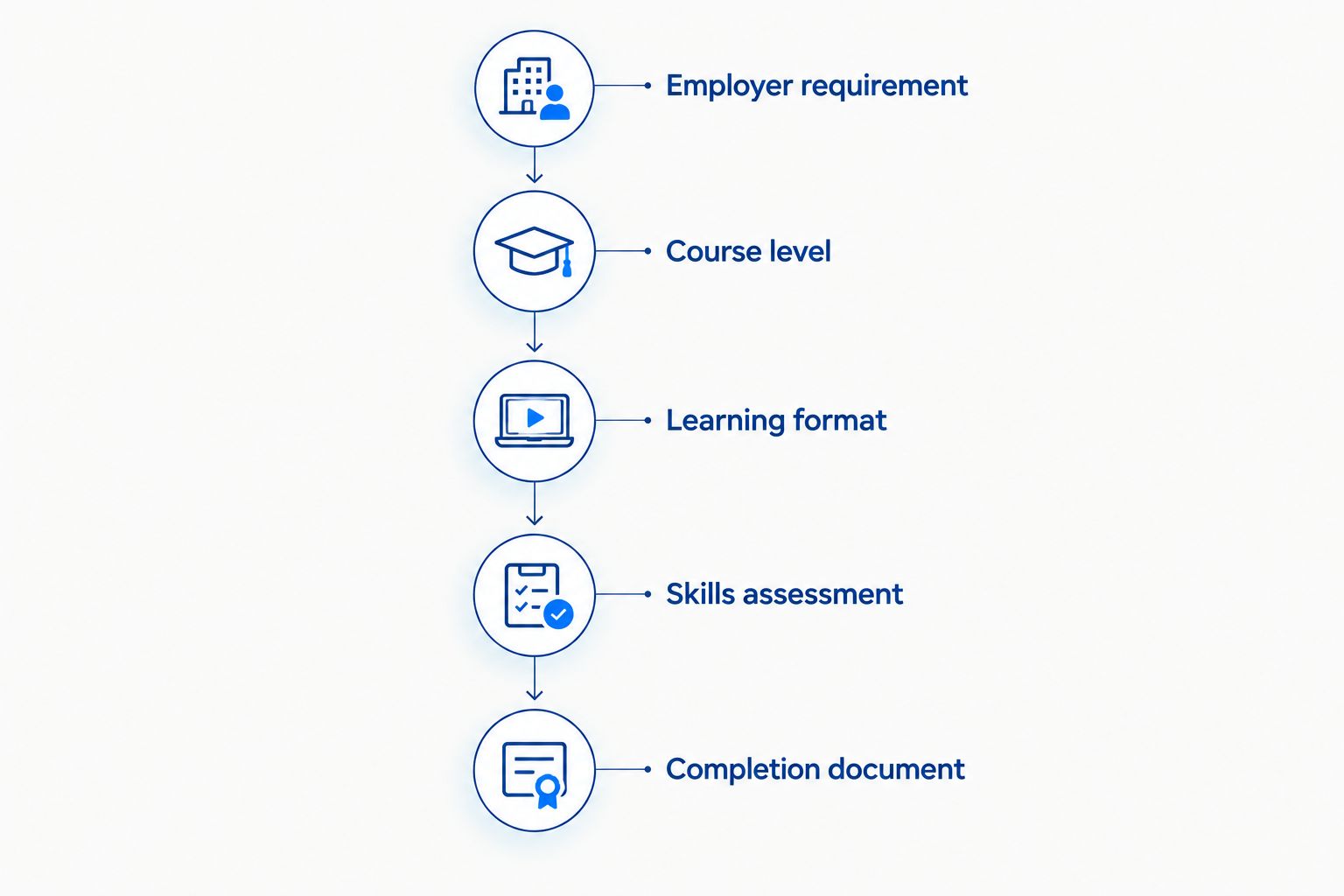
Use this sequence before you book. It prevents a common mismatch: choosing a convenient learning format first and checking the credential afterward.
- Employer requirement: Get the exact course name and accepted issuing organization from the person responsible for approving your credential.
- Course level: Match that wording to CPR, BLS, ACLS, or PALS. Ask for clarification if the requirement simply says CPR but your role involves patient care.
- Learning format: Decide whether classroom or blended learning fits your circumstances while still meeting the requirement.
- Skills assessment: Confirm whether you must complete an in-person assessment and how that component is arranged.
- Completion document: Ask what document you receive after completing all required components and how your employer verifies it.
The order matters. A convenient format cannot fix the wrong course level, and a completed online lesson is not the same as a completed certification pathway.
For a 2026 deadline, ask about the entire completion pathway. Include coursework, assessment, and receipt of the completion document in your planning; do not treat the first available lesson as the finish line.
What hands-on training should help you practice
Hands-on CPR training lets an instructor assess actions that reading alone cannot demonstrate. You should understand what the course teaches and what skills you must perform successfully.
For adult CPR, American Heart Association guidance calls for a compression rate of 100–120 compressions per minute and a depth of at least 2 inches, while avoiding excessive depth greater than 2.4 inches. Those are adult CPR targets, not instructions to apply unchanged to infants or children.
A skills session should give you the opportunity to practice the techniques included in your selected course. Ask how the assessment addresses compression quality, AED use, and any other required skills.
These clinical numbers describe technique, not how long certification takes. Do not use them to infer a course duration or a provider’s completion time. Follow your course’s current instruction and assessment requirements.
When staying with My CPR Certification Online is the right call
Stay with My CPR Certification Online if the specific course meets your employer’s written requirement, covers the required skills, and provides the required assessment and completion document. Switching providers has no value when your existing choice already satisfies those conditions.
Verify those points before enrollment. If you already hold a certificate, ask the approving organization whether that exact credential is accepted rather than buying another course unnecessarily.
For 2026, keep your comparison focused on fit. A different provider name is not an upgrade by itself, and a familiar provider name is not proof of acceptance.
Best for: People whose selected course has confirmed acceptance and a suitable completion pathway.
Verdict: Hold your existing choice when it meets the requirement; switch only to solve a specific mismatch.
FAQ
What’s the best My CPR Certification Online alternative in 2026?
Same Day CPR is the best fit when you need AHA certification classes with online/in-person options. An AHA training center or American Red Cross course is another option when its specific credential meets your employer’s requirement.
Is online CPR certification enough for a healthcare job?
Online CPR study alone is not enough when your healthcare employer requires BLS certification with a hands-on skills assessment. Get the exact course and issuer requirement from your employer before enrolling.
Is BLS the same as a general CPR course?
BLS is not automatically interchangeable with a general CPR course. Healthcare roles can require BLS specifically, so match the full course name to your employer’s instructions.
Is American Red Cross certification better than AHA certification?
Neither credential is universally better for every job. Choose the issuing organization and course your employer accepts; a Red Cross certificate does not satisfy a policy that specifically requires AHA.
Can I complete the online lessons without doing a skills test?
You cannot omit a required skills assessment and still complete that certification pathway. Confirm which components your selected course requires before treating online coursework as finished certification.
How long does an AHA course completion card last?
AHA course completion cards are generally valid for 2 years. Check the expiration shown on your card and any earlier renewal requirement set by your employer.
What should I check before booking CPR certification?
Check the accepted issuer, exact course level, learning format, skills assessment, and completion document. Confirm the entire pathway fits your deadline, not just the coursework portion.
One last thing
Ask your employer to approve the exact course title, not just the training provider. One organization can offer courses for different audiences, and acceptance of one course does not establish acceptance of every course it offers.
Send the course name and issuing organization to the person who approves your credential before booking. That specific check is more useful than asking whether online CPR certification is accepted in general.